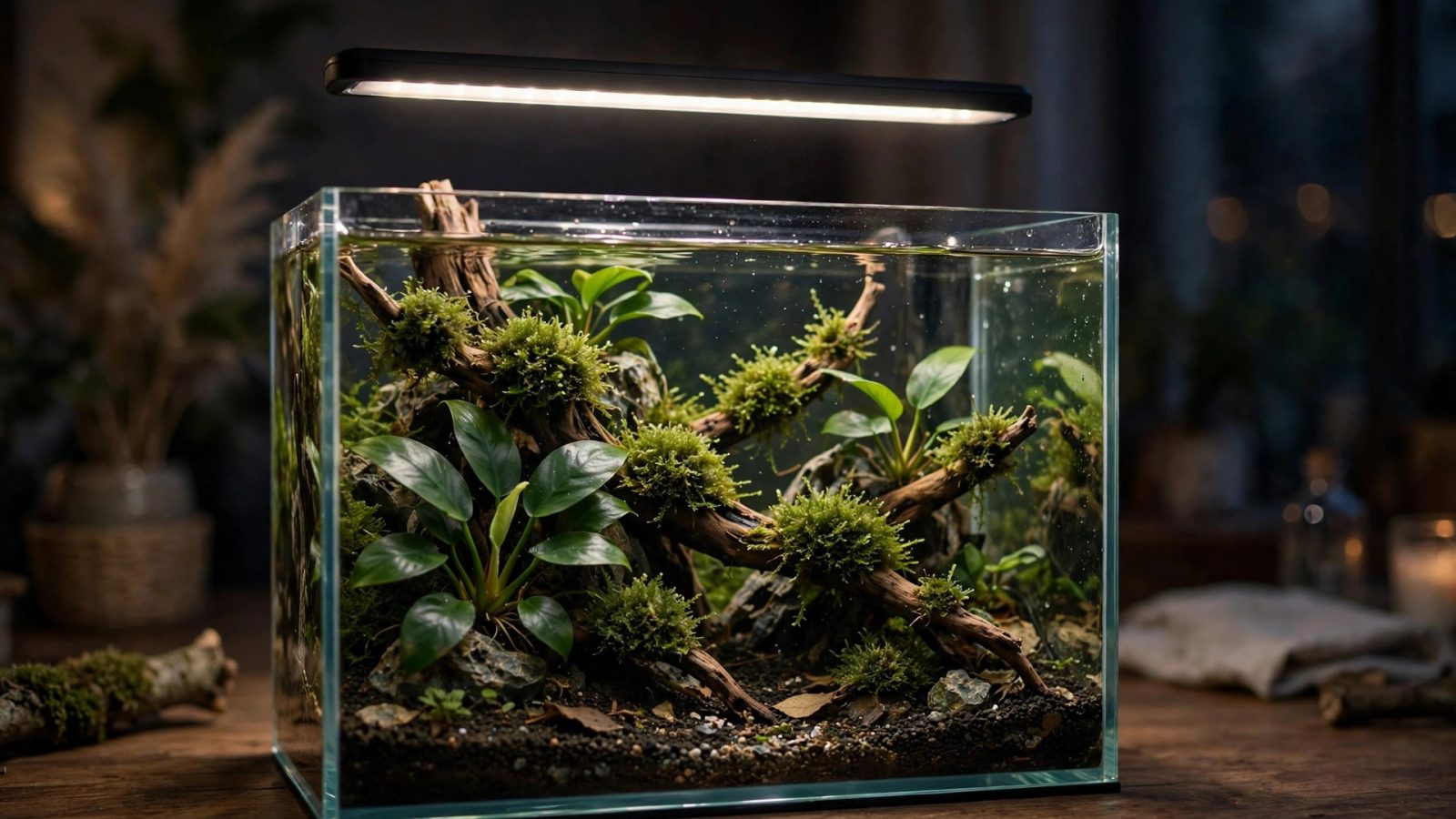
Low-tech planted tanks — no CO2 injection, moderate light, easy plants — are the most popular setups in the hobby, and they have specific lighting needs. Too much light without CO2 is the classic beginner trap; too little starves even undemanding plants. These 6 LED lights hit the low-tech sweet spot: enough PAR for healthy growth, dimming or modest output to prevent algae, and prices that leave budget for plants and hardscape.
For the flagship roundup covering all tank types, see our 8 best aquarium lights for planted tanks. This guide is specifically for no-CO2 and low-energy setups.
What Low-Tech Lighting Needs
- Low to medium PAR (15–45 at substrate): enough for anubias, crypts, swords, and easy stems without demanding CO2. See how much light plants need for the full breakdown.
- Dimming or modest fixed output: the ability to run below maximum is essential — even “low-tech” fixtures can be too strong at 100% on shallow tanks.
- Timer compatibility: built-in or via outlet timer for the 6–7 hour photoperiod low-tech tanks prefer.
- Full-spectrum daylight (~6500K): grows plants well and looks natural. Extra red diodes are a bonus, not a requirement, at these light levels.
The 6 Best LED Lights for Low-Tech Planted Tanks
1. NICREW ClassicLED Plus — Best Overall Value
The default recommendation for a reason: genuine full-spectrum output with added red/blue diodes, extendable brackets, and medium PAR that suits 20–40 gallon low-tech tanks perfectly. At $40–70 depending on length, it leaves budget for everything else. Add an inexpensive inline dimmer ($10–12) and it’s essentially perfect for low-tech — run at 60–80% and forget it.
2. Hygger Full Spectrum with Timer — Best Built-in Features
Where NICREW is bare-bones, Hygger packs in a programmable timer, multiple brightness levels, and color modes at a similar price ($35–65). PAR is modest — low to medium — which is exactly right for no-CO2 setups. The all-in-one convenience (no separate timer purchase) makes it the best pick for beginners who want one box. Build quality is good, not great; handle the controls gently.
3. Finnex Stingray 2 — Best Slim Profile
The Stingray 2 is the understated choice: ultra-slim aluminum bar, clean 7000K + RGB mix, low-medium PAR that’s nearly impossible to overdo. It’s the light you buy when you want the tank to look like furniture — minimal visual intrusion, reliable output. No dimmer or timer included (add both), but the fixed output is so well-judged for low-tech that many run it stock. $45–85 by length.
4. Fluval Aquasky — Best App Control on a Budget
The Aquasky brings Fluval’s excellent app (programmable 24-hour cycle, custom colors, ramping) to a lower price point ($60–110) than the Plant 3.0. PAR is lower — it’s designed as a fish-first light that also grows easy plants — which makes it ideal for low-tech community tanks where plants are the supporting cast. If you want phone control without the Plant 3.0 price, this is it.
5. BeamsWork DA FSPEC — Best Ultra-Budget
Often under $35, the BeamsWork DA FSPEC delivers surprising plant-growing capability with its 6500K + red/blue diode mix. It’s the “is this hobby for me?” light — cheap enough to be disposable if you upgrade later, good enough to grow a genuinely nice low-tech tank now. Fit and finish reflect the price; check that the extendable legs actually grip your rim. Pair with a timer and dimmer for best results.
6. Chihiros A Series (A601 etc.) — Best Step-Up Pick
For low-tech keepers who want premium build and might add CO2 later: the Chihiros A series offers excellent aluminum construction, strong output (dim it for now — headroom for later), and clean aesthetics at $70–130. It’s overkill for a pure low-tech tank today, but it’s the light you won’t need to replace if you catch the high-tech bug next year. Buy once, dim now, grow later.
Quick Comparison
- NICREW ClassicLED Plus — $40–70 · Medium PAR · Add dimmer · Best value
- Hygger Full Spectrum — $35–65 · Low-medium PAR · Timer built in · Best features
- Finnex Stingray 2 — $45–85 · Low-medium PAR · Slimmest · Best aesthetics
- Fluval Aquasky — $60–110 · Low PAR · App control · Best for fish-first tanks
- BeamsWork DA FSPEC — Under $35 · Low-medium PAR · Cheapest · Best ultra-budget
- Chihiros A Series — $70–130 · High PAR (dim it) · Premium build · Best future-proof
Setting Up Low-Tech Lighting
- Start at 60–70% intensity (or full, for fixed-output budget lights) with a 6-hour photoperiod for the first month.
- Extend to 7 hours once plants show new growth and algae is minimal.
- Resist the urge to upgrade “for better growth” — in low-tech, slow growth is the design. If plants are healthy but slow, the system is working.
- Floating plants are your dimmer: a 30% cover of frogbit or salvinia (see our floater guide) softens light naturally while consuming excess nutrients — the low-tech aquarist’s secret weapon.
- Clean the splash guard monthly. On modest fixtures, a dusty lens can cut 20% of already-modest PAR.
When Low-Tech Lighting Isn’t Enough
Signs you’ve outgrown the low-tech light tier: stem plants that won’t bush no matter the fertilizer, carpets that refuse to spread after 3+ months, or a deliberate decision to add CO2. That’s the moment to revisit the main lighting roundup — not before. Until then, the lights above grow beautiful tanks for a fraction of the cost and effort.
Complete Low-Tech Setup Examples
The $150 starter: 10-gallon betta tank
- Light: Hygger 14″ full spectrum with timer ($35)
- Plants: anubias nana on driftwood, java fern, frogbit cover, crypt wendtii
- Schedule: 6 hours daily, 70% brightness
- Ferts: weekly half-dose all-in-one liquid
- Result: a lush betta paradise needing 20 minutes weekly. The frogbit (see our floater guide) does half the algae-prevention work.
The $250 classic: 29-gallon community
- Light: NICREW ClassicLED Plus 30″ ($60) + inline dimmer ($12)
- Plants: vallisneria background, amazon sword centerpiece, crypts midground, anubias on wood
- Schedule: 7 hours at 75%
- Ferts: root tabs under swords + weekly liquid
- Result: the timeless low-tech look — big green plants, minimal fuss, happy community fish.
The $400 aspirational: 40-gallon aquascape
- Light: Chihiros A601 dimmed to 60% ($110)
- Plants: Monte Carlo (attempted carpet), staurogyne repens, rotala rotundifolia, buce accents
- Schedule: 7 hours, aquasoil substrate
- Ferts: full EI-low-tech dosing
- Result: the most ambitious no-CO2 setup — Monte Carlo creeps rather than carpets, but the tank looks intentional and lush. If the carpet bug bites hard, this light has headroom for a future CO2 addition.
Plant Pairings by Light Choice
- With Hygger/NICREW at 60–70%: anubias, java fern, mosses, crypts, vallisneria, frogbit — the bulletproof set. See our low-light plants guide.
- With Finnex Stingray / Fluval Aquasky: add swords, hygrophila, rotala rotundifolia, dwarf sagittaria. Medium-easy plants that appreciate the cleaner spectrum.
- With Chihiros A dimmed: everything above plus Monte Carlo attempts and ludwigia repens. The ceiling of no-CO2 ambition.
Longevity and When to Replace
LED fixtures don’t burn out like old fluorescents, but they do fade. Budget LEDs typically hold useful output for 3–5 years; premium ones longer. Signs of decline: plants that thrived for years start stretching, or algae increases with no other changes. Before replacing, clean the splash guard and check the power supply — a failing adapter mimics diode decline. When you do replace, the market will have moved on; re-evaluate against the current main roundup rather than rebuying the same model blindly.
Budget Allocation Advice
For a $300 total planted-tank budget, here’s the split that grows the best tank:
- Light: $50–70 (this guide’s tier — don’t overspend here)
- Substrate: $40–60 (aquasoil matters more than light upgrades at this level)
- Plants: $60–80 (buy more plants than you think — dense planting from day one prevents algae)
- Hardscape: $30–50
- Fertilizer + timer + test kit: $40–50
- Reserve: $30–50 for replacements and surprises
Notice light is ~20% of the budget. Beginners routinely spend 50% on the fixture and starve everything else. The tank grows from the substrate up — allocate accordingly.
Troubleshooting Low-Tech Light Problems
Plants growing but covered in algae
The light is too strong for the system’s CO2/nutrient capacity. Dim 20%, cut photoperiod to 6 hours, and add floating plants. Don’t add fertilizer to “help plants outcompete” — in low-tech, excess nutrients with excess light just feeds algae faster. See too-much-light signs.
Plants alive but not growing (months)
Some stagnation is normal in low-tech, but zero growth for 3+ months suggests too little light or missing nutrients. Increase intensity 15–20% or start a complete fertilizer — not both simultaneously. Wait a month and reassess.
One side of the tank grows, the other doesn’t
Uneven coverage — the fixture is too short or off-center. Center it, or add a small supplementary light for the dim side. Common with extendable-bracket fixtures that don’t quite span the tank.
New light, immediate algae bloom
The classic upgrade mistake: old dim light → new brighter light at 100% from day one. Always start new fixtures at 50–60% for the first month regardless of what the old light was. Plants adapted to dim conditions need time to adjust their photosynthetic machinery.
Low-Tech Lighting FAQs
Can I use the light that came with my aquarium kit?
Often yes for the easiest plants. Kit LEDs typically deliver 15–25 PAR — enough for anubias, java fern, mosses, and floaters. You’ll outgrow it if you want stems or carpets, but it’s a fine starting point. Our low-light plants guide lists what thrives under kit lighting.
Do I need a timer if my light has one built in?
No — built-in is better (one less failure point). The Hygger’s integrated timer is genuinely useful. Just verify it holds settings through power outages; some budget lights reset to defaults.
How high above the tank should the light sit?
Stock legs (2–4 inches above the rim) are fine for low-tech. Higher mounting softens intensity and improves spread — useful if your fixture is slightly too strong. There’s no benefit to mounting higher than needed; you’re just wasting photons on the room.
White light vs. “plant” mode (reddish)?
Use white for viewing; the colored modes are aesthetic options, not growth requirements. Some hobbyists run a redder mix believing it helps plants — at low-tech intensities, the difference is negligible. Pick what looks good to your eyes.
Should I upgrade my light or add CO2 first?
CO2 first, almost always. A medium light with CO2 outperforms a strong light without it, because carbon — not photons — is the usual limiter once basic intensity is adequate. If your current light grows anubias fine but stems stall, the answer is carbon (see do plants need CO2), not a brighter fixture.
The Upgrade Path: From Low-Tech Light to High-Tech System
When you’re ready to go beyond low-tech, upgrade in this order:
- CO2 system — the transformative addition. Budget options in our cheap CO2 guide.
- Fertilizer routine — complete dosing to match accelerated growth.
- Light intensity — last, not first. Raise your existing dimmable fixture’s output (or remove the dimmer limitation) only after CO2 is stable and plants show they want more.
This order prevents the #1 upgrade disaster: bright light + no CO2 = algae farm. The light you bought from this guide (especially dimmable picks like the NICREW or Chihiros A) likely has the headroom already — you may not need a new fixture at all, just more of the one you have.
Pairing Lights With Hardscape Styles
- Iwagumi (rock-focused): even, shadow-free light matters most — rocks cast hard shadows under point sources. A wide bar or hung fixture beats a clip-on. The minimalist aesthetic also favors slim fixtures (Finnex Stingray, Chihiros A) that don’t visually intrude.
- Jungle/valley styles: dense planting tolerates (and benefits from) slightly stronger light — the plant mass absorbs it. Floating plants for dappled shade complete the look.
- Dutch streets: demands the most light of the styles (dense stems need penetration to lower leaves). This is the one low-tech style that pushes fixture limits — consider whether Dutch without CO2 is the right ambition.
- Biotope/natural: dimmer, warmer light mimics shaded streams. The Fluval Aquasky’s adjustable color excels here — tune warm and dim for blackwater authenticity.
Second-Hand Lights: What to Check
Used fixtures save 30–50%. Before buying:
- Power it on and verify every LED channel/lamp mode works.
- Inspect for water damage (corrosion near the lens, mineral crust inside).
- Ask the age — budget LEDs past 4 years may have meaningful output decline.
- Test any app pairing before paying (older Bluetooth models lose phone-OS compatibility).
- Factor a new power supply ($15–20) into the price unless the seller confirms it’s recent.
Good used buys: premium fixtures (Twinstar, ONF, Fluval) at 50–60% of retail. Skip used budget fixtures — the savings don’t justify the risk when new ones cost $50.
Your First Low-Tech Light: The 5-Minute Decision
Overwhelmed? Here’s the fast path: tank under 20 gallons → Hygger with built-in timer. Tank 20–40 gallons → NICREW ClassicLED Plus + cheap dimmer. Might add CO2 within a year → Chihiros A series. That’s it — any of these grows a beautiful low-tech tank. Stop researching, buy the light, and spend the saved hours planting densely and enjoying the tank. The best light is the one hanging over water growing plants, not the one in your comparison spreadsheet.