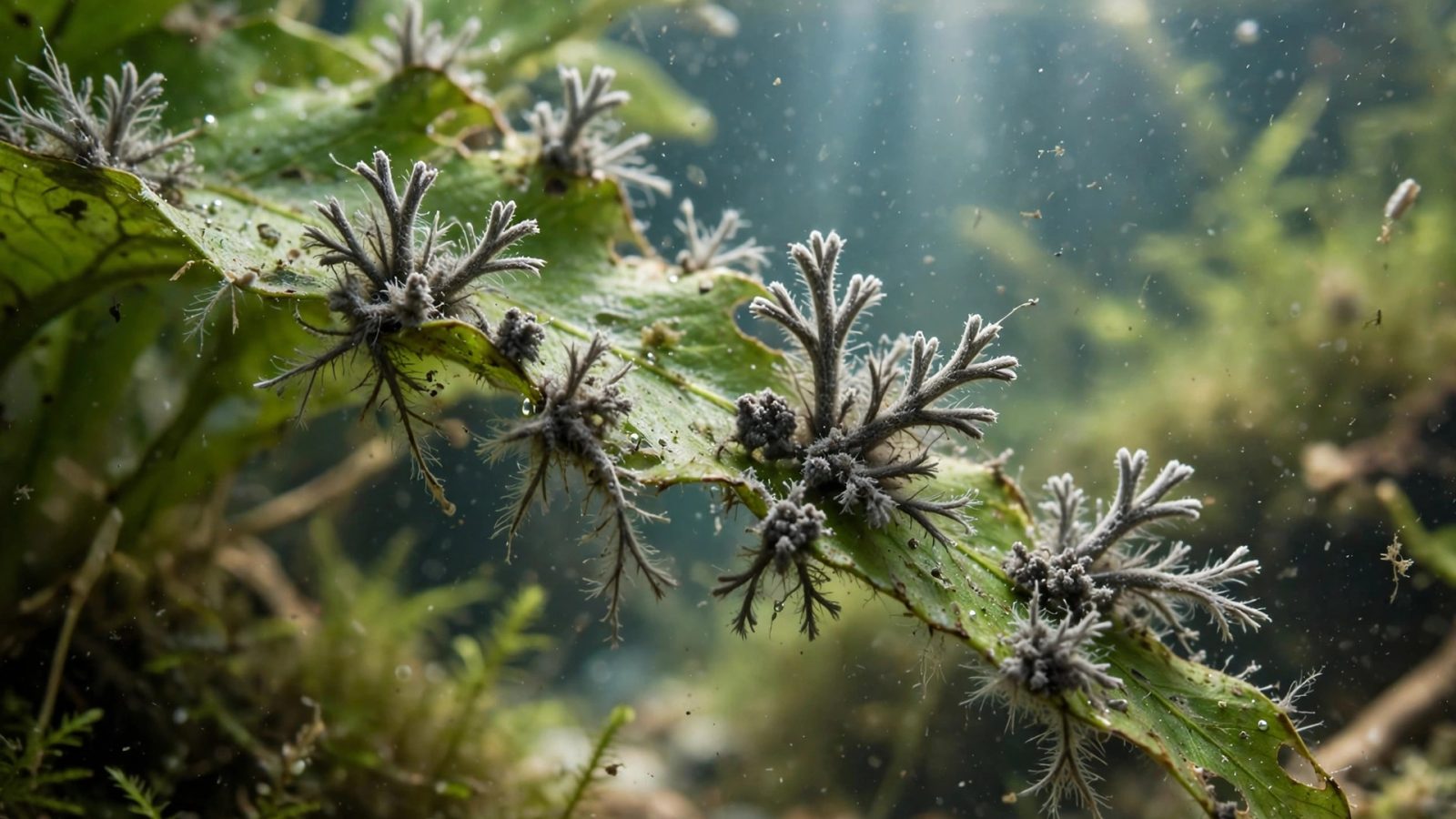
Staghorn algae on aquarium plants looks like tiny gray antlers sprouting from leaf edges — branching, wiry strands that grip foliage and hardscape with surprising tenacity. It is less famous than black beard algae but equally stubborn, and it points to a specific set of tank conditions: ammonia spikes and dead spots in water flow. This guide covers identification, what separates it from its lookalikes, removal, and the fixes that keep it from returning.
Identification
- Branching, antler-like strands — gray, gray-green, or whitish, growing in distinct branching tufts up to a centimeter or more. The branching is the signature.
- Grows on leaf edges first, then spreads across leaf surfaces, hardscape, and filter equipment.
- Firmly attached — does not wipe off, does not siphon off easily.
- Often appears in patches rather than tank-wide, clustering where flow is poorest.
Staghorn vs the lookalikes
- Black beard algae: dense, short, velvety tufts — no distinct branching strands. See our BBA removal guide if that matches better.
- Hair/thread algae: long, soft, unbranched green strands that pull off easily in clumps. Different beast, easier to remove manually.
- Fuzz algae: short soft fuzz, usually in new tanks, wipes off without a fight.
What Causes Staghorn Algae
Staghorn is an ammonia-and-flow algae. The consistent triggers:
- Ammonia spikes. The number-one correlate — a mini-cycle after filter maintenance, overfeeding, a dead fish hidden behind hardscape, disturbed deep substrate releasing trapped waste, or a new tank still cycling. Even brief ammonia elevations that your test kit catches at 0.25 ppm can trigger it.
- Dead spots in circulation. Staghorn clusters where water barely moves — behind dense plant thickets, in tank corners, below overhangs. Poor flow means waste accumulates locally and CO2/nutrients do not reach the leaves, stressing them exactly where the algae settles.
- Dirty filters and substrate. Mulm-choked filter media and never-vacuumed substrate are slow ammonia sources that keep the trigger present for weeks.
- Overfeeding and overstocking. More waste than the biological filtration comfortably processes.
Like BBA, staghorn is about instability and waste rather than any single nutrient level. Chasing phosphate or nitrate numbers will not fix it.
Removal
Manual removal first
Staghorn’s branching strands can be pulled off more easily than BBA’s velvet — twirl a toothbrush through the tufts, or trim affected leaf sections. Remove what you can mechanically before any chemical step; less algae means less chemical needed.
Spot treatment
Liquid carbon or 3% hydrogen peroxide applied directly to remaining tufts (flow off, syringe, conservative labeled doses) kills staghorn within days — strands turn pinkish-white and disintegrate. Follow the same safety protocol as any spot treatment: labeled doses only, sensitive species and invertebrates in mind, one intervention at a time. The full protocol is detailed in our black beard algae guide and applies identically here.
Trimming judgment
Fast-growing stems with staghorn: trim hard and let them regrow — they will outrun the problem in weeks. Slow growers (anubias, ferns): treat in place and trim only the worst leaves. Leaves smothered beyond photosynthesis are liabilities either way.
Fixing the Causes
- Find the ammonia source. Test ammonia and nitrite. Check for a dead fish or snail, clean the filter (in tank water, never tap), vacuum visible mulm, cut feeding to what fish finish in two minutes. If the tank is new or recently rescaped, the filter bacteria may simply need time — protect them by not over-cleaning.
- Fix the flow. Every area of the tank should have gentle movement. Reposition the outflow, trim back plant thickets that block circulation, or add a small circulation pump aimed at the dead spots. You should see every plant swaying slightly.
- Deep-clean judiciously. Vacuum the substrate in sections (a third per week, not all at once — deep all-at-once cleaning can cause the very ammonia spike you are trying to fix). Rinse mechanical filter media regularly so trapped waste does not rot in the filter.
- Stabilize feeding and stocking. Feed less than you think; most tanks are overfed. Do not add livestock during an outbreak — more bioload is the wrong direction.
Prevention
- Never let ammonia above zero. Weekly testing during the first months, and after any filter maintenance or livestock change, catches spikes before algae does.
- Clean filters on schedule — monthly rinsing in tank water prevents the slow waste buildup that feeds chronic low-level ammonia.
- Design flow into the scape. Leave circulation channels behind hardscape; avoid wall-to-wall plant masses with stagnant pockets behind them.
- Quarantine the trigger, not the symptom. When staghorn appears, ask “what changed in the last two weeks?” before reaching for treatments. New fish? Filter cleaned with tap water? Substrate disturbed? The answer is usually there.
Timeline
With the ammonia source removed and flow fixed, existing staghorn stops spreading within a week. Spot-treated tufts die in days. New growth comes in clean. If it keeps appearing in the same spot after two weeks, the flow dead spot or waste source is still there — look harder at that specific location rather than re-treating the whole tank.
Staghorn on Hardscape and Equipment
Staghorn does not limit itself to plants. It colonizes driftwood grain, rock crevices, filter intakes, heater bodies, and thermometer suction cups — anywhere flow eddies and a surface stays put. Hardscape colonies are actually easier to deal with than leaf colonies: pull the wood or rock out during a water change and scrub it with a stiff brush under hot tap water (no soap), then spot-treat any remnants before replacing it. Equipment can be wiped down or soaked in a dilute bleach solution, rinsed thoroughly, and dechlorinated. Treat equipment colonies as free intelligence — a tuft on the filter intake tells you waste is accumulating right there, which usually means the intake strainer needs more frequent cleaning.
Frequently Asked Questions
Is staghorn algae dangerous to fish?
The algae itself is harmless to fish. But its favorite trigger — ammonia — is very harmful, so treat staghorn as an early warning system and check your water.
Will algae eaters clear it?
Not reliably. Some report Siamese algae eaters grazing young staghorn, but established strands are generally ignored. Manual removal plus cause-fixing outperforms livestock.
Why is it only in one corner of my tank?
That corner is telling you exactly where your flow dies and waste settles. Fix circulation to that specific spot — the localized pattern is a diagnostic gift.
Does staghorn mean my cycle crashed?
Not necessarily crashed, but it usually means the biological filtration was overwhelmed or disrupted — a mini-cycle rather than a full one. Test ammonia and nitrite: if ammonia is present but nitrite is zero, the colony is struggling but alive; if both are elevated, the cycle took a real hit and you should treat the tank like it is cycling again (light feeding, frequent small water changes, no new livestock).
It was gone for months — why is it back?
Recurring staghorn means a recurring trigger. The usual suspects: seasonal overfeeding (fish get more food in summer when you are home more), filter maintenance lapses, or a slowly growing dead spot as plants fill in and block flow that used to reach an area. Compare against your maintenance log — the trigger almost always maps to something that changed a few weeks before the return.
Finding Hidden Ammonia Sources: The Detective Checklist
When tests show ammonia but the cause is not obvious, work through this list — the source is almost always one of these:
- A dead fish or snail hidden behind hardscape or in dense plants. Count your livestock; the missing one is decomposing somewhere.
- Filter cleaned with tap water — chlorine killed the beneficial bacteria, causing a mini-cycle. Always rinse media in tank water.
- New filter media replacing all old media at once — you threw away the bacteria colony. Never replace all biological media simultaneously.
- Disturbed deep substrate — a rescape or aggressive vacuuming released trapped waste. Test daily for a week after any major substrate work.
- Overfeeding compounded — food rotting in the substrate or filter. Cut feeding in half and vacuum thoroughly.
- A dead plant mass — a melted crypt colony or rotting root ball decomposing in the substrate. Remove dead plant material completely when replanting.
- Medication aftermath — antibiotics can nuke filter bacteria. After treating fish, monitor ammonia as the filter recovers.
Flow Fixes: Practical Circulation Improvements
- The sway test: every plant in the tank should move gently. Any plant standing dead still is in a dead spot — that is where staghorn will settle.
- Outflow positioning: aim the filter output to create a gentle circular current around the tank, not a jet blasting one area. Spray bars distributed along the back wall give the most even flow.
- Thin the jungle: dense stem-plant thickets block flow completely behind them. Leave circulation corridors — your scape needs plumbing as well as beauty.
- Clean intake strainers monthly: a clogged intake silently halves your flow, creating dead spots tank-wide. This single maintenance item prevents more algae than any product.
- Right-size the filter: aim for 5–10x tank volume per hour turnover for planted tanks. Underfiltered tanks cannot maintain the circulation algae prevention requires.
Staghorn in New Tanks: Special Considerations
New tanks are staghorn-prone because the nitrogen cycle is still establishing — ammonia spikes are part of cycling. During the first 6–8 weeks:
- Plant heavily from day one. Fast-growing stems consume ammonia directly, smoothing the cycle and denying algae its trigger.
- Stock slowly. Add fish over weeks, not all at once. Each addition is an ammonia step the young filter must absorb.
- Test ammonia and nitrite twice weekly. Catch spikes at 0.25 ppm and water-change them away before algae notices.
- Do not over-clean. The new filter bacteria are fragile — rinse media gently and never replace it during cycling.
- Accept some algae. A new tank with zero algae is the exception. Early staghorn tufts removed manually while the cycle matures rarely become an outbreak.