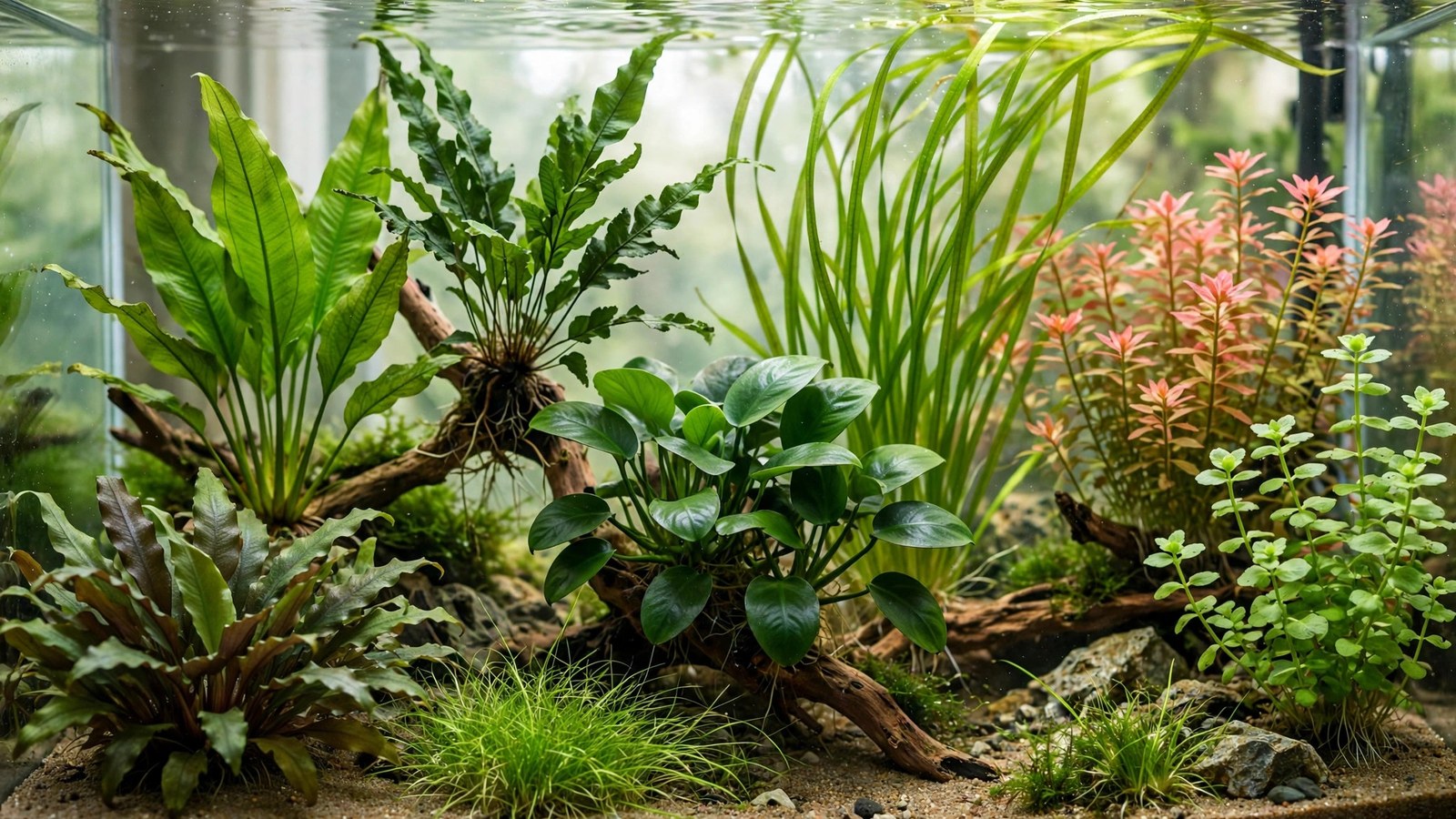
Discus are the kings of the aquarium — and the most demanding fish to plant around. They need warm water (82–88°F), soft and acidic conditions, frequent large water changes, and tankmates that won't stress them. Most plants melt in discus temperatures or can't handle the water-change regimen. But the right plants don't just survive with discus — they complete the Amazonian biotope these fish deserve. These 8 plants thrive in discus conditions.
Understanding Discus Tank Conditions
Discus shape every plant choice. Temperature 82–88°F (28–31°C) — tropical-only plants; temperate species like anacharis melt. Soft, acidic water — pH 6.0–7.0, low GH/KH, often RO-remineralized. Frequent large water changes — 25–50% multiple times weekly in many discus routines, which means plants must tolerate parameter swings and physical disturbance. Dim, calm aesthetic — discus are shy; bright blasting light and strong flow stress them.
The classic discus tank is actually lightly planted — many breeders run bare-bottom. But a well-planted discus display is the hobby's pinnacle: warm, soft, dim, Amazonian. The plants below handle all of it. Our soft-water plant guide covers the chemistry these plants want.
The 8 Best Discus-Tank Plants
1. Amazon Sword (Echinodorus amazonicus / bleheri)
The names say it all — Amazon swords evolved in the same waters as discus. They thrive in 82–86°F, love soft acidic water, grow large enough to give discus the cover they crave, and tolerate frequent water changes once established. A group of mature swords is the definitive discus-tank planting. Feed roots heavily; see our sword comparison for variety options.
2. Vallisneria americana (Jungle Val)
Jungle val handles discus temperatures better than most vals and creates the flowing background curtain that makes discus feel secure. It prefers slightly harder water than discus ideal, but adapts to soft acidic conditions fine — growth is just a bit slower. Plant once, never move it; discus tanks get rearranged enough by water changes.
3. Anubias barteri var. nana
Anubias tolerates 86°F without blinking, thrives in soft acidic water, and attaches to the driftwood that's central to discus aquascaping. Its broad leaves give discus resting spots and visual barriers that reduce aggression. The slow growth is a virtue here — nothing to trim during the heavy maintenance routine. Our epiphyte guide covers attachment.
4. Java Fern
Another heat-tolerant epiphyte that loves soft water and dim conditions — java fern is practically designed for discus tanks. Attach to driftwood alongside anubias for the classic Amazon hardscape planting. It propagates via plantlets, slowly filling the woodwork with zero effort and zero disturbance to the fish.
5. Cryptocoryne wendtii
Crypts are Amazon-adjacent (Asian, but with identical preferences): warm, soft, acidic, dim — crypt wendtii's dream conditions. It forms low colonies that give the foreground texture without demanding attention, and it's unbothered by the water-change regimen once established. Expect initial melt; then permanence.
6. Water Sprite (Ceratopteris thalictroides)
Floating water sprite is a discus-tank multitasker: it diffuses the light (discus hate bright tanks), absorbs nitrates between the frequent water changes, and provides the dappled shade of an Amazonian flooded forest. Thin it weekly — it grows fast in warm water. As a planted specimen it also works, but floating is where it serves discus best.
7. Tiger Lotus (Nymphaea zenkeri)
The warm-water showpiece. Tiger lotus thrives at discus temperatures, its red-mottled leaves are spectacular against green, and it provides the broad-leaf cover discus appreciate. The bulb stores energy through any rough patches. Trim surface leaves to keep it in submersed rosette form — or let a pad or two float for the full Amazon effect. Also featured in our flowering plants guide.
8. Hygrophila corymbosa (Giant Hygro)
A fast-growing background stem that tolerates 84°F+ and soft water — useful for filling the background quickly while slower plants establish. It grows large, so it suits 55+ gallon discus displays. Trim regularly; in warm nutrient-rich discus water it grows vigorously and provides excellent nitrate uptake between water changes.
Planting Around the Discus Routine
Anchor for water changes
Large frequent water changes disturb substrate and uproot light plantings. Plant deeply, use heavy substrate, and favor epiphytes on hardscape (nothing to uproot) plus deep-rooted rosettes. Do water changes gently — pour onto hardscape, not onto plants.
Dim the lights
Discus show best color and behavior under moderate light. Run 6–8 hours of moderate intensity; the plants on this list all tolerate it. Floating water sprite does double duty as a natural dimmer — the single best lighting tool in a discus tank.
Feed the plants separately
Heavy water changes strip water-column nutrients, so discus tanks need consistent re-dosing — liquid fertilizer after each large change, root tabs on schedule regardless. The fish provide nitrogen; you provide everything else. Hungry plants in a discus tank show it fast, since there's no nutrient reserve between changes.
What to Avoid
Skip cold-water plants (anacharis, hornwort sulk above 82°F), high-light-demanding red stems (the dim discus aesthetic won't color them), and delicate carpets (the water-change disturbance and warm water defeat them). Also avoid sharp hardscape — discus spook easily and injure themselves on rough rock. Smooth driftwood and fine sand are the discus-tank standard.
The Discus-Tank Maintenance Calendar
Planted discus tanks run on routine — here's the weekly rhythm that keeps both fish and plants thriving. Daily: feed 2–3 small meals (discus need frequent feeding), glance at plants for new damage or algae spots, top off evaporation. 2–3x weekly: 25–30% water changes with temperature-matched, remineralized water poured gently over hardscape; dose liquid fertilizer after each change since you're stripping water-column nutrients. Weekly: thin floating water sprite (it doubles fast in warm water), wipe glass, test nitrates to confirm the plants plus water changes are keeping up. Monthly: check root tabs (swords and lotus are hungry in warm water), trim giant hygro before it shades everything, inspect anubias and java fern leaves for algae and clean as needed. The workload is real — discus are not low-maintenance fish — but the routine becomes second nature, and a planted discus tank on autopilot is one of the hobby's great achievements.
Frequently Asked Questions
Will plants survive 86–88°F discus temperatures?
The plants on this list will — they're all tropical species comfortable into the high 80s. Temperate plants (anacharis, hornwort, many vals) melt or stall above 82°F. When in doubt, check the species' native range: Amazonian, Southeast Asian, and African tropical plants handle discus heat; temperate and subtropical ones don't.
Do discus eat plants?
Rarely — discus are carnivores that may mouth plants out of curiosity but don't graze like goldfish or cichlids. The plant risk in discus tanks isn't eating, it's the maintenance routine: big water changes, gravel vacuuming, and medication. Choose sturdy, well-anchored plants and the fish leave them alone.
Can I run CO2 in a discus tank?
Yes, carefully — discus tolerate the mild pH drop from CO2, but they're sensitive to sudden changes and low oxygen. Keep CO2 moderate, ensure good surface agitation (discus need oxygen-rich water at high temperatures), and never let CO2 push pH below 6.0. Many planted discus keepers run low-tech precisely to avoid the added variable.
How do I vacuum gravel without destroying plants?
Vacuum open areas only, hovering above planted zones rather than digging in. Deep-rooted swords and crypts actually benefit from the mulm in their root zone — don't strip it. Better yet, use sand (discus standard) with root tabs, and let Malaysian trumpet snails turn the substrate instead of deep vacuuming.
What's the ideal planted discus aquascape?
The classic: fine sand, large driftwood centerpieces with anubias and java fern attached, Amazon swords as the background, crypt wendtii midground colonies, floating water sprite for shade, and open swimming space in front. Warm dim light, soft acidic water, a group of discus gliding through — it's the Amazon flooded forest, and it's the most elegant freshwater display there is.
My discus breeder says bare-bottom only — are plants compatible with breeding?
Breeding setups are bare for hygiene and fry management, and that's correct for dedicated breeding. But display tanks housing adult discus (including pairs that spawn in the community) thrive planted — many discus spawn on sword leaves and driftwood in planted displays. Breed in bare tanks; display in planted ones.
What tank size works for a planted discus display?
55 gallons minimum for a small group — discus need swimming space plus the footprint for swords and driftwood, and larger water volumes buffer the heavy feeding and water-change routine. A 75-gallon is the sweet spot: room for 6–8 discus, a proper sword background, and stable parameters. Below 55 gallons the maintenance burden outweighs the display value, planted or not.
The Pinnacle Tank
A planted discus tank is the freshwater hobby's summit — demanding fish, demanding conditions, and a result nothing else matches. The plants on this list ask only for warmth, soft water, and stability: exactly what your discus need. Get the fish thriving and the plants follow, turning a tank into a flooded Amazon forest that happens to contain the world's most beautiful cichlids.
Tissue-culture plants are the exception — they’re grown in sterile gel and adapt with minimal melting, which is part of what you’re paying for. Plants bought submersed from another hobbyist’s tank also transition with little melt, since they’re already in the right form.
Which Plants Melt Most (and Least)
Heavy melters (expect significant leaf loss)
- Cryptocorynes — infamous for “crypt melt,” sometimes dropping every leaf after any disturbance. They almost always recover from the roots within weeks.
- Stem plants grown emersed — rotala, ludwigia, and hygrophila often shed lower emersed leaves while the growing tips transition.
- Amazon swords — emersed-grown swords typically lose their broad oval aerial leaves and replace them with longer submersed ribbon leaves.
Light melters
- Anubias, java fern, bucephalandra — slow-growing rhizome plants transition gradually; occasional old-leaf melt but rarely dramatic.
- Vallisneria — usually transitions well, though it dislikes the move itself and may sulk for a week.
- Floating plants — minimal melt since their leaves were already at the air-water interface.
The Acclimation Protocol
Step 1: Quarantine or dip first
Before acclimating to your tank’s conditions, make sure you’re not acclimating pests along with the plant. Run new arrivals through our quarantine and dip protocol — it adds days upfront but prevents months of regret.
Step 2: Float to temperature-match (30 minutes)
Float the bag or container in your tank for 20–30 minutes to equalize temperature. Plants are less temperature-sensitive than fish, but a 10°F shock on top of transplant stress is an avoidable insult.
Step 3: Trim before planting
Remove any leaves that are already damaged, yellowing, or heavily algae-covered — they won’t recover and they’ll rot in your tank, feeding algae. For stem plants, trim off the bottom inch and any emersed leaves that look unlikely to adapt; the plant wastes energy maintaining leaves it’s going to shed anyway. Keep the healthy growing tips — that’s where recovery starts.
Step 4: Plant correctly the first time
Follow our planting guide — right depth, crown exposed on rosettes, rhizomes unburied on epiphytes. Every uprooting and replanting restarts the acclimation clock, so get placement right on the first attempt. Decide where each plant goes before it goes in the water.
Step 5: Run a gentle first week
For the first 7 days after planting:
- Moderate light — run your normal photoperiod but consider dropping intensity 20–30% if your light is dimmable. Blast-level light on a melting plant grows algae on the dying leaves, not recovery.
- Stable CO2 — if you inject CO2, keep it consistent. Fluctuating CO2 during acclimation is a melt accelerator. If you’re low-tech, this doesn’t apply — see growing without CO2.
- Half-strength fertilizer — new plants with damaged leaves can’t use full dosing, and the excess feeds algae. Ramp to full strength over 2–3 weeks per our fertilizer schedule.
- No disturbance — don’t move, trim, or “check on” new plants for at least two weeks. Every touch resets root establishment. This is especially critical for crypts.
Step 6: Remove melt, keep the base
As emersed leaves melt, remove the mushy material promptly — decaying leaves release ammonia and grow fungus that can spread to healthy tissue. But never discard the plant while the crown, rhizome, or roots are firm and alive. A crypt that’s lost every leaf but has firm roots is a plant that’s about to recover, not a dead plant. Give it 3–4 weeks before judging.
Telling Normal Melt From Real Problems
Normal transition melt:
- Affects oldest/emersed leaves first, newest growth last
- New submersed leaves emerge even as old ones dissolve
- Roots and crown stay firm and white/green
- Timeline: 1–4 weeks, then obvious new growth
Concerning melt (see our full melting diagnosis guide):
- New growth also melts or emerges deformed
- Rhizome or crown turns mushy and brown — this is rot, not transition
- Entire plant dissolves within days with no new growth after 4+ weeks
- Melting spreads to established plants that weren’t recently moved
Buying Tips to Minimize Melt
- Buy submersed-grown when available — hobbyist-grown cuttings transition with almost no melt.
- Choose tissue culture for sensitive species — crypts and delicate stems establish far more reliably from sterile cups.
- Avoid plants already melting in the store tank — some melt is normal, but a plant that’s mostly mush at purchase has less energy for recovery.
- Transport carefully — keep plants damp and out of direct sun/heat. A plant that dries out or cooks in a hot car melts far worse than one transported properly.
The First-Month Timeline: What to Expect Week by Week
Knowing what’s normal when removes most acclimation anxiety. Here’s the typical timeline for a healthy plant adapting to a new tank:
Week 1: The quiet week
Almost nothing visible happens. The plant is growing roots you can’t see and assessing its new environment. Some species (vallisneria, stem plants) may start shedding their lowest leaves. This is normal. Resist the urge to “help” — no moving, no extra fertilizer, no light changes. The most common beginner mistake is intervening during a week when the correct action is nothing.
Week 2: Melt peaks
This is when emersed leaves give up in earnest. Crypts may drop everything; swords shed their broad aerial leaves; stem plants lose lower foliage. It looks catastrophic and it’s usually fine. Keep removing mushy material, keep conditions stable, and watch the crown and growing tips — if those are firm and green, recovery is already underway.
Week 3: The turn
New submersed-adapted leaves emerge — smaller, thinner, often a slightly different shade of green than the emersed foliage. Stem plant tips start growing visibly; crypts push tiny curled leaves from the crown; swords unfurl narrow ribbon leaves. This is the moment most beginners exhale for the first time.
Week 4+: Established
New growth outpaces melt, and the plant is functionally yours. You can resume full-strength fertilizer, normal trimming, and stop treating it as fragile. Some slow growers (anubias, bucephalandra) take 6–8 weeks to show obvious progress — that’s their normal speed, not a problem.
Acclimating Different Plant Formats
Tissue-culture cups
Sterile, pest-free, and already adapted to high-humidity (not emersed) growth — tissue cultures melt the least of any format. Rinse the agar gel off gently (leftover gel rots and feeds fungus), split the portion into small plantlets, and plant per our planting guide. They establish slowly for the first two weeks, then accelerate. No dip needed, minimal acclimation stress — this is the premium experience you’re paying for.
Potted plants
Remove the pot and strip away the rockwool completely — leftover rockwool traps debris and rots. Tease the root mass apart gently; if it’s a dense mat, splitting it into 2–3 smaller portions actually establishes faster than planting one big clump (more growing points, better water flow around roots). Potted plants are usually emersed-grown, so expect the standard 2–4 week melt cycle.
Bare-root / bunched stems
Typically sold as weighted bunches. Remove any bands, foam, or weights, strip the lower leaves, and plant stems individually or in small groups. Bunched stems from the store are often already transitioning — check for new submersed growth at the tips, which tells you the plant is mid-adaptation and will settle quickly.
Hobbyist cuttings
Already submersed-grown and the fastest to establish — often showing new growth within days. The main acclimation factor is water-parameter difference between the two tanks. Float to temperature-match, plant promptly, and they’ll usually take off with minimal melt. This is why experienced hobbyists prefer trading cuttings over buying potted plants.
Frequently Asked Questions
Should I use a “plant starter” or transplant fertilizer?
Products marketed for transplant shock are mostly B-vitamins and mild hormones. They don’t hurt, but there’s no strong evidence they help aquarium plants specifically. Stable conditions and patience outperform any bottle. Save the money for more plants.
My new plant melted completely — bare crown, no leaves. Is it dead?
Probably not, if the crown or rhizome is firm. Crypts and swords routinely lose 100% of their leaves and regrow from the base within a month. The test is firmness: firm and pale/green means alive; mushy and brown/black means rot. Give firm-but-leafless plants a full 4 weeks before declaring them dead.
Can I speed up acclimation with extra light or CO2?
No — and trying usually backfires. A melting plant can’t use extra light; the excess just grows algae on its dying leaves. Keep light moderate and CO2 stable (not boosted) during acclimation. Growth speed comes from the plant’s own adaptation timeline, which you can’t rush, only avoid delaying.
Should new plants go straight into my main display tank?
After quarantine/dipping, yes — there’s no benefit to a separate “growing-in” tank for most plants. They acclimate to your water fastest in the tank they’ll live in. The exception is very delicate species going into a tank with boisterous fish; give those a few weeks in a calm corner or breeder box first.
The Patience Rule
The single most important acclimation skill is restraint: plant it right, set gentle conditions, remove decay, and then leave it alone for a month. The hobbyists with the best plant growth aren’t doing something clever in week one — they’re simply not interfering in weeks two through four while the plants do what they’ve evolved to do. Melt looks like failure and feels like failure, but in most cases it’s the visible part of a plant successfully becoming yours.