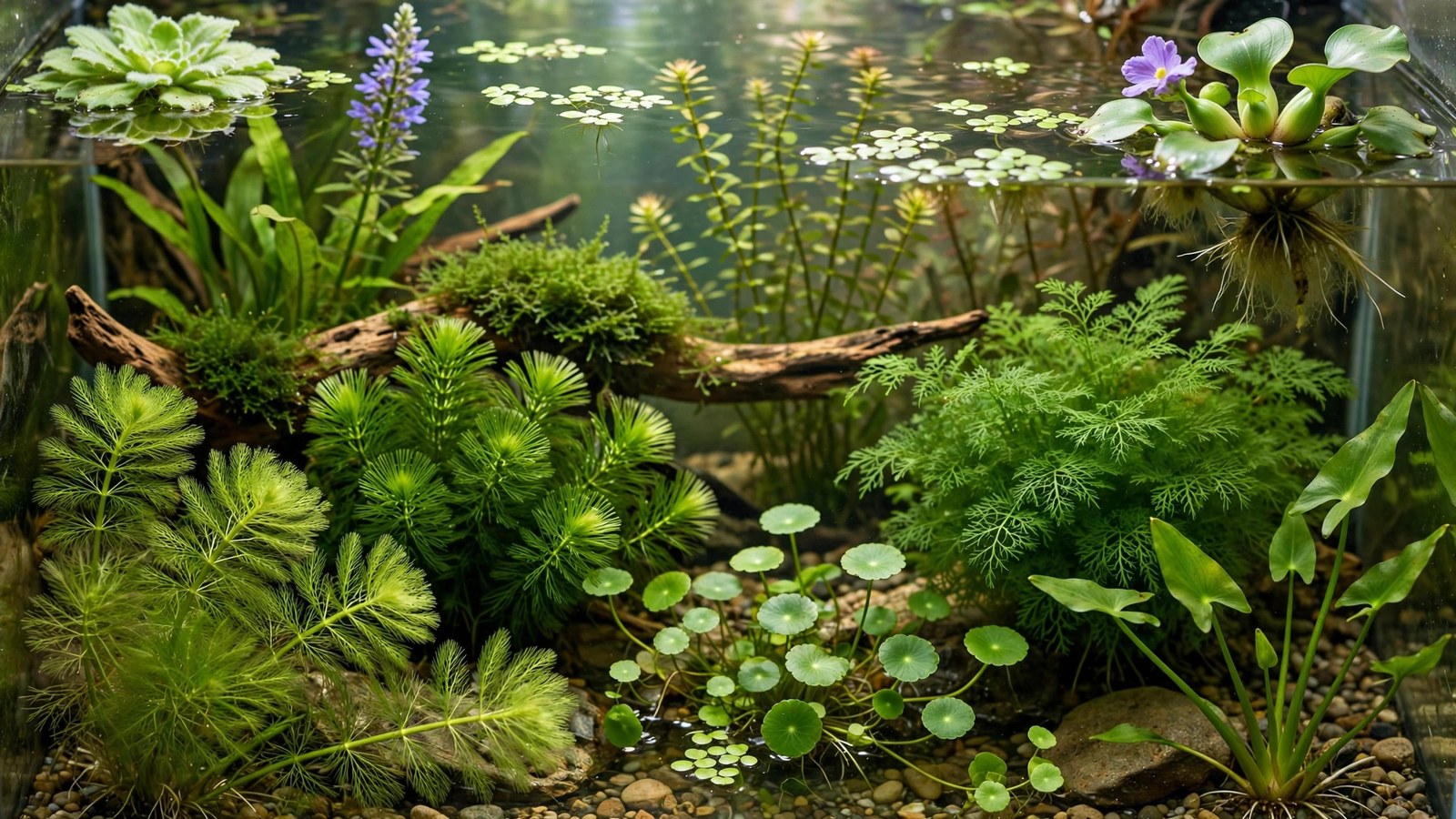
Many aquarium plants are pond plants in disguise — species that grow submerged in your tank spend summers emersed in outdoor ponds, often growing faster and flowering spectacularly. If you have (or are building) a garden pond, your aquarium plant knowledge transfers directly, and your indoor trimmings become free pond stock. These 10 aquarium plants thrive in outdoor ponds, with notes on what changes when they move outside.
Why Aquarium Plants Love Ponds
Outdoor ponds offer what indoor tanks can't: unlimited sunlight, atmospheric CO2, natural temperature swings, and rainwater. Many aquarium species grow emersed (leaves in air) in ponds during summer, growing 5–10x faster than submerged indoors — then you bring cuttings inside for winter and the cycle repeats. A pond is essentially a free summer grow-out facility for your aquarium plants.
Pond plants also do real work: submerged oxygenators keep water clear, floating plants shade out algae, and marginal plants filter runoff nutrients. The same nutrient-sponge principles from our nitrate-absorbing aquarium plants apply at pond scale.
What Changes Outdoors
Emersed growth
Most of these plants grow emersed in shallow pond margins — different leaf shapes (often broader, thicker), faster growth, and frequent flowering. When you bring them indoors for winter, expect a transition melt as they switch back to submersed form. This is normal; see the acclimation principles that apply to any plant move.
Temperature and seasons
Tropical species (water sprite, dwarf sag) thrive in summer but die below ~50°F — treat them as annuals or overwinter indoors. Temperate species (hornwort, anacharis, vallisneria) survive winters in deep ponds that don't freeze solid. Know your USDA zone and each plant's limits before committing.
Pests and invasives
Outdoor plants pick up snails, insects, and algae — quarantine and dip before bringing pond plants indoors. And critically: never release aquarium plants into local waterways. Many pond-suitable species (anacharis, hornwort, water hyacinth where legal) are invasive. Compost excess, don't dump it. If you're unsure about a species' status in your area, check local regulations before planting — and cross-reference growth requirements in Tropica's plant database.
10 Aquarium Plants for Outdoor Ponds
1. Hornwort (Ceratophyllum demersum)
The classic pond oxygenator — and the same plant from your aquarium. Hornwort floats freely, grows explosively in summer sun, oxygenates water, and provides fry and tadpole shelter. It's hardy enough to overwinter in most climates (it forms dormant turions that sink and resprout). Buy once, have it forever. It's also one of the best cold-water plants for unheated setups if you bring a sprig indoors for winter.
2. Anacharis (Egeria densa)
Another dual-purpose oxygenator, sold in both aquarium and pond trades. Anacharis grows submerged in ponds all summer, rooting in the pond bottom or floating free. Check local regulations — it's restricted or invasive in some regions, in which case use native alternatives. Where legal, it's unbeatable for the price.
3. Water Sprite (Ceratopteris thalictroides)
In ponds, water sprite grows emersed into a lush ferny marginal plant 2+ feet tall — dramatically different from its submerged aquarium form. It loves the pond margin's wet soil and full sun. Tropical: bring it inside before first frost, or treat as an annual and buy fresh each spring.
4. Vallisneria americana (Jungle Val)
Native to North American waterways, jungle val is a true pond plant that happens to work in aquariums. In ponds it forms massive flowing meadows, flowers readily, and overwinters in zone 6+ ponds. Plant in submerged pots to contain its enthusiastic runner spread — in a pond, "invasive" starts at home.
5. Dwarf Sagittaria
Grows emersed in pond shallows as a grassy marginal, spreading by runners into a shoreline lawn. Handles full sun and wet feet; dies back in hard freezes but resprouts from runners in spring in mild climates. Excellent for naturalizing pond edges.
6. Bacopa caroliniana / Bacopa monnieri
Both bacopas grow beautifully as pond marginals — creeping along wet shorelines, rooting at nodes, and producing small flowers all summer. They're more ornamental emersed than submersed, making the pond their better venue. Overwinter indoors; they're tropical.
7. Water Wisteria (Hygrophila difformis)
Emersed wisteria in a pond margin grows into a bushy 2-foot plant with broader leaves and purple-tinged flowers — unrecognizable from its aquarium form, and gorgeous. Fast enough to fill a bog filter or marginal shelf in one summer. Tropical; bring cuttings inside for winter.
8. Ludwigia repens
Pond-grown ludwigia creeps along shorelines with round emersed leaves, turning red-bronze in full sun — a beautiful marginal accent. It roots readily in wet soil and spreads politely. Handles mild frosts; in cold climates, overwinter a pot indoors.
9. Cryptocoryne wendtii
Surprising but true: crypts grow well as pond marginals in warm climates, spreading into colonies in boggy soil at the pond's edge. They flower more readily emersed (the spathe is the point of the genus name). Only for frost-free or greenhouse ponds — crypts have zero cold tolerance.
10. Rotala rotundifolia
Emersed rotala forms a creeping mat with small round leaves and tiny pink flowers — a charming pond edging plant. In full sun the emersed form blushes pink. Tropical, so it's a summer annual in most climates — but one $5 bunch becomes a pond's worth of edging in a season.
Pond Planting Zones
| Zone | Depth | Best aquarium plants |
|---|---|---|
| Deep water | 18"+ | Hornwort, anacharis (oxygenators) |
| Submerged shelves | 6–18" | Vallisneria, dwarf sag (potted) |
| Marginals | 0–6" | Water sprite, bacopa, ludwigia, wisteria, rotala |
| Bog / wet soil | Above waterline | Crypts, bacopa, ludwigia |
The Indoor-Outdoor Pipeline
Run your pond and tanks as one system: in spring, move indoor trimmings outside to explode in summer growth; in fall, bring the best specimens inside to overwinter and propagate under lights. Your pond becomes a free plant farm that stocks your aquariums all winter. Just quarantine everything coming back inside — pond snails, dragonfly nymphs, and algae hitchhike invisibly. A week in a quarantine bucket with a snail treatment saves months of regret. The explosive summer growth makes ponds ideal nurseries for fast-growing plants for new tank setups — and warm-climate ponds will reward you with the spectacular aquarium plant blooms most indoor tanks never see.
Building a Bog Filter With Aquarium Plants
A bog filter — water pumped up through a gravel-filled marginal bed — is the pond equivalent of a planted sump, and aquarium plants are perfect for it. Fill a shallow lined bed with pea gravel, plant it densely with water sprite, bacopa, ludwigia, and wisteria, and pump pond water through it before it returns to the main pond. The plants strip ammonia, nitrate, and phosphate relentlessly in the sun-drenched, high-flow environment, and the gravel hosts massive bacterial colonies. A well-planted bog filter can keep a moderately stocked pond crystal clear with no other filtration — it's the same nutrient-sponge principle as a planted aquarium, scaled up and supercharged by sunlight. Harvest handfuls of growth monthly to permanently export the captured nutrients, and divide the marginals each spring to keep them vigorous.
Frequently Asked Questions
Which aquarium plants survive winter in a pond?
Temperate natives: hornwort, vallisneria americana, and (in deep non-freezing ponds) anacharis. Everything tropical — water sprite, bacopa, wisteria, ludwigia, crypts, rotala — dies below ~50°F and must come inside or be replanted each spring. In USDA zone 7+, marginals in deep water often survive with mulching.
Will pond plants bring diseases to my aquarium?
They can carry snails, parasites, and algae — but not typically fish diseases (different pathogens). The standard protocol: quarantine pond plants in a fishless bucket for 1–2 weeks, do a snail-killing dip (alum or potassium permanganate), rinse thoroughly, and inspect for insect eggs. After that, they're as safe as store-bought.
Can I just throw aquarium trimmings in my pond?
For the species on this list, yes — that's the idea. But check invasiveness first: in many regions it's illegal to plant anacharis, parrot's feather, or water hyacinth outdoors. When in doubt, keep aggressive growers in submerged pots (which also makes fall retrieval easy) and compost trimmings instead of letting them escape via overflow.
Do pond plants need fertilizer?
Usually not — fish waste, decaying leaves, and runoff provide abundant nutrients (often too abundant, hence algae). In fishless ornamental ponds, a few aquatic fertilizer tablets in potted plants help. The bigger pond challenge is excess nutrients, which is exactly what fast growers like hornwort are for.
Why do my pond plants look different from my aquarium plants?
Emersed vs submersed growth — same species, different leaf forms adapted to air vs water. Emersed leaves are typically thicker, broader, and often differently colored, and plants usually flower only emersed. When you move them back indoors, they shed emersed leaves and regrow submersed ones. It's the same transition every new aquarium plant goes through.
What's the easiest pond-aquarium crossover for a beginner?
Hornwort — throw it in the pond in spring, watch it triple by midsummer, bring armfuls inside in fall for your tanks. Zero planting, zero care, nearly indestructible, and useful in both venues. Anacharis is the runner-up where legal. Start with these before investing in marginals.
Two Hobbies, One Plant Collection
The pond-aquarium pipeline is one of the hobby's best-kept secrets: summer sun grows in weeks what takes months indoors, and your "pond weeds" become premium aquarium stock every fall. Start with hornwort and anacharis, add marginals as your pond matures, and never buy the same plant twice again. A single season of pond growing can produce enough trimmings to stock several aquariums — the most productive square footage in the hobby.
Tissue-culture plants are the exception — they’re grown in sterile gel and adapt with minimal melting, which is part of what you’re paying for. Plants bought submersed from another hobbyist’s tank also transition with little melt, since they’re already in the right form.
Which Plants Melt Most (and Least)
Heavy melters (expect significant leaf loss)
- Cryptocorynes — infamous for “crypt melt,” sometimes dropping every leaf after any disturbance. They almost always recover from the roots within weeks.
- Stem plants grown emersed — rotala, ludwigia, and hygrophila often shed lower emersed leaves while the growing tips transition.
- Amazon swords — emersed-grown swords typically lose their broad oval aerial leaves and replace them with longer submersed ribbon leaves.
Light melters
- Anubias, java fern, bucephalandra — slow-growing rhizome plants transition gradually; occasional old-leaf melt but rarely dramatic.
- Vallisneria — usually transitions well, though it dislikes the move itself and may sulk for a week.
- Floating plants — minimal melt since their leaves were already at the air-water interface.
The Acclimation Protocol
Step 1: Quarantine or dip first
Before acclimating to your tank’s conditions, make sure you’re not acclimating pests along with the plant. Run new arrivals through our quarantine and dip protocol — it adds days upfront but prevents months of regret.
Step 2: Float to temperature-match (30 minutes)
Float the bag or container in your tank for 20–30 minutes to equalize temperature. Plants are less temperature-sensitive than fish, but a 10°F shock on top of transplant stress is an avoidable insult.
Step 3: Trim before planting
Remove any leaves that are already damaged, yellowing, or heavily algae-covered — they won’t recover and they’ll rot in your tank, feeding algae. For stem plants, trim off the bottom inch and any emersed leaves that look unlikely to adapt; the plant wastes energy maintaining leaves it’s going to shed anyway. Keep the healthy growing tips — that’s where recovery starts.
Step 4: Plant correctly the first time
Follow our planting guide — right depth, crown exposed on rosettes, rhizomes unburied on epiphytes. Every uprooting and replanting restarts the acclimation clock, so get placement right on the first attempt. Decide where each plant goes before it goes in the water.
Step 5: Run a gentle first week
For the first 7 days after planting:
- Moderate light — run your normal photoperiod but consider dropping intensity 20–30% if your light is dimmable. Blast-level light on a melting plant grows algae on the dying leaves, not recovery.
- Stable CO2 — if you inject CO2, keep it consistent. Fluctuating CO2 during acclimation is a melt accelerator. If you’re low-tech, this doesn’t apply — see growing without CO2.
- Half-strength fertilizer — new plants with damaged leaves can’t use full dosing, and the excess feeds algae. Ramp to full strength over 2–3 weeks per our fertilizer schedule.
- No disturbance — don’t move, trim, or “check on” new plants for at least two weeks. Every touch resets root establishment. This is especially critical for crypts.
Step 6: Remove melt, keep the base
As emersed leaves melt, remove the mushy material promptly — decaying leaves release ammonia and grow fungus that can spread to healthy tissue. But never discard the plant while the crown, rhizome, or roots are firm and alive. A crypt that’s lost every leaf but has firm roots is a plant that’s about to recover, not a dead plant. Give it 3–4 weeks before judging.
Telling Normal Melt From Real Problems
Normal transition melt:
- Affects oldest/emersed leaves first, newest growth last
- New submersed leaves emerge even as old ones dissolve
- Roots and crown stay firm and white/green
- Timeline: 1–4 weeks, then obvious new growth
Concerning melt (see our full melting diagnosis guide):
- New growth also melts or emerges deformed
- Rhizome or crown turns mushy and brown — this is rot, not transition
- Entire plant dissolves within days with no new growth after 4+ weeks
- Melting spreads to established plants that weren’t recently moved
Buying Tips to Minimize Melt
- Buy submersed-grown when available — hobbyist-grown cuttings transition with almost no melt.
- Choose tissue culture for sensitive species — crypts and delicate stems establish far more reliably from sterile cups.
- Avoid plants already melting in the store tank — some melt is normal, but a plant that’s mostly mush at purchase has less energy for recovery.
- Transport carefully — keep plants damp and out of direct sun/heat. A plant that dries out or cooks in a hot car melts far worse than one transported properly.
The First-Month Timeline: What to Expect Week by Week
Knowing what’s normal when removes most acclimation anxiety. Here’s the typical timeline for a healthy plant adapting to a new tank:
Week 1: The quiet week
Almost nothing visible happens. The plant is growing roots you can’t see and assessing its new environment. Some species (vallisneria, stem plants) may start shedding their lowest leaves. This is normal. Resist the urge to “help” — no moving, no extra fertilizer, no light changes. The most common beginner mistake is intervening during a week when the correct action is nothing.
Week 2: Melt peaks
This is when emersed leaves give up in earnest. Crypts may drop everything; swords shed their broad aerial leaves; stem plants lose lower foliage. It looks catastrophic and it’s usually fine. Keep removing mushy material, keep conditions stable, and watch the crown and growing tips — if those are firm and green, recovery is already underway.
Week 3: The turn
New submersed-adapted leaves emerge — smaller, thinner, often a slightly different shade of green than the emersed foliage. Stem plant tips start growing visibly; crypts push tiny curled leaves from the crown; swords unfurl narrow ribbon leaves. This is the moment most beginners exhale for the first time.
Week 4+: Established
New growth outpaces melt, and the plant is functionally yours. You can resume full-strength fertilizer, normal trimming, and stop treating it as fragile. Some slow growers (anubias, bucephalandra) take 6–8 weeks to show obvious progress — that’s their normal speed, not a problem.
Acclimating Different Plant Formats
Tissue-culture cups
Sterile, pest-free, and already adapted to high-humidity (not emersed) growth — tissue cultures melt the least of any format. Rinse the agar gel off gently (leftover gel rots and feeds fungus), split the portion into small plantlets, and plant per our planting guide. They establish slowly for the first two weeks, then accelerate. No dip needed, minimal acclimation stress — this is the premium experience you’re paying for.
Potted plants
Remove the pot and strip away the rockwool completely — leftover rockwool traps debris and rots. Tease the root mass apart gently; if it’s a dense mat, splitting it into 2–3 smaller portions actually establishes faster than planting one big clump (more growing points, better water flow around roots). Potted plants are usually emersed-grown, so expect the standard 2–4 week melt cycle.
Bare-root / bunched stems
Typically sold as weighted bunches. Remove any bands, foam, or weights, strip the lower leaves, and plant stems individually or in small groups. Bunched stems from the store are often already transitioning — check for new submersed growth at the tips, which tells you the plant is mid-adaptation and will settle quickly.
Hobbyist cuttings
Already submersed-grown and the fastest to establish — often showing new growth within days. The main acclimation factor is water-parameter difference between the two tanks. Float to temperature-match, plant promptly, and they’ll usually take off with minimal melt. This is why experienced hobbyists prefer trading cuttings over buying potted plants.
Frequently Asked Questions
Should I use a “plant starter” or transplant fertilizer?
Products marketed for transplant shock are mostly B-vitamins and mild hormones. They don’t hurt, but there’s no strong evidence they help aquarium plants specifically. Stable conditions and patience outperform any bottle. Save the money for more plants.
My new plant melted completely — bare crown, no leaves. Is it dead?
Probably not, if the crown or rhizome is firm. Crypts and swords routinely lose 100% of their leaves and regrow from the base within a month. The test is firmness: firm and pale/green means alive; mushy and brown/black means rot. Give firm-but-leafless plants a full 4 weeks before declaring them dead.
Can I speed up acclimation with extra light or CO2?
No — and trying usually backfires. A melting plant can’t use extra light; the excess just grows algae on its dying leaves. Keep light moderate and CO2 stable (not boosted) during acclimation. Growth speed comes from the plant’s own adaptation timeline, which you can’t rush, only avoid delaying.
Should new plants go straight into my main display tank?
After quarantine/dipping, yes — there’s no benefit to a separate “growing-in” tank for most plants. They acclimate to your water fastest in the tank they’ll live in. The exception is very delicate species going into a tank with boisterous fish; give those a few weeks in a calm corner or breeder box first.
The Patience Rule
The single most important acclimation skill is restraint: plant it right, set gentle conditions, remove decay, and then leave it alone for a month. The hobbyists with the best plant growth aren’t doing something clever in week one — they’re simply not interfering in weeks two through four while the plants do what they’ve evolved to do. Melt looks like failure and feels like failure, but in most cases it’s the visible part of a plant successfully becoming yours.