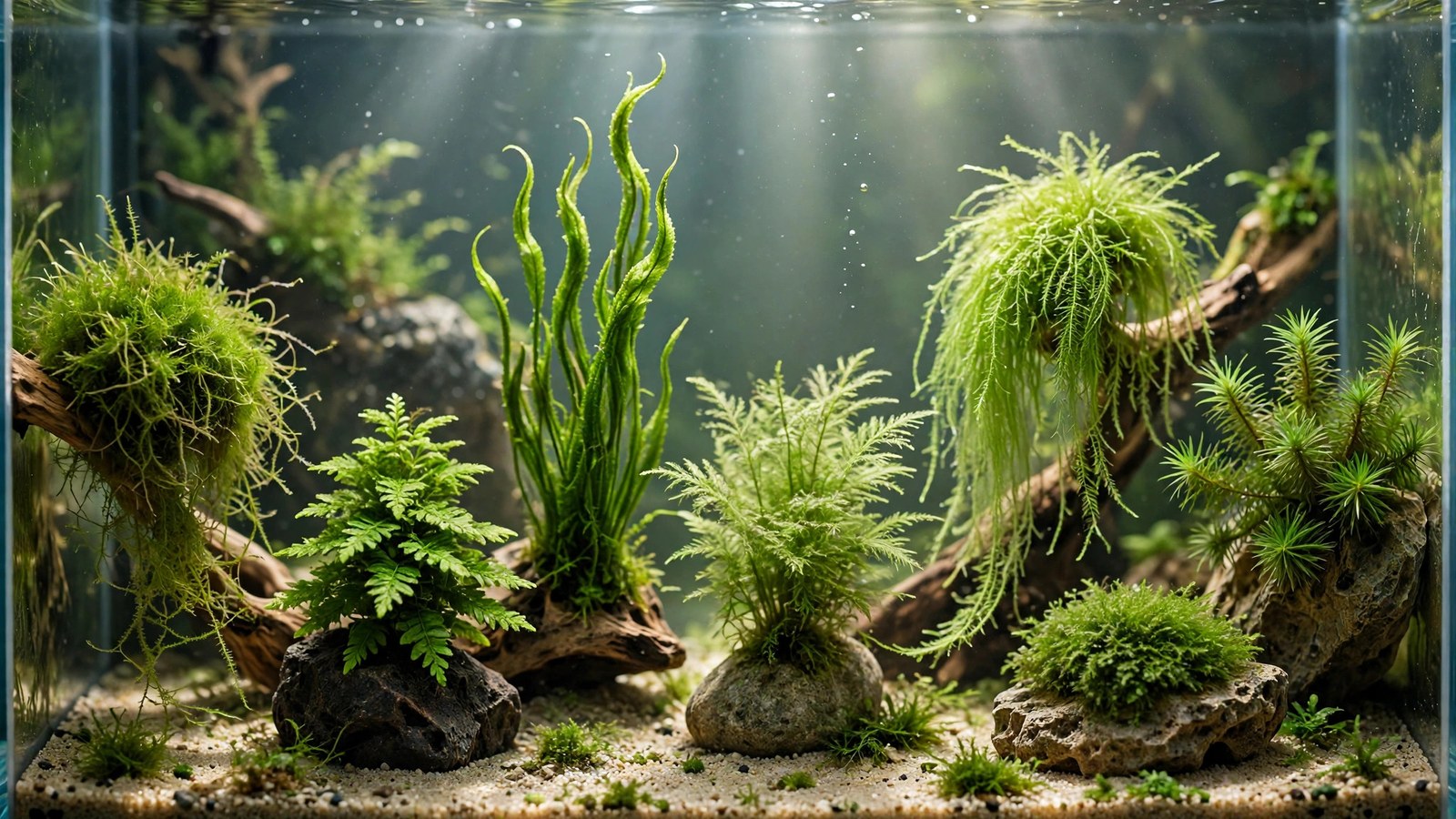
Mosses are the texture artists of the planted tank — softening hardscape edges, carpeting tree canopies, sheltering shrimp and fry, and adding the aged, overgrown character that separates good aquascapes from great ones. But not all mosses are equal: some grow like weeds, others demand patience and precision. These 7 aquarium mosses are compared honestly — growth speed, looks, difficulty, and best uses — so you pick the right one the first time.
What Makes Mosses Different
Mosses are bryophytes — ancient, flowerless plants with no true roots, stems, or vascular tissue. They absorb water and nutrients across their entire surface, which means they feed from the water column, attach to any surface, and couldn't care less about substrate. They grow slowly, propagate by fragmentation (any piece becomes a new colony), and provide unmatched micro-habitat for shrimp, fry, and biofilm grazers.
The tradeoff: slow growth makes mosses algae magnets under strong light. The universal moss rule is shade and patience — moderate light, good flow, and realistic expectations about speed. Nearly all mosses thrive without CO2; injected CO2 speeds them up but isn't required.
How to Attach Moss
Moss has no rhizome to glue — you spread it. The standard methods: sandwich thin layers between hardscape and fishing line or mesh, dab gel superglue on small tufts pressed to wood or rock, or wedge clumps into crevices. Spread it thin — thick wads rot in the middle while the outside grows. A sparse, even layer fills in faster and healthier than a thick blob. For moss-first hardscape designs, see our epiphyte guide, which covers moss placement alongside anubias and ferns.
The 7 Best Aquarium Mosses Compared
1. Java Moss (Taxiphyllum barbieri) — the indestructible one
The most forgiving moss in the hobby. Java moss grows in almost any light, any water, with or without CO2, and recovers from abuse that kills fancier mosses. The downside of its vigor: it grows stringy and wild, trapping debris and needing frequent trimming to look tidy. Best for: beginners, shrimp tanks, fry cover, and anywhere function beats form. Our shrimp tank plant guide leans heavily on it for good reason.
2. Christmas Moss (Vesicularia montagnei) — the aquascaper's favorite
Named for its branching fronds that resemble tiny Christmas trees, Christmas moss grows in neat, triangular patterns that look deliberate and manicured. It's nearly as hardy as java moss but far better-looking — the default choice for moss trees, moss walls, and hardscape detailing in contest tanks. Slightly slower than java moss, which is actually an advantage: it stays tidy longer between trims.
3. Phoenix Moss (Fissidens fontanus) — the most beautiful
Tiny feather-like fronds growing in precise, slow-spreading patches — phoenix moss is the most refined-looking moss you can buy. It doesn't get stringy, forms velvety cushions on wood and rock, and looks stunning in close-up. The catch: it's genuinely slow (months to fill in) and pricier than common mosses. Best for: detail work on showpiece hardscape where you'll wait for perfection.
4. Peacock Moss (Taxiphyllum sp.) — the textured upgrade
Similar to java moss but with a distinctive iridescent sheen and more orderly, fan-like growth. Peacock moss is hardy and adaptable like its cousin but looks significantly better — a straight upgrade for anyone who finds java moss too scruffy. Good middle ground between bulletproof and beautiful.
5. Weeping Moss (Vesicularia ferriei) — the waterfall effect
Weeping moss grows in distinctive drooping, tear-shaped fronds that cascade downward — perfect for creating the weeping-willow effect on driftwood branches. Attach it to elevated hardscape and let it drape. Moderate growth speed, good hardiness, and a unique form no other moss replicates. Superb on bonsai-style trees.
6. Flame Moss (Taxiphyllum 'Flame') — the sculptural one
Flame moss grows in upright, twisting spirals that look like green flames frozen mid-flicker. It's a slow grower that forms distinctive vertical tufts — unlike the creeping habit of most mosses. Best as an accent on rock points or wood tips where its upward form contrasts with creeping neighbors. Patience required; impact guaranteed.
7. Riccia fluitans (Crystalwort) — the floating carpet
Technically a liverwort, not a moss, but used like one. Riccia forms bright-green, coral-like mats that float naturally — tie it down with mesh or glue it to rock for a stunning foreground carpet, or let it float as fry cover. It pearls beautifully (oxygen bubbles trapped in its structure) and grows faster than true mosses. Needs decent light and benefits from CO2, making it the highest-maintenance plant on this list — but the brightest green in the hobby.
Comparison Table
| Moss | Growth speed | Difficulty | Look | Best use |
|---|---|---|---|---|
| Java moss | Fast | Trivial | Wild, stringy | Shrimp/fry cover, beginners |
| Christmas moss | Medium | Easy | Neat, triangular | Moss trees, walls, aquascaping |
| Phoenix moss | Slow | Easy–medium | Velvety, refined | Showpiece hardscape detail |
| Peacock moss | Medium | Easy | Sheen, fan-like | Upgrade over java moss |
| Weeping moss | Medium | Easy | Drooping, cascading | Bonsai trees, branches |
| Flame moss | Slow | Easy–medium | Upright spirals | Accents, contrast |
| Riccia | Fast | Medium | Bright coral mats | Foreground carpet, floating |
Moss Care Essentials
Keep it shaded
Moss under direct intense light grows algae faster than it grows moss. Tuck mosses into shaded hardscape positions, under overhangs, or beneath floating plants. If a moss patch turns brown and hairy with algae, the fix is less light and more flow — not fertilizer.
Trim regularly
Untrimmed moss grows over itself: the top stays green while the shaded interior browns and rots, eventually lifting off in an ugly mat. Trim every 4–8 weeks with scissors, removing the cuttings promptly (loose moss fragments colonize everywhere — including your filter intake). Regular trims keep moss dense and vibrant.
Provide gentle flow
Moss feeds across its whole surface, so water movement delivers nutrients and prevents debris settling into the mat. Position mosses where filter outflow passes gently — not blasted, not stagnant. Shrimp help enormously, constantly picking the moss clean.
Debris management
Moss traps everything — fish food, plant debris, mulm. During water changes, gently wave a turkey baster or siphon over moss patches to lift trapped debris. A moss choked with detritus browns from the inside; a clean moss stays green to the base.
Moss in Shrimp and Breeding Tanks
Moss is functionally irreplaceable in shrimp tanks: it harbors the biofilm and infusoria that newborn shrimp eat, provides hiding spots that dramatically improve shrimplet survival, and gives shrimp constant grazing. A shrimp tank without moss is leaving survival rates on the table. Java moss or Christmas moss, a handful of shrimp, and patience is the entire recipe — details in our shrimp tank plants guide. Mosses also serve as spawning medium for egg-scattering fish, catching adhesive eggs in their fronds.
Frequently Asked Questions
Why is my moss turning brown?
The most common causes, in order: too much light (algae smothering it), debris choking the interior (needs cleaning and trimming), or too-thick initial application (the middle rotted). Thin it out, move it to shade, clean it gently, and trim away brown portions — healthy moss regrows from green fragments remarkably well.
Can moss grow on substrate as a carpet?
Yes, with help — spread it thin on the substrate and hold it down with mesh until it grips (2–4 weeks). Riccia and phoenix moss make the best moss carpets; java moss works but looks wild. Moss carpets need regular trimming to stay attached and tidy, and they trap debris, so they're higher-maintenance than plant carpets.
How do I get rid of moss that's spreading everywhere?
Java moss fragments root anywhere — remove unwanted patches by hand, siphon diligently after trimming, and check filter intakes. For a full reset, remove the hardscape and scrub it. Prevention beats cure: trim over a net, remove cuttings immediately, and never let moss near filter intakes unguarded.
Does moss need fertilizer?
Light liquid dosing helps, but moss needs far less than stem plants — it's a slow grower with modest appetite. In a stocked tank, fish waste often suffices. If moss looks pale and stagnant despite good light and flow, a half-dose of comprehensive liquid fertilizer usually perks it up.
What's the best moss for a beginner?
Christmas moss — hardy enough for beginners, good-looking enough that you won't want to replace it later. Java moss is tougher but you'll eventually find it scruffy; starting with Christmas moss skips that upgrade cycle. Both survive the full range of beginner mistakes.
Can different mosses be mixed?
Yes, and it looks great — Christmas moss on the branches, phoenix moss on the rock bases, weeping moss draping from high points. Faster mosses will eventually overgrow slower ones where they touch, so give slow growers (phoenix, flame) their own territory with some separation.
Pick Your Texture
Start with Christmas moss for general aquascaping, java moss for utility (shrimp, fry, quarantine tanks), and phoenix moss when you want a showpiece. Mosses reward the patient and punish the hasty — spread thin, shade well, trim regularly, and your hardscape will develop the soft, ancient character that makes planted tanks feel like real underwater worlds.
Tissue-culture plants are the exception — they’re grown in sterile gel and adapt with minimal melting, which is part of what you’re paying for. Plants bought submersed from another hobbyist’s tank also transition with little melt, since they’re already in the right form.
Which Plants Melt Most (and Least)
Heavy melters (expect significant leaf loss)
- Cryptocorynes — infamous for “crypt melt,” sometimes dropping every leaf after any disturbance. They almost always recover from the roots within weeks.
- Stem plants grown emersed — rotala, ludwigia, and hygrophila often shed lower emersed leaves while the growing tips transition.
- Amazon swords — emersed-grown swords typically lose their broad oval aerial leaves and replace them with longer submersed ribbon leaves.
Light melters
- Anubias, java fern, bucephalandra — slow-growing rhizome plants transition gradually; occasional old-leaf melt but rarely dramatic.
- Vallisneria — usually transitions well, though it dislikes the move itself and may sulk for a week.
- Floating plants — minimal melt since their leaves were already at the air-water interface.
The Acclimation Protocol
Step 1: Quarantine or dip first
Before acclimating to your tank’s conditions, make sure you’re not acclimating pests along with the plant. Run new arrivals through our quarantine and dip protocol — it adds days upfront but prevents months of regret.
Step 2: Float to temperature-match (30 minutes)
Float the bag or container in your tank for 20–30 minutes to equalize temperature. Plants are less temperature-sensitive than fish, but a 10°F shock on top of transplant stress is an avoidable insult.
Step 3: Trim before planting
Remove any leaves that are already damaged, yellowing, or heavily algae-covered — they won’t recover and they’ll rot in your tank, feeding algae. For stem plants, trim off the bottom inch and any emersed leaves that look unlikely to adapt; the plant wastes energy maintaining leaves it’s going to shed anyway. Keep the healthy growing tips — that’s where recovery starts.
Step 4: Plant correctly the first time
Follow our planting guide — right depth, crown exposed on rosettes, rhizomes unburied on epiphytes. Every uprooting and replanting restarts the acclimation clock, so get placement right on the first attempt. Decide where each plant goes before it goes in the water.
Step 5: Run a gentle first week
For the first 7 days after planting:
- Moderate light — run your normal photoperiod but consider dropping intensity 20–30% if your light is dimmable. Blast-level light on a melting plant grows algae on the dying leaves, not recovery.
- Stable CO2 — if you inject CO2, keep it consistent. Fluctuating CO2 during acclimation is a melt accelerator. If you’re low-tech, this doesn’t apply — see growing without CO2.
- Half-strength fertilizer — new plants with damaged leaves can’t use full dosing, and the excess feeds algae. Ramp to full strength over 2–3 weeks per our fertilizer schedule.
- No disturbance — don’t move, trim, or “check on” new plants for at least two weeks. Every touch resets root establishment. This is especially critical for crypts.
Step 6: Remove melt, keep the base
As emersed leaves melt, remove the mushy material promptly — decaying leaves release ammonia and grow fungus that can spread to healthy tissue. But never discard the plant while the crown, rhizome, or roots are firm and alive. A crypt that’s lost every leaf but has firm roots is a plant that’s about to recover, not a dead plant. Give it 3–4 weeks before judging.
Telling Normal Melt From Real Problems
Normal transition melt:
- Affects oldest/emersed leaves first, newest growth last
- New submersed leaves emerge even as old ones dissolve
- Roots and crown stay firm and white/green
- Timeline: 1–4 weeks, then obvious new growth
Concerning melt (see our full melting diagnosis guide):
- New growth also melts or emerges deformed
- Rhizome or crown turns mushy and brown — this is rot, not transition
- Entire plant dissolves within days with no new growth after 4+ weeks
- Melting spreads to established plants that weren’t recently moved
Buying Tips to Minimize Melt
- Buy submersed-grown when available — hobbyist-grown cuttings transition with almost no melt.
- Choose tissue culture for sensitive species — crypts and delicate stems establish far more reliably from sterile cups.
- Avoid plants already melting in the store tank — some melt is normal, but a plant that’s mostly mush at purchase has less energy for recovery.
- Transport carefully — keep plants damp and out of direct sun/heat. A plant that dries out or cooks in a hot car melts far worse than one transported properly.
The First-Month Timeline: What to Expect Week by Week
Knowing what’s normal when removes most acclimation anxiety. Here’s the typical timeline for a healthy plant adapting to a new tank:
Week 1: The quiet week
Almost nothing visible happens. The plant is growing roots you can’t see and assessing its new environment. Some species (vallisneria, stem plants) may start shedding their lowest leaves. This is normal. Resist the urge to “help” — no moving, no extra fertilizer, no light changes. The most common beginner mistake is intervening during a week when the correct action is nothing.
Week 2: Melt peaks
This is when emersed leaves give up in earnest. Crypts may drop everything; swords shed their broad aerial leaves; stem plants lose lower foliage. It looks catastrophic and it’s usually fine. Keep removing mushy material, keep conditions stable, and watch the crown and growing tips — if those are firm and green, recovery is already underway.
Week 3: The turn
New submersed-adapted leaves emerge — smaller, thinner, often a slightly different shade of green than the emersed foliage. Stem plant tips start growing visibly; crypts push tiny curled leaves from the crown; swords unfurl narrow ribbon leaves. This is the moment most beginners exhale for the first time.
Week 4+: Established
New growth outpaces melt, and the plant is functionally yours. You can resume full-strength fertilizer, normal trimming, and stop treating it as fragile. Some slow growers (anubias, bucephalandra) take 6–8 weeks to show obvious progress — that’s their normal speed, not a problem.
Acclimating Different Plant Formats
Tissue-culture cups
Sterile, pest-free, and already adapted to high-humidity (not emersed) growth — tissue cultures melt the least of any format. Rinse the agar gel off gently (leftover gel rots and feeds fungus), split the portion into small plantlets, and plant per our planting guide. They establish slowly for the first two weeks, then accelerate. No dip needed, minimal acclimation stress — this is the premium experience you’re paying for.
Potted plants
Remove the pot and strip away the rockwool completely — leftover rockwool traps debris and rots. Tease the root mass apart gently; if it’s a dense mat, splitting it into 2–3 smaller portions actually establishes faster than planting one big clump (more growing points, better water flow around roots). Potted plants are usually emersed-grown, so expect the standard 2–4 week melt cycle.
Bare-root / bunched stems
Typically sold as weighted bunches. Remove any bands, foam, or weights, strip the lower leaves, and plant stems individually or in small groups. Bunched stems from the store are often already transitioning — check for new submersed growth at the tips, which tells you the plant is mid-adaptation and will settle quickly.
Hobbyist cuttings
Already submersed-grown and the fastest to establish — often showing new growth within days. The main acclimation factor is water-parameter difference between the two tanks. Float to temperature-match, plant promptly, and they’ll usually take off with minimal melt. This is why experienced hobbyists prefer trading cuttings over buying potted plants.
Frequently Asked Questions
Should I use a “plant starter” or transplant fertilizer?
Products marketed for transplant shock are mostly B-vitamins and mild hormones. They don’t hurt, but there’s no strong evidence they help aquarium plants specifically. Stable conditions and patience outperform any bottle. Save the money for more plants.
My new plant melted completely — bare crown, no leaves. Is it dead?
Probably not, if the crown or rhizome is firm. Crypts and swords routinely lose 100% of their leaves and regrow from the base within a month. The test is firmness: firm and pale/green means alive; mushy and brown/black means rot. Give firm-but-leafless plants a full 4 weeks before declaring them dead.
Can I speed up acclimation with extra light or CO2?
No — and trying usually backfires. A melting plant can’t use extra light; the excess just grows algae on its dying leaves. Keep light moderate and CO2 stable (not boosted) during acclimation. Growth speed comes from the plant’s own adaptation timeline, which you can’t rush, only avoid delaying.
Should new plants go straight into my main display tank?
After quarantine/dipping, yes — there’s no benefit to a separate “growing-in” tank for most plants. They acclimate to your water fastest in the tank they’ll live in. The exception is very delicate species going into a tank with boisterous fish; give those a few weeks in a calm corner or breeder box first.
The Patience Rule
The single most important acclimation skill is restraint: plant it right, set gentle conditions, remove decay, and then leave it alone for a month. The hobbyists with the best plant growth aren’t doing something clever in week one — they’re simply not interfering in weeks two through four while the plants do what they’ve evolved to do. Melt looks like failure and feels like failure, but in most cases it’s the visible part of a plant successfully becoming yours.