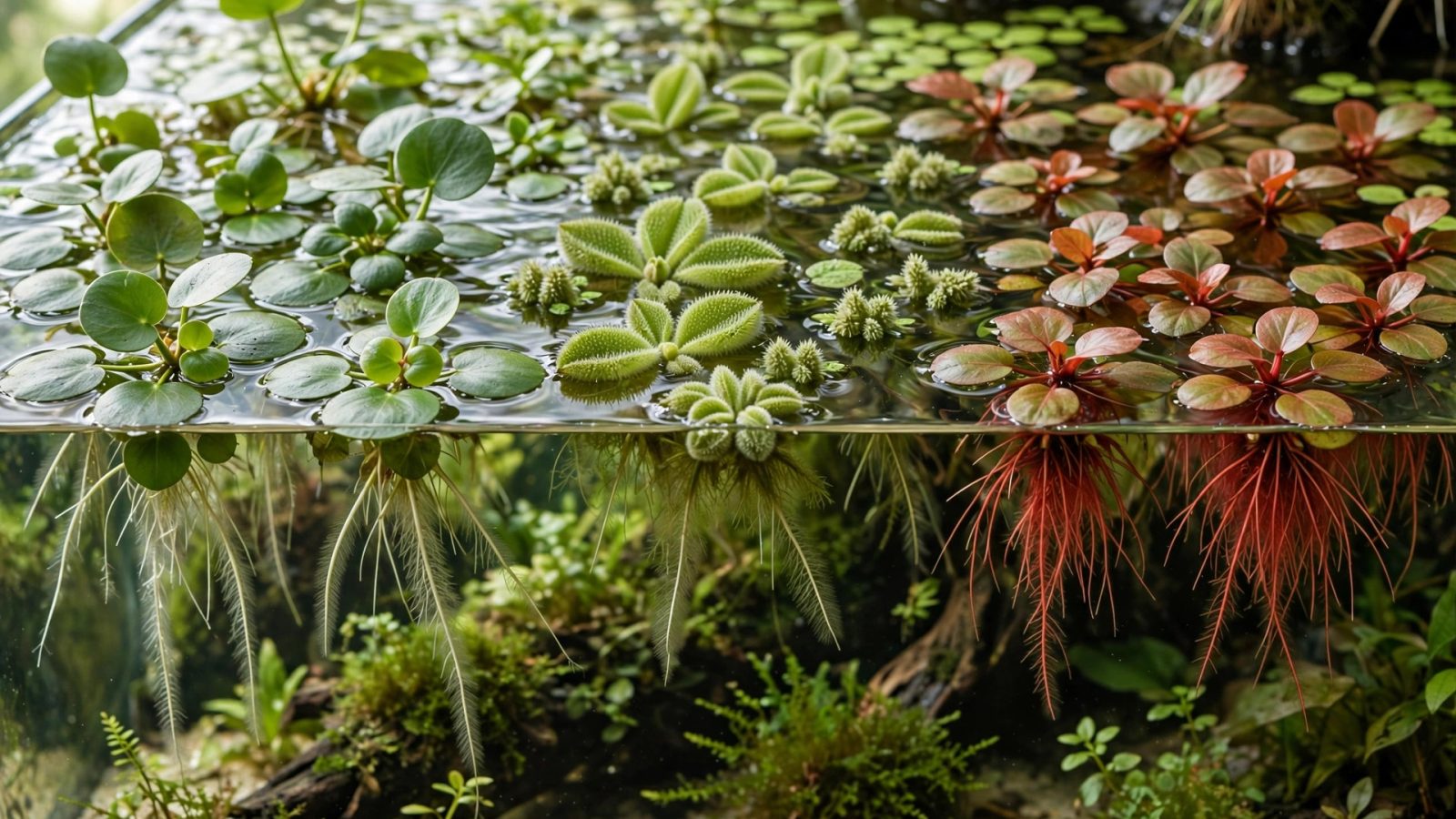
Floating plants are the most underrated category in the hobby. They grow faster than anything planted (unlimited atmospheric CO2), strip excess nutrients from the water, shade the tank against algae, and give shy fish the overhead cover they instinctively crave. Yet many aquarists skip them — or try duckweed once and swear off floaters forever. The best floating aquarium plants for beginners below are the well-behaved species: easy to grow, easy to manage, and transformative for water quality.
A note on scope: this is the general floating-plant guide — species selection, care, and management for any freshwater tank. If you’re specifically planting for a betta, our floating plants for betta tanks guide covers the betta-specific considerations (bubble nests, labyrinth-fish surface access, and which floaters bettas prefer).
Why Every Tank Benefits From Floaters
- Nutrient export: floaters are the fastest nutrient absorbers in the hobby — they pull ammonia, nitrate, and phosphate directly from the water at rates submerged plants can’t match. They’re living water purifiers.
- Algae suppression: by monopolizing nutrients and shading the water column, a healthy floater cover starves algae. New tanks with floaters have dramatically fewer algae problems.
- Fish comfort: most aquarium fish evolved under vegetated surfaces. Overhead cover reduces stress, encourages natural behavior, and gives shy species the security to venture out.
- Oxygen and surface habitat: floater roots create a rich microhabitat — biofilm, infusoria, shelter — that fry and shrimplets exploit. Floating roots are among the best fry cover available.
Managing Floaters: The Corral Method
Floaters’ vigor is their challenge: unmanaged, they cover 100% of the surface, blocking light and gas exchange. The solution is corralling: loop a length of airline tubing into a ring, join it with a connector, and float it on the surface. Floaters stay inside the ring; the open water outside allows light penetration and surface agitation. Use multiple rings for large tanks, or suction-cup the tubing to the glass to hold position against filter flow.
Thin weekly. Remove a handful of floaters every week — compost them or share with other hobbyists. This isn’t just maintenance; it’s nutrient export. Every handful removed permanently extracts the nitrogen and phosphorus the plants absorbed. A floater cover you never thin eventually self-shades, with the lower layers dying and rotting back into the water.
The 8 Best Floating Plants for Beginners
1. Amazon Frogbit (Limnobium laevigatum)
The best all-around floater. Frogbit forms rosettes of round, glossy leaves with long, feathery roots dangling beneath — beautiful from above, functional below. It grows fast but not invasively, it’s easy to thin (just scoop), and the roots provide superb fry and shrimplet cover. It tolerates a wide range of conditions but prefers calmer surface water; strong filter outflow pushes it around (another reason to corral). The long roots are its signature — a healthy frogbit root mass is one of the most attractive features in a planted tank.
2. Red Root Floaters (Phyllanthus fluitans)
The pretty one. Red root floaters produce small round leaves that blush red on top under good light, with intensely red roots below — the most colorful floater available. They’re slightly more delicate than frogbit (they dislike water on their leaves and strong surface agitation), but in a calm tank they’re easy and stunning. The red coloration also makes them a beginner-friendly red plant — color without the demands of submerged reds. Thin regularly; they multiply steadily.
3. Water Sprite (floating form)
Water sprite floated is a different beast from water sprite planted — faster-growing, larger, with an extensive root system that’s arguably the best fry cover of any floater. A single plant becomes a floating island within weeks, propagating plantlets from its leaves. It’s the workhorse choice for breeding tanks and new setups where maximum nutrient export matters. The tradeoff is size: it’s a big plant that suits 20+ gallon tanks better than nanos. Featured in our new-tank plant list for exactly this vigor.
4. Salvinia (Salvinia minima / natans)
Salvinia forms chains of small, oval, velvety leaves that knit into a cohesive mat — the tidiest floater, staying where you put it better than most. The tiny hairs on its leaves repel water (a fascinating hydrophobic effect visible as silvery bubbles). It grows fast, handles gentle surface movement, and its compact size suits nano tanks where frogbit would dominate. Salvinia minima is the common aquarium species; avoid the giant salvinia (S. molesta), which is invasive and often illegal.
5. Dwarf Water Lettuce (Pistia stratiotes ‘dwarf’)
Water lettuce forms velvety rosettes resembling tiny cabbages, with dense root masses below. The dwarf aquarium variety stays manageable (2–4 inches across) unlike its pond cousin. It’s a heavy nutrient feeder — excellent for tanks with high bioloads — and the rosette form looks striking. It wants good light and dislikes condensation dripping from lids (an open-top or well-ventilated lid works best). Check local regulations: water lettuce is invasive in warm climates and restricted in some areas.
6. Hornwort (floating)
Hornwort floated is the ultimate low-maintenance floater: no roots to manage, no rosettes to arrange — just feathery green masses that grow anywhere. It’s the hardiest plant on this list, tolerating cold water (see our cold-water guide), low light, and neglect. It won’t win beauty contests, but as a functional nutrient sponge and fry refuge it’s unmatched. Anchor a bunch in a back corner or let it drift; either way it works.
7. Giant Duckweed (Spirodela polyrhiza)
Yes, duckweed — but the manageable one. Giant duckweed’s fronds are 5–10x larger than common duckweed, with reddish undersides, making it far easier to control and remove. It provides the same benefits (nutrient export, shade, fish comfort) with a fraction of the headache. It still multiplies fast — thin weekly — but a stray frond doesn’t colonize your filter and soul the way common duckweed does. Think of it as duckweed’s responsible older sibling.
8. Azolla (Azolla filiculoides)
Azolla — fairy moss — is the tiny, fast, fascinating floater: miniature fern-like fronds that shift from green to red-bronze under strong light. It doubles its biomass in days under good conditions, making it the fastest nutrient exporter here. It fixes atmospheric nitrogen (via symbiotic cyanobacteria), so it thrives even in low-nitrate water where other floaters stall. Its small size suits any tank, but thin aggressively — it’s the closest to duckweed-like vigor on this list. A unique texture no other floater replicates.
The Duckweed Question: Honest Advice
Common duckweed (Lemna minor) is the elephant in the room. It’s the easiest floating plant to grow — too easy. It reproduces explosively, clings to everything, clogs filters, and once introduced is nearly impossible to eradicate completely. Experienced keepers are divided: some love it as the ultimate nutrient sponge and free fish food (goldfish and cichlids devour it), others consider it a plague.
Our honest recommendation for beginners: start with the seven above. If you later want duckweed’s benefits, try giant duckweed first — 90% of the function, 10% of the regret. If you do introduce common duckweed, do it knowingly: quarantine it in a separate container first, never share equipment without sterilizing, and never release it outdoors. It’s invasive in waterways worldwide, and “just a little duckweed” has ecological consequences.
Floaters and Equipment: Practical Coexistence
Filters: hang-on-back filters are floaters’ nemesis — the outflow pushes plants underwater and the intake sucks them in. Solutions: baffle the outflow with a sponge, switch to a canister with a spray bar aimed at the glass, or corral floaters away from the filter zone. Sponge filters are the floater-friendly choice — gentle flow, no intake hazard.
Lids: floaters and tight lids conflict — condensation drips rot leaves (especially water lettuce and red root floaters). Use a glass lid with a ventilation gap, a mesh top, or go open-top (with the evaporation top-offs that requires). Surface agitation: most floaters prefer calm surfaces; strong agitation sinks them. Balance gas exchange needs (fish load) against floater preferences — a gentle ripple in the open corral-free zone usually satisfies both.
Frequently Asked Questions
How much surface should floaters cover?
30–50% is the sweet spot — enough for nutrient export and fish comfort, open enough for light and gas exchange. More than 70% sustained coverage starves submerged plants of light.
Will floaters kill my submerged plants by blocking light?
Only if unmanaged. Corralled to 30–50% coverage, floaters help submerged plants by stabilizing water quality. The danger is the unthinned 100% cover — which is a maintenance failure, not a plant failure.
Do floating plants need fertilizer?
They’re the first to show deficiencies (yellowing = hungry tank) and the fastest to respond to feeding. In stocked tanks, fish waste usually suffices; in lightly stocked tanks, dose liquid fertilizer at half strength. Their rapid growth makes them excellent nutritional indicators.
Can I use floaters in a high-tech CO2 tank?
Absolutely — they’re the safety net that prevents the algae outbreaks high-light CO2 tanks are prone to. Many award-winning aquascapers run a corralled floater section permanently. Just thin aggressively, because CO2 + strong light + floaters = explosive growth.
Propagation and Sharing: The Floater Economy
Floaters propagate themselves — your job is managing the surplus. Every floater on this list multiplies vegetatively: frogbit sends out runners with daughter rosettes, salvinia chains extend and fragment, red root floaters divide, azolla simply doubles. A single portion becomes a tankful within a month under good conditions. This makes floaters the cheapest plants in the hobby: buy once, never again.
The surplus has value. Local fish clubs and online hobbyist groups constantly trade floaters — a bag of frogbit or red root floaters is welcome currency. Many keepers maintain a dedicated “floater farm”: a simple tub or spare tank with strong light where trimmings grow out for trading, selling, or feeding to herbivorous fish. A 5-gallon bucket on a sunny patio grows astonishing quantities in summer. Just never release surplus into local waterways — compost excess or trash it.
Quarantine new floaters. Because they grow at the surface, floaters harbor hitchhikers — snail eggs, hydra, algae spores — more than submerged plants. A week in a separate container with an alum dip (1 tablespoon per gallon, 3-day soak, then rinse) eliminates most pests before they reach your display tank. This one habit prevents the majority of “where did these snails come from” mysteries.
Outdoor Summer Tubs: Floaters Unleashed
The advanced move: grow floaters outdoors in summer. A simple patio tub — 20 gallons, no filter, no heater — with frogbit, water lettuce, and salvinia becomes a production powerhouse under natural sunlight. The plants grow 3–5x faster than indoors, developing the intense coloration (deep red roots, bronze leaves) that indoor lighting rarely achieves. Scoop the surplus weekly for your indoor tanks, where it arrives pre-conditioned and vigorous.
Outdoor tubs need minimal care: top off evaporated water, thin the plants, and watch for mosquitoes (a few white cloud minnows or a mosquito dunk handles larvae). Bring prized floaters indoors before nighttime temperatures drop below 55°F — tropical species (water lettuce, red root floaters) chill-damage below 60°F. Temperate-tolerant frogbit and salvinia survive cooler, but frost kills everything. The summer tub is the highest-yield, lowest-effort plant growing in the hobby — and it costs almost nothing.