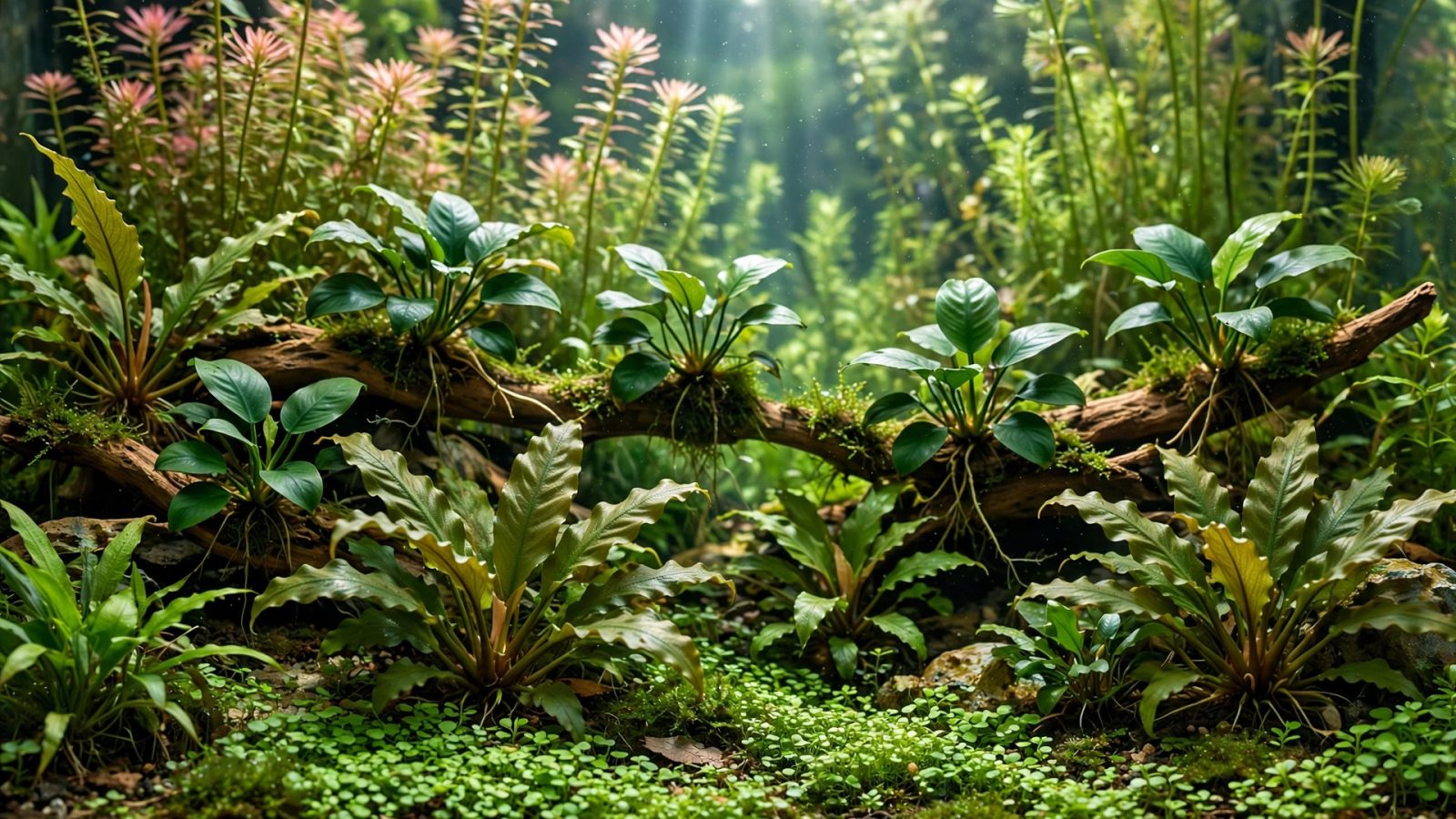
Every aquascaping guide talks about foreground carpets and background walls, but the best midground aquarium plants are what separate a flat, amateur-looking tank from one with genuine depth. The midground is the transition zone — the 4-to-10-inch band where the eye travels between carpet and canopy — and getting it right is the single highest-leverage move in planted-tank layout. These twelve plants are chosen specifically for that job: the right height, the right growth habits, and the visual weight to bridge your scape’s layers.
The midground fails in predictable ways. Too many beginners plant it with background species that outgrow the zone in weeks, or leave it empty entirely, creating a visual canyon between foreground and background. The fix is plants that stay midground-sized — either naturally compact species or ones that tolerate the regular trimming a transition zone demands — plus hardscape (wood and rock) carrying epiphytes at midground height.
What Makes a Good Midground Plant
- Mature height of 4–10 inches: tall enough to hide the base of background stems, short enough not to block them.
- Bushy or broad form: the midground’s job is visual mass — fine, wispy plants disappear here.
- Trimming tolerance: you’ll shape this zone more than any other; the plants must bounce back.
- Contrast with neighbors: midground plants should differ in leaf shape, size, or color from both foreground and background for a layered read.
The 12 Best Midground Aquarium Plants
1. Cryptocoryne wendtii
The workhorse of the midground. Crypt wendtii forms broad, ruffled rosettes in greens, bronzes, and browns, topping out around 6–8 inches — textbook midground height. It’s nearly indestructible once established: tolerates low light, variable water, and beginner mistakes. The one rule is don’t move it; crypts famously “melt” their leaves when disturbed or when parameters swing, then regrow from the roots. Plant it, leave it alone for a month, and you’ll have a permanent midground anchor. Feed with root tabs — crypts are hungry root feeders.
2. Anubias barteri (standard)
While nana suits the foreground, full-size Anubias barteri is a midground natural: broad, dark-green leaves on a sturdy rhizome, reaching 8–12 inches across when mature. Tie it to midground driftwood or wedge it between rocks — never bury the rhizome. Its slow growth is an asset here; a midground that doesn’t need constant trimming stays composed. Like all anubias, it thrives in shade, so tuck it under the shadow of taller background plants where fussier species would starve. If leaves yellow, our anubias yellowing guide diagnoses the cause.
3. Staurogyne repens
S. repens is the midground’s great compromiser: a compact, bright-green stem plant that grows 3–6 inches tall and spreads into dense bushes. It carpets if you push it with high light and CO2, but in moderate low-tech conditions it stays a perfect midground mound. Trim the tops regularly and replant them — each cutting roots fast and the mother plant branches, so a single pot becomes a thicket. It’s one of the few stem plants genuinely well-behaved enough for the transition zone.
4. Bucephalandra ‘Wavy Green’ and mixed varieties
Buce belongs in every serious midground. Its small, often iridescent leaves and ultra-slow growth make it ideal for rockwork at midground height — a cluster of buce on a fist-sized stone reads as a miniature landscape. Mix varieties for texture: ‘Wavy Green’ for classic form, ‘Kedagang’ for red-edged narrow leaves, ‘Brownie Phantom’ for deep purple-bronze. Because buce barely grows, position it as permanent architecture, not filler. See our substrate-free plant guide for attachment techniques.
5. Cryptocoryne beckettii
Where wendtii is broad and ruffled, beckettii is upright and spear-like, with olive-green to bronze leaves reaching 6–8 inches. That vertical accent makes it perfect for breaking up horizontal midground masses — plant a group of three behind a low S. repens mound and you get instant layering. Same crypt rules: root tabs, stable conditions, patience through the initial melt. It propagates by runners, so one healthy plant becomes a colony within a year.
6. Java Fern ‘Windelov’
Standard Java fern can get lanky for the midground, but the ‘Windelov’ variety — with its intricately forked, antler-like leaf tips — stays more compact and brings unmatched texture. Attach it to midground wood where its lacy silhouette contrasts with the bold leaves of anubias nearby. All the standard Java fern care principles apply: rhizome exposed, low to moderate light, liquid fertilizer. The plantlets that sprout on old leaves can be plucked and attached elsewhere — free midground filler.
7. Alternanthera reineckii ‘Mini’
The midground needs a red, and AR ‘Mini’ is the best-behaved one. This dwarf cultivar stays 4–8 inches tall with intense pink-red leaves under decent light — a color focal point that draws the eye into the middle layer. It’s honest about needing moderate light and iron; in dim tanks it reverts to leggy green. But it doesn’t demand CO2 the way its full-size cousins do, making it the most accessible red for low-tech scapers. Trim tops and replant to keep the bush dense.
8. Pogostemon helferi (Downoi)
Downoi looks like a tiny green starburst — curly, crinkled leaves in a tight rosette, 2–4 inches tall. It’s technically foreground-height, but its starburst form and bright color make it a superb midground accent when placed on a slight rise or in front of darker plants. It appreciates moderate light and a mature tank; new setups sometimes melt it. Once settled, it propagates by side shoots you can separate and replant. A genuinely distinctive texture nothing else replicates.
9. Lobelia cardinalis (dwarf form)
In submerged form, Lobelia cardinalis grows round, light-green leaves on upright stems to about 6 inches — a soft, mounding presence that contrasts beautifully with the sharp leaves of crypts or the dark mass of anubias. It’s undemanding, tolerates low light, and responds to trimming by branching enthusiastically. Let a few stems reach the surface and it may even flower — a bonus, though flowering stems should be pruned to keep energy in the submerged growth.
10. Anubias nana ‘Petite’
The miniature anubias (leaves under an inch) is the detail plant of the midground: glue or tie small portions to rock crevices and branch forks where they’ll form dense, dark-green cushions over months. ‘Petite’ is slow even by anubias standards, so think of it as living grout between hardscape elements rather than a feature plant. In nano and small tanks it can carry the whole midground; see our 5-gallon plant picks for scale-appropriate companions.
11. Cryptocoryne undulata
Undulata splits the difference between wendtii and beckettii: long, wavy-edged leaves in bronze-green, reaching 8–10 inches — the tallest crypt most midgrounds need. Its hammered leaf texture catches light in a way smooth crypts don’t, adding subtle shimmer to the middle layer. It’s one of the more adaptable crypts, tolerating harder water better than most. Plant in groups of 5–7 for a proper stand; single crypts look lonely.
12. Hygrophila corymbosa ‘Kompakt’
The compact cultivar of giant hygro keeps the broad, bright-green leaves in a tight 4–6 inch mound — all the lushness, none of the skyscraper habit. It’s fast for a midground plant, which is useful: ‘Kompakt’ fills gaps quickly while slower neighbors establish. Trim aggressively; left alone it eventually reverts toward leggier growth. An excellent “nurse plant” for new midgrounds that you’ll gradually thin as crypts and anubias mature.
Layering Technique: Building the Transition
Professional-looking depth comes from overlapping triangles, not straight rows. Arrange midground plants in odd-numbered groups (3, 5, 7) at staggered depths — one group slightly forward-left, another mid-right, a third tucked behind. Let midground foliage overlap the base of background stems by a few inches; that overlap is what hides the “seam” between layers and creates the illusion of continuous depth.
Height should step down toward the focal point. If your focal stone or wood sits left-of-center, keep midground plants tallest at the back-right and shortest near the focal area — the descending height line pulls the eye exactly where you want it. This is the same principle behind the tall-tank background arrangements, applied horizontally.
Midground Maintenance Rhythm
The midground is the highest-maintenance zone precisely because it’s the most visible. Set a biweekly 10-minute routine: pinch back stem-plant tops (S. repens, AR mini, hygro), remove any algae-spotted anubias leaves at the rhizome, and thin crypt runners that wander into the foreground. Replant healthy trimmings into thin spots rather than discarding them — a midground thickens fastest from its own cuttings.
Resist the urge to constantly rearrange. Midground plants — especially crypts and anubias — punish disturbance with melting and stalled growth. Plan the layout, plant it, and let it grow in for 6–8 weeks before judging. The best midgrounds look slightly overgrown; a little wildness reads as natural.
Scaling Down: Midground in Nano Tanks
In a 5–10 gallon tank, the midground compresses to a 2–4 inch band, so reach for the smallest plants on this list: anubias nana ‘Petite’ on tiny stones, buce clusters in rock crevices, downoi rosettes, and S. repens kept short by frequent pinching. Skip the big crypts — wendtii overwhelms a nano midground within months. One well-placed stone carrying buce plus a downoi cluster can be the entire midground of a 5-gallon; restraint reads as elegance at small scale. Our 5-gallon plant picks pair naturally with these choices.
Frequently Asked Questions
How many midground plants do I need?
For a standard 20-gallon long, 3–5 groups (15–25 individual plants/pots total) fills the zone. Denser is better — sparse midgrounds look unfinished for months while plants fill in.
Can I use only epiphytes (no planted species) in the midground?
Yes, if your hardscape provides the height. Anubias, buce, and Java fern on well-placed wood and rock can carry a midground alone — the substrate-free approach works at any layer. But mixing in a few rooted plants (crypts, S. repens) adds fullness faster.
Why does my midground look flat?
Usually insufficient contrast — same green, same leaf size across the zone. Fix it with the designer’s trio: one broad-leaf (anubias/crypt), one fine-textured (buce/moss), one color accent (AR mini/red crypt). Three textures minimum per zone.
Do midground plants need CO2?
None of the twelve require it. CO2 accelerates everything and improves color in AR mini, but all twelve are proven in low-tech setups — consistent with the low-tech method.
How do I stop crypts from melting when I plant them?
You mostly don’t — some melt is the crypt’s standard complaint about change, and fighting it causes more disturbance. Plant the crypt, add a root tab beneath it, keep parameters stable, and leave it completely alone for 3–4 weeks. New leaves emerging from the crown mean it has accepted the spot; remove the melted foliage gently once replacements are growing. The melt is a reset, not a death — crypt roots are remarkably persistent.
5 Midground Mistakes That Ruin Depth
1. The straight line. Planting midground species in a neat row parallel to the front glass is the fastest way to make a tank look like a grocery shelf. Nature doesn’t do rows — stagger depths, vary group sizes, and let some plants drift slightly forward or back.
2. One texture everywhere. A midground of only crypts, or only anubias, reads as a blob. The eye needs contrast to perceive depth: pair broad leaves against fine ones, dark green against bright, matte against glossy. Walk through the list above and deliberately pick plants that look nothing like each other.
3. Ignoring the hardscape. The best midgrounds aren’t just plants — they’re plants on something. A fist-sized rock carrying buce, or a branch fork holding ‘Petite’, adds inches of height no planted species can match in the same footprint. Hardscape is how you cheat the midground taller without waiting months.
4. Planting background species “temporarily.” That hygro or rotala cutting will not stay midground-sized, and by the time you admit it, its roots have tangled with everything nearby. If a plant’s mature height exceeds 10 inches, it lives in the background — no exceptions, no “I’ll trim it.”
5. Starving the middle. Root tabs go under swords in the back; liquid ferts dose the whole tank — but the midground’s heavy root feeders (crypts especially) get forgotten. Push a root tab under each crypt group when planting and refresh every few months. Pale, stunted midground crypts are almost always hungry, not sick.