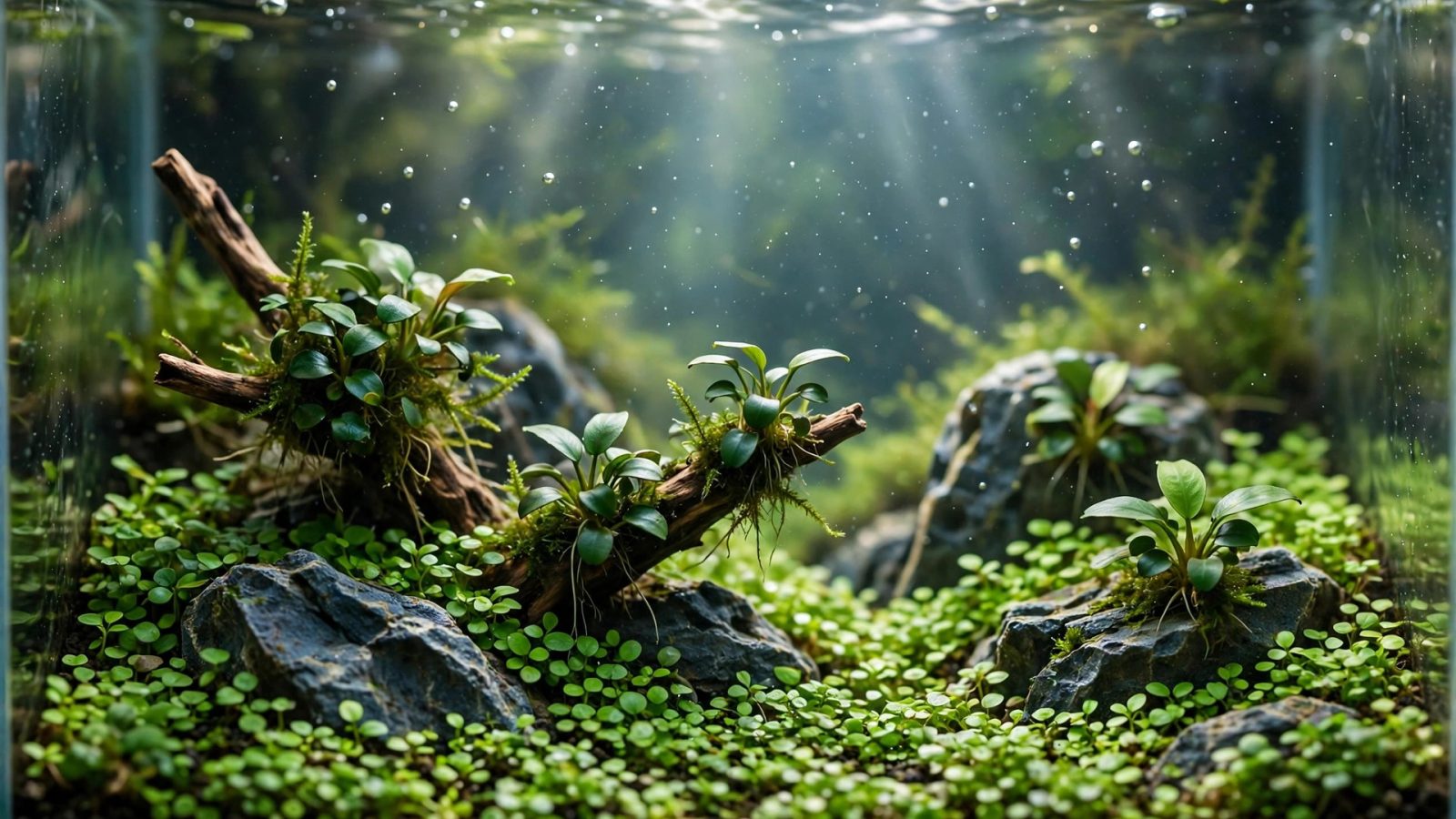
Choosing aquascaping plants for nano tanks (5 gallons / 20 liters and under) is a scale problem: most aquarium plants are bred for 20-gallon-plus tanks, and a “medium” plant in a big tank becomes a tank-busting monster in a nano. The trick is picking species whose mature size fits the tank — not species you’ll be fighting with scissors every week. These 12 plants stay proportional, behave in small water volumes, and cover every layer from carpet to background.
What Makes a Plant Nano-Suitable?
- Small mature size — stays under ~15 cm, or carpets under 5 cm.
- Slow to moderate growth — a nano tank has no room for a stem plant that grows 5 cm a week.
- Fine texture — small leaves make the tank feel bigger (the same forced-perspective principle in our depth guide).
- Tolerant of small-volume instability — nano tanks swing parameters faster; hardy plants forgive.
Carpets (Foreground)
1. Monte Carlo (Micranthemum tweediei)
The nano carpet king. Small round leaves, carpets readily even without CO2, and stays low with occasional trims. In a nano tank a single tissue-culture cup plants the whole foreground.
2. Dwarf hairgrass ‘Mini’ (Eleocharis acicularis ‘Mini’)
The shorter cultivar of the iwagumi classic — 3–5 cm tall, perfect nano scale. Spreads by runners; trim with scissors to keep it lawn-like.
3. Marsilea hirsuta (dwarf water clover)
Adorable four-leaf-clover foliage that stays under 3 cm in high light. Slow to establish but nearly indestructible once rooted — a great low-tech nano carpet.
Midground Anchors
4. Anubias nana ‘Petite’
The miniature Anubias — leaves barely 2–3 cm. Tie to a small stone or wood; a single rhizome becomes a perfect nano focal accent. If leaves yellow, see anubias yellowing causes and fixes.
5. Cryptocoryne parva
The smallest crypt — a slow grass-like rosette under 5 cm. Plant in groups; it never outgrows a nano and never needs trimming.
6. Staurogyne repens
Compact bright-green stems that stay 5–10 cm with regular pinching. The Dutch foreground standard, scaled perfectly for nano midgrounds.
7. Bucephalandra ‘Wavy Green’ / ‘Kedagang’
Slow-growing, small-leaved epiphytes with gorgeous iridescent foliage. Expensive per rhizome but you need tiny amounts — ideal nano luxury accents on wood.
Background Height (Without Taking Over)
8. Rotala rotundifolia ‘Green’ / H’ra (trimmed)
Fine-leaved stems that stay proportionate if trimmed regularly. Plant small groups; pinch tops weekly to keep them bushy rather than leggy. The ‘H’ra’ variant adds orange-pink tips under good light.
9. Limnophila sessiliflora (controlled)
Feathery and fast — use sparingly as a single background corner bunch, and thin monthly. Its fine texture is perfect nano-scale foliage.
10. Dwarf water lettuce / frogbit (surface)
Nano tanks benefit enormously from floaters: they diffuse light, shelter shrimp and bettas, and absorb excess nutrients that would otherwise feed algae in the small water volume. Keep to 30% surface coverage with a feeding ring.
Epiphyte Accents
11. Java fern ‘Needle Leaf’ / ‘Trident’
The narrow-leaf Java fern cultivars stay far more proportional in nanos than the standard broad form. Tie to hardscape; read our Java Fern care guide for the full rundown.
12. Christmas moss / Java moss
Moss on a small branch or stone adds aged, natural texture at nano scale. Trim monthly to keep it tight — neglected moss in a nano becomes a debris trap.
Plants to Avoid in Nano Tanks
- Amazon swords — a single sword can fill a 5-gallon tank. Beautiful, but wrong scale.
- Vallisneria americana/gigantea — meter-long leaves in a 25 cm tall tank. Use V. nana if you must have Vallisneria.
- Fast giant stems (Hygrophila corymbosa, Limnophila aquatica untrimmed) — they’ll need weekly warfare.
- Aponogeton crispus/ulvaceus — stunning, but the leaves alone exceed nano dimensions.
Nano Layout Tips
- Use 3–5 species max. Fewer species at nano scale reads as designed; more reads as cluttered.
- One hardscape piece. A single small stone or branch — nano tanks can’t compose multiple elements.
- Dark background + small leaves = the tank feels twice as big. See depth techniques.
- Go easy on light. Nano tanks need less intensity than you think; 20–30 PAR at substrate with a 6–7 hour photoperiod prevents the algae blooms small volumes are prone to.
- Consider a nano iwagumi. The minimalist style scales down beautifully — three small stones and a Monte Carlo carpet is a perfect 5-gallon scape. See the iwagumi guide.
Frequently Asked Questions
What is the best carpet plant for a 5-gallon tank?
Monte Carlo — it carpets without CO2, stays low, and a single tissue-culture cup covers a nano foreground.
Can you aquascape a 5-gallon tank?
Absolutely — nano is one of the most popular aquascaping scales. Stick to 3–5 small species, one hardscape piece, and restrained lighting.
How many plants should be in a nano tank?
Plant densely from day one (bare substrate + light = algae), but limit yourself to 3–5 species for a composed look.
Nano Equipment That Fits the Scale
Plants are only half the nano equation — oversized equipment ruins the scale as fast as oversized plants:
- Lighting: a small clip-on or nano LED bar. 20–30 PAR at substrate is plenty; nano tanks need less light than beginners expect, and excess light in 5 gallons grows algae fast.
- Filtration: gentle sponge filter or small hang-on-back with baffled flow. Strong current uproots nano carpets and stresses bettas/shrimp.
- Heater: 25W adjustable, or none for room-temperature setups (white cloud minnows, shrimp).
- CO2 (optional): nano tanks respond beautifully to CO2 — even liquid carbon or a small DIY setup transforms carpet growth. But all 12 plants above grow without it.
- Substrate: 3–5 cm of aquasoil. In a nano, one 3L bag is plenty — don’t skimp; the substrate is proportionally more important in small volumes.
Three Nano Layout Formulas
Formula 1 — Nano iwagumi
Three small stones (largest 8–10 cm), Monte Carlo carpet, nothing else. The minimalist style at its purest — and the easiest nano to keep clean. See the iwagumi guide for stone-placement rules.
Formula 2 — Nano jungle corner
Background corner of dwarf water lettuce roots + Anubias ‘Petite’ on a small wood piece + Java moss + dwarf sagittaria foreground. Shrimp paradise — a cherry shrimp colony in a planted 5-gallon is endlessly watchable.
Formula 3 — Nano island
Single small mound (lava rock core + aquasoil cap), Bucephalandra and Anubias ‘Petite’ on a tiny stone peak, Monte Carlo shoreline, open sand around. The island style scaled to 5 gallons — dramatic and very maintainable.
Nano Water-Change and Dosing Routine
- Water changes: 30–40% weekly. Small volumes accumulate waste fast; the water change is proportionally more impactful than in big tanks.
- Fertilizer: dose lean — half the label dose of complete liquid fertilizer, once or twice weekly. Nano tanks need less because there’s less plant mass and less water to buffer mistakes.
- Top-offs: evaporation shifts parameters in small volumes; top off with dechlorinated water between changes.
- Testing: test weekly for the first two months. Ammonia spikes that a 50-gallon would shrug off can crash a 5-gallon.
Nano Stocking That Suits Planted Tanks
- Betta (single): the classic 5-gallon resident. Provide floaters and broad leaves near the surface for resting — see planted betta setups.
- Cherry shrimp colony (10–20): perfect nano livestock — tiny bioload, constant activity, and they clean.
- Chili rasboras / ember tetras (8–12): schooling nano fish that stay small and colorful.
- Nerite snails (1–2): algae control without the reproduction explosion of pest snails.
One species as the feature + shrimp + snail is the sweet spot. Three fish species in 5 gallons looks crowded no matter how small they are.
Expanded Plant Notes: Getting Each Species Right
Monte Carlo — planting detail
Split tissue-culture cups into 1 cm plugs and plant on a 2 cm grid with tweezers — a single cup yields 30–40 plugs, enough for a 5-gallon foreground. In low-tech nanos it spreads steadily; the dry-start method (4 weeks emersed) gives it an unbeatable head start. Trim with curved scissors when it reaches 3 cm; replant trimmings into thin spots.
Dwarf hairgrass ‘Mini’ — the mowing routine
Plant like Monte Carlo. The ‘Mini’ cultivar stays 3–5 cm versus 10 cm+ for standard hairgrass — the difference between a nano lawn and a nano meadow. Mow monthly with scissors, siphon out the cuttings (they rot and spike ammonia in small volumes). Runners spread 2–3 cm per month once established.
Anubias ‘Petite’ — placement matters
Glue the rhizome to the shaded side of your hardscape — direct nano-LED light on slow Anubias grows algae faster than the plant. One rhizome with 6–10 leaves is a full nano accent; don’t overbuy. New leaves appear every 2–4 weeks — patience.
Bucephalandra — the slow luxury
Buce takes months to settle but rewards with iridescent, textured leaves no other nano plant matches. Start with the cheaper ‘Wavy Green’ before trying showpiece variants. Glue — don’t tie — tiny rhizomes; thread crushes them.
Rotala in nanos — the trimming contract
Rotala works in nanos only with a weekly pinch habit. Let it go two weeks and it shades everything below. Plant 5–7 stems in one tight background corner group, pinch tops weekly, replant the best tops monthly. The ‘H’ra’ variant’s orange tips under good light are worth the effort.
Nano Algae: Prevention Over Cure
Small water volumes mean small mistakes become big algae fast. The nano-specific prevention stack:
- Start with 6-hour photoperiods. Ramp to 7–8 only after plants establish (month 2).
- Plant densely on day one. Every bare patch is an algae invitation — more so in 5 gallons than 50.
- Understock initially. Add livestock gradually over the first month; the bacterial colony in a nano filter is tiny.
- Keep a cleanup crew from week 2: 5–10 cherry shrimp + 1 nerite snail. They’ll graze the early diatoms and biofilm before it becomes a problem.
- Respond fast. In a nano, a three-day algae delay is like a two-week delay in a big tank. Spot-treat and adjust light at the first sign.
More Nano Questions, Answered
What size tank counts as nano?
Generally 5 gallons (20 liters) and under, though some hobbyists extend “nano” to 10 gallons. The plant-scale principles here apply up to about 10 gallons; beyond that, standard plant choices work.
Can shrimp live with a betta in a planted nano?
Sometimes. Heavily planted nanos with moss and floaters give shrimp hiding places, and many bettas ignore them. But some bettas hunt shrimp relentlessly — have a backup tank ready. Amano shrimp (larger, less edible-looking) survive bettas better than cherry shrimp.
How often should you trim nano plants?
Stems: weekly pinching. Carpets: monthly mowing. Moss: monthly thinning. Epiphytes: rarely — remove old leaves as they age. The small scale means small tasks; five minutes weekly keeps a nano sharp.
Do nano tanks need water changes?
Yes — 30–40% weekly. Small volumes concentrate waste faster than big tanks, and the water change is the simplest stability tool you have. Skipping water changes is the most common nano failure mode.