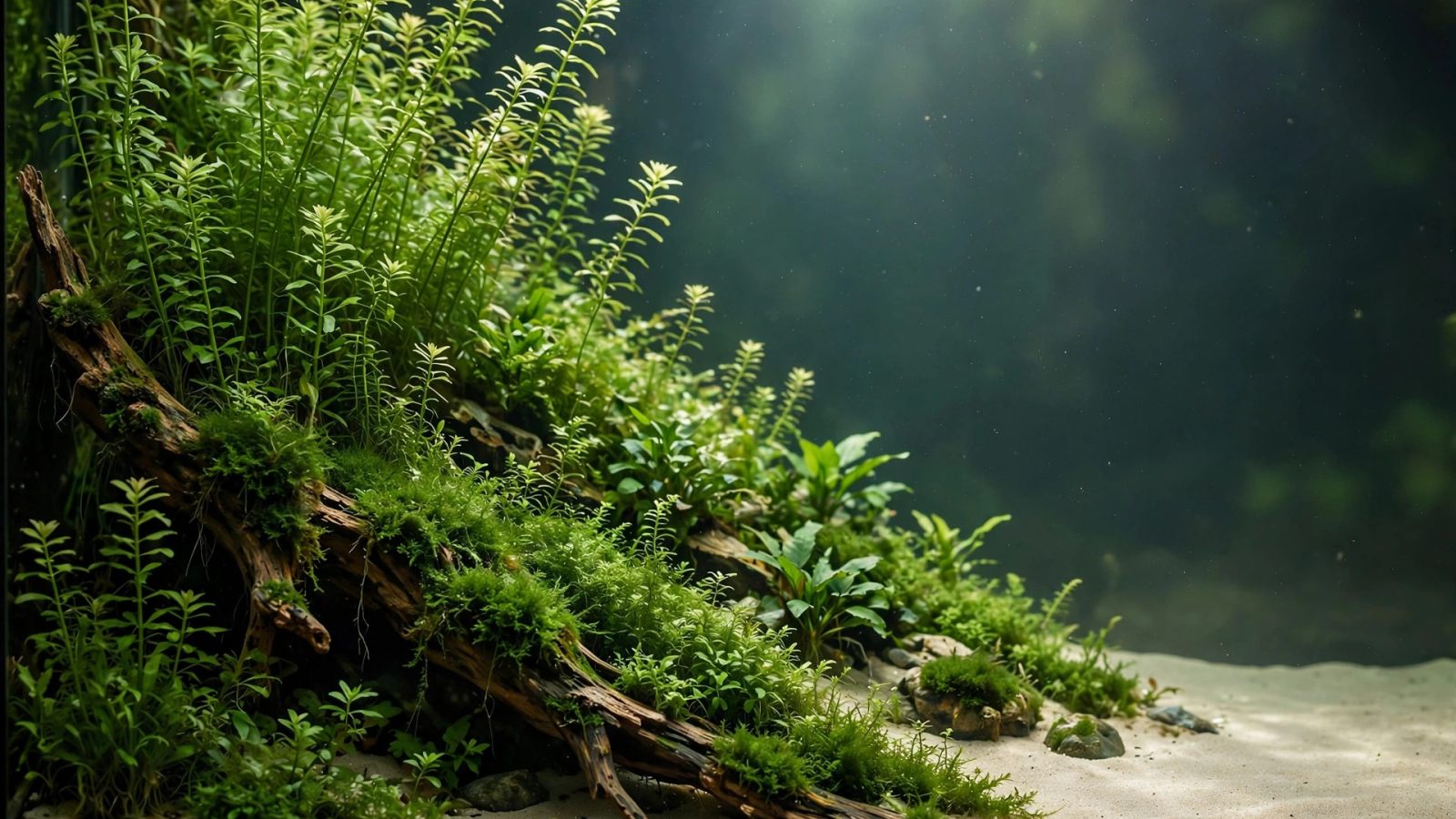
Triangle composition aquascaping is the workhorse layout of the nature style: plants and hardscape arranged in a rising wedge — low on one side, peaking off-center, then dropping away. It’s more forgiving than iwagumi, less demanding than Dutch, and it photographs beautifully. If you want one versatile layout formula that works in almost any tank, learn the triangle.
What Is Triangle Composition?
Viewed from the front, the layout forms a right triangle: the tall side (the “apex”) sits at roughly the one-third or two-thirds mark, plant height slopes down toward the opposite side, and the substrate follows the same diagonal. The eye enters at the low side, travels up the slope, and rests at the apex — a built-in visual journey that makes the tank feel deep and intentional.
The triangle is one of three classic nature-style geometries, alongside the island (peak in the middle, open space around — see island-style setup) and the concave/U-shape (high on both sides, low center). Triangle suits tanks viewed mainly from the front; island suits peninsula and room-divider tanks.
Why the Triangle Works
- Built-in focal point. The apex is the focal point — place it on a rule-of-thirds line and composition is half done.
- Natural depth. The diagonal slope is forced perspective; the tank reads deeper than its glass. See depth techniques.
- Forgiving planting. Unlike iwagumi‘s single carpet or Dutch‘s strict streets, the triangle accommodates a natural mix of species at different heights.
- Scales to any tank. Works in 5-gallon nanos (mini triangle) and 100-gallon show tanks alike.
Building the Triangle: Step by Step
Step 1 — Choose the apex side
Decide whether the peak sits left or right of center. Either works; consider your room — the apex usually goes on the side away from the main viewing approach, so the slope “opens” toward the viewer. Mark the one-third line on the front glass with tape.
Step 2 — Place the apex hardscape
Set your tallest wood or stone at the apex mark. In wood-based triangles, a single dramatic branching root or trunk rising two-thirds of the tank height is the classic anchor. In rock triangles, stack or choose a tall stone group. The apex hardscape should be unambiguously the tallest element — no competitors.
Angle secondary hardscape pieces so they lean toward the apex, reinforcing the diagonal flow. Everything points uphill.
Step 3 — Sculpt the diagonal substrate
Substrate follows the triangle: deep under the apex (10–15 cm), shallow at the low side (2–4 cm), sloping along the diagonal — not just front-to-back but side-to-side. Use supports under the deep end. This diagonal grade is what sells the composition; a flat substrate with tall plants on one side looks like plants piled in a corner, not a landscape.
Step 4 — Plant in height zones
- Apex zone: tall background stems (Rotala, Limnophila) or large epiphytes on the apex wood (Java fern ‘Trident’, Bolbitis). Height here: surface-reaching.
- Slope zone: mid-height plants stepping down — Hygrophila, Ludwigia, crypts, Anubias on midground stones. Each step 5–10 cm lower than the last.
- Low zone: carpet or low foreground (Monte Carlo, dwarf hairgrass, Marsilea) sweeping across the open side. This negative space balances the apex mass — don’t fill it.
Keep the slope clean and readable: if midground plants blur the diagonal into a blob, thin them until the wedge shape reappears. Step back and squint — you should see a clear triangle silhouette.
Step 5 — Detail the transitions
Where hardscape meets plants, tuck in transition plants: moss on the apex wood base, Anubias ‘Petite’ in rock crevices, a crypt cluster softening the substrate-to-hardscape line. These details hide the “placed” look and make the triangle feel grown, not built. Our guides to attaching plants to driftwood and attaching plants to rocks cover the techniques.
Plant Selection for Triangles
The triangle needs reliable height-graduated plants:
- Apex height: Rotala rotundifolia, Limnophila sessiliflora, Hygrophila corymbosa, Vallisneria (tall tanks)
- Mid-slope: Ludwigia repens, Hygrophila polysperma, Cryptocoryne wendtii, Java fern on wood
- Low sweep: Monte Carlo, Eleocharis parvula, Staurogyne repens, Marsilea hirsuta
- Accents: Bucephalandra on hardscape, red Alternanthera reineckii ‘Mini’ as a mid-slope color pop, mosses on wood
One color accent on the slope — a red or orange cluster at the two-thirds point — gives the eye a second stop after the apex. Two accents compete; one complements.
Maintenance: Keeping the Wedge Sharp
- Trim the slope, not just the tops. The diagonal silhouette needs edging — when mid-slope plants blur the line, thin from the front face of each step.
- Protect the low zone. Runners invading the open foreground get pulled; the negative space is structural.
- Re-plant apex tops. Tall stems get leggy — top and replant every few weeks to keep the apex dense rather than stringy.
- Vacuum the open side. The low zone collects detritus; a gentle vac during water changes keeps it clean without disturbing the carpet.
Triangle Mistakes
- Apex dead-center. A centered peak makes a pyramid, not a triangle — static and unnatural. One-third mark.
- Flat substrate, tall plants. Without the diagonal grade, it’s just plants in a corner.
- Filling the low zone. The open sweep balances the apex; planting it full collapses the composition.
- Two competing peaks. One apex. Secondary hardscape stays clearly subordinate.
- Blurred slope. If the squint test shows a blob instead of a wedge, thin the midground until the diagonal reads again.
For the broader error list, see 11 aquascaping mistakes beginners make.
Frequently Asked Questions
What is triangle composition in aquascaping?
A layout where plants and hardscape form a rising wedge — low on one side, peaking at an off-center apex. It’s the most versatile nature-style geometry.
Is triangle composition good for beginners?
Yes — it’s the recommended first “designed” layout. More forgiving than iwagumi, less work than Dutch, and it teaches focal placement, depth, and height graduation in one project.
Triangle vs island aquascape — which should I choose?
Triangle for front-viewed tanks; island for peninsula or multi-sided viewing. Triangle is slightly easier to plant and maintain.
Advanced Triangle Variations
The double triangle (valley)
Two triangles facing each other, peaks at opposite thirds, with a low valley between — essentially the concave/U-shape layout. More dramatic than a single triangle, twice the planting discipline. The valley becomes a natural vanishing path leading deep into the tank.
The emergent triangle
Let the apex break the surface — emergent growth (Hygrophila, peace lilies, pothos roots) rising above the waterline at the peak. The triangle extends beyond the glass, and the emergent growth’s shadows add drama. Needs an open-top tank and humidity-tolerant species.
The red triangle
Build the entire slope from red/orange plants (Ludwigia super red, Alternanthera, Rotala H’ra) against a green foreground. Maximum color impact — a Dutch color sensibility in a nature-style geometry. Demands high light and CO2 to hold the reds.
The moss triangle
An all-epiphyte triangle: moss-covered wood forming the slope, Anubias and Bucephalandra as the “plants,” no stems at all. Slow (6+ months to mature) but nearly maintenance-free once established — the triangle for the patient.
Triangle Composition Checklist
- Apex at the one-third or two-thirds mark — never centered
- Apex hardscape unambiguously tallest — no rivals
- Substrate graded diagonally: deep under apex, shallow at the low side
- Three height zones planted: tall apex, stepping mid-slope, low open sweep
- Secondary hardscape leaning toward the apex
- One color accent maximum on the slope
- Transition plants softening hardscape-to-substrate lines
- Low zone protected — runners pulled, detritus vacuumed
- Squint test: clear wedge silhouette, not a blob
- Photo test monthly during grow-in
How Long Until a Triangle Looks Finished?
Triangles mature faster than most styles — the stem-heavy planting fills quickly. Expect 6–10 weeks for the slope to read clearly, 3 months for full maturity. The apex stems need the most patience; everything else outruns them. For the complete timeline picture, see how long aquascapes take to fill in.
Triangle Hardscape Selection
The triangle’s hardscape carries more compositional weight than in most styles — it defines the apex. Choose with care:
- Driftwood triangles: one primary root or trunk with character — twisting grain, branches reaching along the slope direction. Spider wood and redmoor root are ideal; their branching naturally suggests the diagonal flow. Avoid stubby, blobby wood — the apex needs vertical presence.
- Rock triangles: a tall stone group at the apex — either one dramatic spire or 3–5 stacked stones forming a peak. Dragon stone stacks well; seiryu gives the classic look. The iwagumi stone roles (oyaishi → soeishi) apply here too, just arranged on the diagonal.
- Mixed hardscape: wood + stone is allowed in nature-style triangles (unlike strict iwagumi). The rule: one material dominates. A wood apex with stone supports, or a stone apex with wood accents — never 50/50, which reads as indecisive.
Size the apex hardscape to the tank: roughly 60–70% of the tank’s height. Shorter and the triangle’s peak feels apologetic; taller and it crowds the surface. And always check the silhouette from the side — a beautiful front view with an awkward profile disappoints every time you walk past the tank.
Lighting a Triangle for Maximum Effect
- Peak illumination: the apex should catch the most light — it’s the star. If using twin fixtures or adjustable LEDs, bias intensity slightly toward the apex side.
- Foreground restraint: the low open zone needs less light; too much grows algae on the exposed substrate. The natural light falloff from a centered fixture usually handles this — another reason to center the light, not the hardscape.
- Shadow as design: the apex hardscape casts shadows down the slope — this is desirable. Dappled light on the mid-slope adds the naturalism the style aims for. Don’t “fix” it with extra lighting; it’s a feature.
Triangle FAQs: Extended
Can a triangle aquascape work in a cube tank?
Yes, but the diagonal reads best with some horizontal length. In cubes, build the triangle front-to-back instead of left-to-right: tall background corner sloping down toward the front glass. The depth techniques in our depth guide help sell it.
How many plant species in a triangle?
5–9 is the sweet spot — enough for the height graduation and texture variety, few enough to stay readable. More than 12 and the slope’s clean lines dissolve into noise.
Triangle vs. Dutch — which is easier?
Triangle, by a wide margin. Dutch demands strict streets, weekly trimming, and high-tech throughout. Triangle tolerates mixed plantings, monthly maintenance, and works low-tech with the right species. Learn triangle first; attempt Dutch when the maintenance discipline is already habit.
Where should fish swim in a triangle tank?
The open low zone is the natural swimming space — and that’s by design. A school crossing the open foreground against the planted slope is the triangle’s signature living picture. Leave that space open; don’t fill it with “just one more plant.”