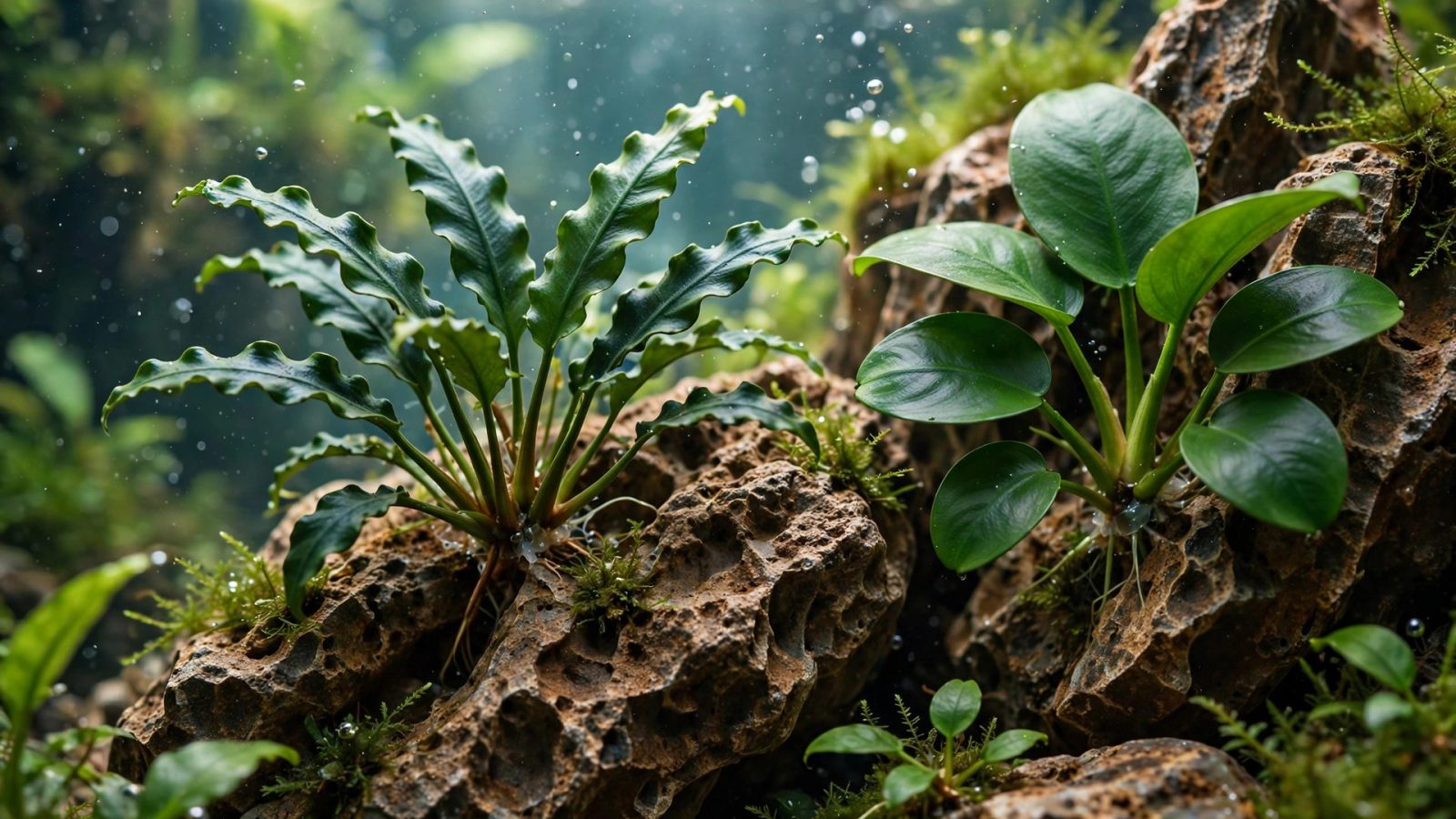
Attaching aquarium plants to rocks uses the same three methods as driftwood — glue, thread, and wedge — but rock brings its own quirks: smooth stone rejects glue, porous stone drinks it, and the wrong rock choice shifts your water chemistry. This guide covers the rock-specific technique so your Anubias, Java fern, Bucephalandra, and mosses grip stone and stay put.
If you haven’t read it yet, start with how to attach aquarium plants to driftwood — the core methods are explained there in full. Below is what’s different about rock.
Which Rocks Work Best for Plant Attachment?
- Dragon stone (Ohko): the best plant rock — full of holes and crevices that grip roots and hide glue. pH-neutral.
- Lava rock: extremely porous; roots and moss colonize it aggressively. Lightweight but rough-textured.
- Seiryu stone: beautiful, but smoother — glue works, wedging is harder. Note it raises GH/KH/pH; test water after adding.
- Slate / flat river stone: smooth surfaces are the hardest to attach to — rely on glue, not wedging.
Rule of thumb: the rougher the rock, the easier the attachment. Porous rock gives roots something to invade; glassy-smooth rock gives them nothing.
Glue on Rock: Rock-Specific Tips
- Dry the spot thoroughly. Rock holds surface water in its pores — blot aggressively with paper towels, or the glue skins over without bonding.
- Use more glue than on wood. Porous rock wicks gel into its pores; a pea-sized blob can vanish. Apply, wait 10 seconds, apply a second small blob, then press the plant.
- Fill crevices first. On dragon stone, push a little glue into a hole, then seat the rhizome into the filled hole — the mechanical lock plus the bond is bombproof.
- For moss on rock: spread the moss thin, then dot with glue every 2 cm. On lava rock you can skip glue entirely — press moss into the pores and it colonizes on its own within weeks.
- White residue shows more on dark rock. Use the minimum effective amount, and place attachments on the rock’s shaded sides where residue is less visible until plants cover it.
Thread on Rock
Thread works on rock but with a catch: you can’t always loop all the way around a large stone. Solutions:
- Wrap around smaller stones completely, as with wood.
- On large rocks, run thread through natural holes (dragon stone is full of them) and tie off.
- Use the thread as a temporary clamp: wrap plant-to-rock, then remove once roots grip (6–8 weeks).
- Dark green or black thread disappears against most rock; avoid white thread.
Wedge Into Crevices
Rock wedging is the most natural method where the stone allows it. Dragon stone and lava rock are ideal — press rhizome sections and moss tufts directly into holes and cracks. The plant’s own root growth locks it in within weeks. On smooth seiryu or slate, don’t bother — use glue.
Design Tips: Plants on Rock
- Match plant to stone character. Fine moss and Bucephalandra suit craggy dragon stone; bold Anubias barteri suits massive seiryu.
- Plant the crevices, not just the tops. Moss and Anubias ‘Petite’ tucked into vertical crevices make rock look ancient and colonized — the signature iwagumi aging effect.
- Keep the oyaishi readable. In rock-focused layouts, don’t bury your master stone under plants — accent the secondary stones and leave the star mostly clean.
- Consider the chemistry. Attaching acid-loving plants (Bucephalandra, some mosses) to carbonate-leaching seiryu is a mismatch — the rock fights the plant’s preferences. Pair accordingly.
Frequently Asked Questions
What glue is safe to attach plants to rocks?
Cyanoacrylate gel (plain super glue gel). It’s inert once cured and the standard choice for both rock and wood.
Will Java fern grow on rocks?
Yes — Java fern is an epiphyte and grows on any stable surface. See our Java Fern care guide for the full picture.
How do you attach moss to rocks without glue?
Press thin layers into the pores of lava rock or the holes of dragon stone — no glue needed. Keep flow gentle until it anchors (6–10 weeks).
Step-by-Step: Planting a Rock-Focused Scape
Example: dragon stone ridge with moss and Anubias
- Dry-layout the stones in the empty tank. Photograph from all sides; adjust until the ridge reads naturally.
- Remove the stones and work on them at the table — much easier than reaching into the tank.
- Blot each attachment spot dry with paper towels.
- Moss first: press thin Java or Christmas moss into the dragon stone holes. No glue needed on porous stone — just press firmly. Work from the top down so falling debris doesn’t land on finished sections.
- Anubias ‘Petite’ next: pea-sized glue blob in a crevice, press the rhizome in, hold 20 seconds. Place 3–5 rhizomes per medium stone, on shaded faces.
- Bucephalandra accents: one or two rhizome sections per stone, glued into vertical crevices where they’ll catch side light.
- Mist everything with dechlorinated water, cover with damp paper towels if there’s a delay before planting.
- Set stones into the substrate (one-third buried), plant the carpet around them, and flood.
Rock + Plant Combinations That Work
- Seiryu + Anubias barteri + moss: the classic iwagumi-aging combo — bold stone softened by dark green.
- Dragon stone + Bucephalandra + Anubias ‘Petite’: texture heaven — pitted stone against varied small leaves.
- Lava rock + Java moss + Java fern ‘Needle Leaf’: the budget natural look; lava’s porosity does half the work.
- Slate ledges + Hydrocotyle tripartita: the creeping Hydrocotyle spills over flat slate beautifully.
- Grey mountain stone + Fissidens moss: refined and calm — Fissidens’ tiny fronds suit smooth stone.
Long-Term: What Happens as Plants Mature on Rock
- Months 1–2: glue residue fades; roots visibly enter pores and crevices. Moss looks patchy — normal.
- Months 3–4: rhizomes thicken and lock mechanically into crevices. Thread (if used) can come off now.
- Months 6+: the plant-rock boundary disappears — moss carpets the stone, Anubias roots wrap it. The stone looks colonized, not decorated. This is the payoff.
- Year 1+: mature epiphytes may need dividing — a Bucephalandra clump can be split with a sharp blade, each section re-glued. Free plants from your rock garden.
Maintenance is minimal: brush algae off exposed stone during water changes, trim moss before it gets thick enough to trap debris, and divide overgrown rhizomes before they lever themselves off the rock. A planted rock scape is one of the lowest-maintenance layouts in the hobby once established — which is exactly why iwagumi and rock-focused nature styles reward the initial attachment effort so well.
Rock Chemistry and Plant Compatibility
The rock you attach to affects the water around the plant — and some pairings fight each other:
- Seiryu stone leaches carbonates (raises GH, KH, pH). Avoid pairing with soft-water lovers like Bucephalandra and delicate mosses if your tap water is already hard — the combined effect can push parameters past their comfort zone. In soft tap water areas, the leaching is milder and usually fine.
- Dragon stone, lava rock, slate: effectively inert. Pair with anything.
- Test, don’t guess: put the rock in a bucket of your tap water for a week, test GH/KH/pH before and after. A significant shift means the rock is active — plan livestock and plants accordingly.
Preparing Rock for Planting
- Scrub hard with a stiff brush under running water. Quarried stone carries dust and sometimes clay in its pores — planted tanks show every bit of it as cloudy water.
- Inspect for metal. Occasionally rocks contain metallic veins (pyrite, etc.) that leach iron or worse. Unusual metallic streaks or rust staining = don’t use it.
- Break safely if reshaping: wrap in a towel, score with a chisel, controlled taps — never bare-handed hammering. Wear eye protection; stone shards are no joke.
- Test stability in the final arrangement before planting — a rock that shifts after plants attach tears roots and ruins the work.
- Pre-wet porous rock before gluing day — paradoxically, slightly damp (not dripping) porous stone bonds better than bone-dry, which wicks glue too fast.
When Attachments Fail: Recovery
- Plant detached but healthy: re-glue to a better spot — rougher surface, deeper crevice. Second attempts usually hold; you know the failure mode now.
- Rhizome damaged: trim mushy sections with a clean blade, keep firm green parts, reattach. Rhizomes are resilient — a 2 cm firm section regrows.
- Moss sloughed off: the layer was too thick or flow too strong. Reapply thinner, in a sheltered spot, and reduce direct flow for a month.
- Algae overran the attachment: remove the plant, gently brush or dip (hydrogen peroxide dip for hardy rhizomes), fix the light/nutrient cause, reattach.
Failed attachments are tuition, not tragedy. Every experienced scaper has a graveyard of floated Anubias behind them — the skill is in the retry, informed by what went wrong.
Quick Answers: Rock Attachment
Can you use hot glue instead of super glue?
No — hot glue softens in warm aquarium water and releases over weeks. Cyanoacrylate is the only glue for the job.
How long does super glue last underwater?
The bond itself is permanent, but its job is temporary: within 2–3 months, roots and rhizome growth mechanically lock the plant to the rock, and the glue becomes irrelevant. Think of it as a clamp, not a weld.
Should you quarantine rocks before planting?
A good scrub is usually enough for quarried aquarium stone. Wild-collected rock deserves a bleach dip (1:20, then thorough dechlorinated rinsing and a week of soaking) to kill hitchhikers and algae spores before it meets your plants.