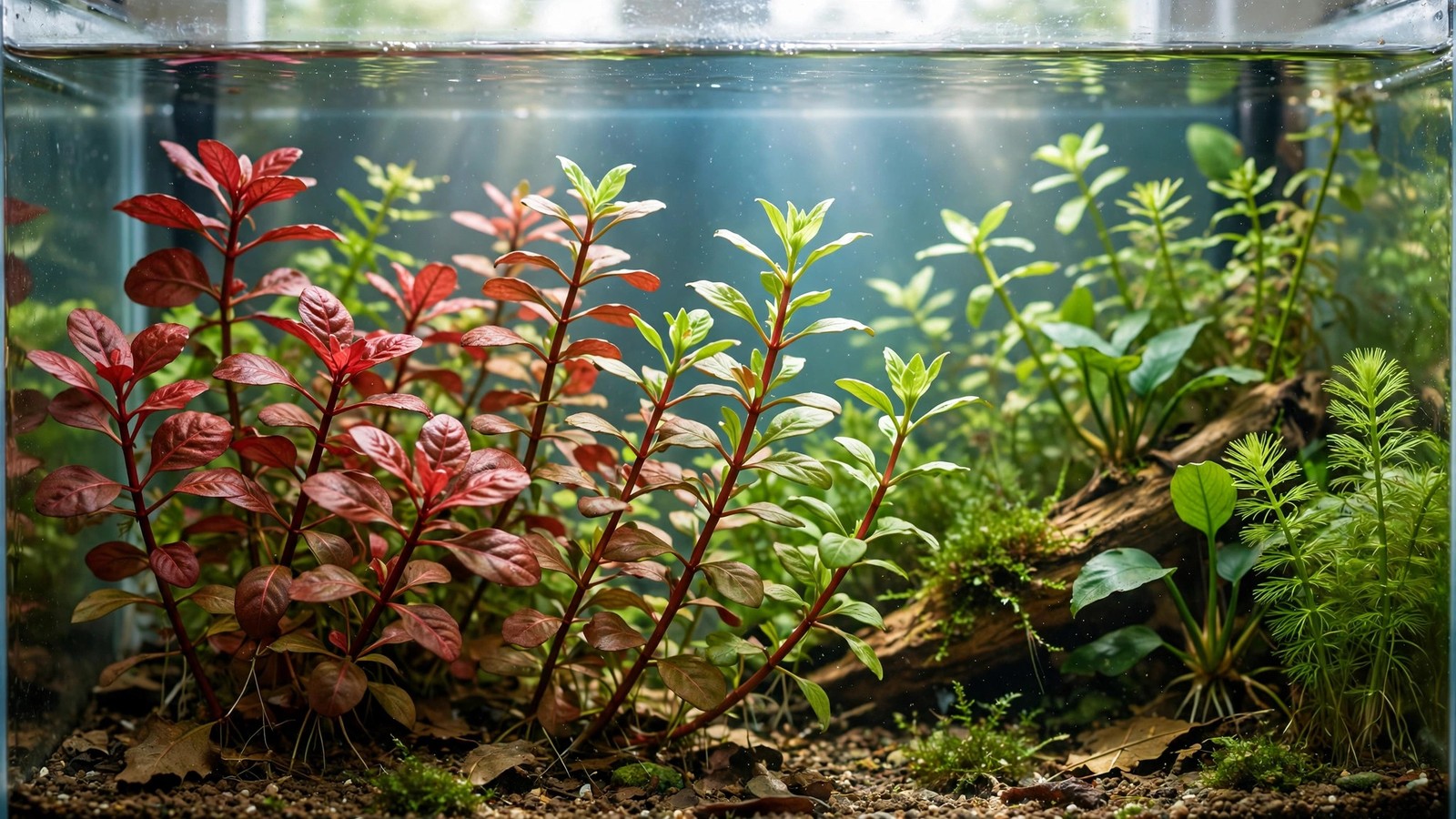
You bought that flaming red ludwigia, planted it with dreams of a crimson aquascape — and three months later it's stubbornly, relentlessly green. Or your rotala was ruby red at the store and faded to olive in your tank. Red plants losing color is the most aesthetically frustrating problem in the hobby: the plant is healthy, growing fine, just the wrong color. The good news: red coloration is controllable. It's driven by specific, adjustable factors — and "more iron," the standard advice, is only a small part of the story.
Why Plants Turn Red (The Science in Brief)
Red coloration comes from anthocyanins — pigments plants produce as sunscreen and stress response. In bright light, plants manufacture anthocyanins to shield their photosynthetic machinery from excess light energy, the same way human skin produces melanin. This is the key insight: red is a stress response to high light, not a sign of luxury.
Additional factors modulate anthocyanin production:
- Light intensity and spectrum — the primary driver. Strong light, especially with red/blue peaks, triggers the most anthocyanin.
- Nitrate limitation — low (not zero) nitrates intensify reds. Nitrogen-starved plants produce more anthocyanin relative to chlorophyll.
- CO2 availability — adequate carbon fuels the metabolic processes that build pigments.
- Iron — supports pigment machinery, but doesn't create redness alone.
- Temperature — cooler water (22–24°C / 72–75°F) often intensifies reds; warm tanks trend greener.
- Genetics — some "red" plants are only red under ideal conditions; true red varieties (ludwigia super red, rotala macrandra) hold color more readily.
The Color Hierarchy: What Matters Most
Ranked by impact on red coloration:
1. Light intensity (dominant factor)
Nothing reddens plants like strong light. The same rotala that's green under medium light turns pink-red under high light — same fertilizer, same CO2, just photons. If your red plants are green, light is the first variable to address:
- Increase intensity if dimmable, or upgrade the fixture.
- Ensure red plants get direct, unshaded light — not tucked behind hardscape or under floaters.
- Full-spectrum lights with strong red output render and promote reds best.
- Photoperiod matters less than intensity — 8 hours of strong light beats 12 hours of weak.
2. Nitrate levels (the lever)
Lean nitrates (5–10 ppm) intensify reds; rich nitrates (20+ ppm) push plants green and lush. This is the most adjustable factor:
- If nitrates run high (heavy stocking, rich dosing), reds fade toward green.
- Reducing nitrogen dosing — while maintaining other nutrients — shifts the balance toward red.
- Don't go to zero — nitrogen deficiency causes its own problems (see our nitrogen deficiency guide). The sweet spot for color is low but detectable: 5–10 ppm.
- This is why heavily stocked tanks struggle with reds — fish supply abundant nitrogen, keeping plants green.
3. CO2 (the enabler)
CO2 doesn't directly create red, but carbon-starved plants can't produce anthocyanins efficiently. Stable, adequate CO2 (drop checker lime-green) is the foundation that lets light and nitrate limitation express as color. A high-light, low-nitrate tank with poor CO2 grows stressed green plants, not red ones — plus algae. See our CO2 deficiency signs.
4. Iron (the supporter)
Iron supports pigment production but doesn't drive it. An iron-deficient red plant goes pale (see our iron deficiency guide); an iron-sufficient plant in dim light with high nitrates stays green. Dose adequate iron (0.1–0.5 ppm) as baseline nutrition, then look to light and nitrates for actual color change. The "dose iron for reds" advice works only when iron was the limiting factor — usually it isn't.
5. Temperature and genetics
- Cooler water (22–24°C) tends to intensify reds; tanks running 27°C+ trend green. If your heater runs hot, try dropping a degree or two (within livestock comfort).
- Variety selection matters enormously: Ludwigia sp. 'Super Red' stays red in moderate conditions that turn regular ludwigia repens green. When buying, choose varieties bred for color, not just species with red potential.
The Red Plant Protocol: Step by Step
- Maximize light on the red plants — reposition to the brightest zone, remove shading, increase intensity. This is step one, always.
- Stabilize CO2 — lime-green drop checker, consistent daily. No fluctuations.
- Lean out nitrates — target 5–10 ppm. Reduce nitrogen dosing or fish load slightly; don't crash to zero.
- Maintain other nutrients — potassium, phosphate, micros at normal levels. Lean nitrogen, not everything (starved plants don't color up, they just suffer).
- Ensure adequate iron — baseline 0.1–0.5 ppm, but don't megadose expecting miracles.
- Trim and replant tops — new growth under improved conditions colors up; old green growth rarely converts. Cut the reddest tops and replant them (see our replant technique).
- Wait 3–4 weeks — color change happens in new growth, not existing leaves. Judge by the newest foliage.
Species Guide: Red Potential Ranked
| Plant | Red ease | What it needs |
|---|---|---|
| Ludwigia sp. 'Super Red' | Easy | Red in medium+ light; very forgiving |
| Rotala rotundifolia | Easy–Medium | Pinks up under good light; orange-red with lean nitrates |
| Alternanthera reineckii | Medium | Needs good light + CO2; pink undersides even when tops are green |
| Ludwigia palustris 'Super Red' | Medium | Strong light for deep red; goes green-orange in medium light |
| Rotala macrandra | Hard | High light + CO2 + lean nitrates + soft water; spectacular but demanding |
| Ammannia gracilis | Hard | Similar demands to macrandra; golden-red when happy |
| Red tiger lotus | Easy | Red leaves with minimal demands; the beginner's red plant |
Common Color Myths, Debunked
- "More iron = more red." Only if iron was deficient. Beyond adequacy, extra iron grows thread algae (see our thread algae guide), not redder plants.
- "Red plants need special red fertilizer." Marketing. They need the same nutrients as green plants, in slightly leaner nitrogen ratios.
- "My red plant is dying because it's green." No — green growth on a red species is healthy growth in suboptimal color conditions. The plant is fine; the conditions need tuning. Worry about color only after health is confirmed.
- "Old leaves turning green means failure." Normal — anthocyanins concentrate in new growth; older leaves naturally green with age. Judge color by the growing tips, not the lower foliage.
When Green Is the Right Answer
Honest assessment: not every tank should chase reds. Deep red coloration demands high light, lean nitrates, and stable CO2 — a combination that also demands rigorous algae management and precise dosing. In a low-tech tank, a healthy green ludwigia is a greater achievement than a struggling red one. There's no shame in growing gorgeous greens; the red chase is optional aesthetics, not a health metric. Choose the goal that matches the tank you actually maintain, not the tank in the contest photo.
Frequently Asked Questions
Why was my plant red at the store but green in my tank?
Stores and farms grow red plants under intense light with lean nutrients — ideal color conditions. Your tank likely has less light and richer nitrates (from fish), so the plant reverts to green. It's adapting correctly to your conditions. To recover the red: increase light on that plant, lean out nitrates to 5–10 ppm, ensure CO2 is stable — then wait for new growth, which will color up under the improved regime.
How long does it take for red color to develop?
3–6 weeks after conditions improve — and only in new growth. Existing green leaves rarely turn red; the plant produces new, anthocyanin-rich foliage from the growing tips. Trim and replant the tops once new growth shows color to accelerate the transformation. If nothing changes after two months of improved light and lean nitrates, the species may simply need more than your setup provides — consider an easier red variety.
Can I get red plants without CO2 injection?
Yes, with caveats. Ludwigia 'Super Red', red tiger lotus, and rotala rotundifolia all show respectable red/pink coloration in low-tech tanks with strong light and lean nitrates. You won't achieve contest-level crimson without CO2, but you'll get genuinely attractive reds. The low-tech red formula: easy red species + high light + 5–10 ppm nitrates + patience. Skip the demanding species (macrandra, ammannia) without CO2 — they'll just be green and leggy.
Do red plants need different fertilizer?
No — they need the same complete fertilizer with less nitrogen. The practical approach: dose your normal all-in-one at slightly reduced strength, or switch to a "lean nitrogen" dosing scheme while keeping potassium, phosphate, and micros adequate. What red plants don't need: iron megadoses, "color-enhancing" specialty products, or any bottle promising red in a week. Light and nitrate management outperform every product.
Why are only the tops of my red plants red?
Because the tops get the most light — and light drives anthocyanin. Lower leaves, shaded by the canopy above, stay green. This is completely normal and actually diagnostic: it confirms light is your color driver. If you want fuller red coverage, thin the planting so light penetrates deeper, and trim regularly to keep the colored tops as the visible mass. The red-top/green-bottom gradient is how these plants naturally grow.
Paint with Light, Shade with Nitrates
Red plants aren't mysterious — they're sun-stressed plants, and you control the sun. Strong light for the anthocyanin, lean nitrates to intensify it, stable CO2 to fuel it, adequate iron as baseline, and the patience to judge by new growth. Get the hierarchy right — light first, nitrates second, everything else supporting — and the green ludwigia becomes the crimson centerpiece you bought it to be.
Tissue-culture plants are the exception — they’re grown in sterile gel and adapt with minimal melting, which is part of what you’re paying for. Plants bought submersed from another hobbyist’s tank also transition with little melt, since they’re already in the right form.
Which Plants Melt Most (and Least)
Heavy melters (expect significant leaf loss)
- Cryptocorynes — infamous for “crypt melt,” sometimes dropping every leaf after any disturbance. They almost always recover from the roots within weeks.
- Stem plants grown emersed — rotala, ludwigia, and hygrophila often shed lower emersed leaves while the growing tips transition.
- Amazon swords — emersed-grown swords typically lose their broad oval aerial leaves and replace them with longer submersed ribbon leaves.
Light melters
- Anubias, java fern, bucephalandra — slow-growing rhizome plants transition gradually; occasional old-leaf melt but rarely dramatic.
- Vallisneria — usually transitions well, though it dislikes the move itself and may sulk for a week.
- Floating plants — minimal melt since their leaves were already at the air-water interface.
The Acclimation Protocol
Step 1: Quarantine or dip first
Before acclimating to your tank’s conditions, make sure you’re not acclimating pests along with the plant. Run new arrivals through our quarantine and dip protocol — it adds days upfront but prevents months of regret.
Step 2: Float to temperature-match (30 minutes)
Float the bag or container in your tank for 20–30 minutes to equalize temperature. Plants are less temperature-sensitive than fish, but a 10°F shock on top of transplant stress is an avoidable insult.
Step 3: Trim before planting
Remove any leaves that are already damaged, yellowing, or heavily algae-covered — they won’t recover and they’ll rot in your tank, feeding algae. For stem plants, trim off the bottom inch and any emersed leaves that look unlikely to adapt; the plant wastes energy maintaining leaves it’s going to shed anyway. Keep the healthy growing tips — that’s where recovery starts.
Step 4: Plant correctly the first time
Follow our planting guide — right depth, crown exposed on rosettes, rhizomes unburied on epiphytes. Every uprooting and replanting restarts the acclimation clock, so get placement right on the first attempt. Decide where each plant goes before it goes in the water.
Step 5: Run a gentle first week
For the first 7 days after planting:
- Moderate light — run your normal photoperiod but consider dropping intensity 20–30% if your light is dimmable. Blast-level light on a melting plant grows algae on the dying leaves, not recovery.
- Stable CO2 — if you inject CO2, keep it consistent. Fluctuating CO2 during acclimation is a melt accelerator. If you’re low-tech, this doesn’t apply — see growing without CO2.
- Half-strength fertilizer — new plants with damaged leaves can’t use full dosing, and the excess feeds algae. Ramp to full strength over 2–3 weeks per our fertilizer schedule.
- No disturbance — don’t move, trim, or “check on” new plants for at least two weeks. Every touch resets root establishment. This is especially critical for crypts.
Step 6: Remove melt, keep the base
As emersed leaves melt, remove the mushy material promptly — decaying leaves release ammonia and grow fungus that can spread to healthy tissue. But never discard the plant while the crown, rhizome, or roots are firm and alive. A crypt that’s lost every leaf but has firm roots is a plant that’s about to recover, not a dead plant. Give it 3–4 weeks before judging.
Telling Normal Melt From Real Problems
Normal transition melt:
- Affects oldest/emersed leaves first, newest growth last
- New submersed leaves emerge even as old ones dissolve
- Roots and crown stay firm and white/green
- Timeline: 1–4 weeks, then obvious new growth
Concerning melt (see our full melting diagnosis guide):
- New growth also melts or emerges deformed
- Rhizome or crown turns mushy and brown — this is rot, not transition
- Entire plant dissolves within days with no new growth after 4+ weeks
- Melting spreads to established plants that weren’t recently moved
Buying Tips to Minimize Melt
- Buy submersed-grown when available — hobbyist-grown cuttings transition with almost no melt.
- Choose tissue culture for sensitive species — crypts and delicate stems establish far more reliably from sterile cups.
- Avoid plants already melting in the store tank — some melt is normal, but a plant that’s mostly mush at purchase has less energy for recovery.
- Transport carefully — keep plants damp and out of direct sun/heat. A plant that dries out or cooks in a hot car melts far worse than one transported properly.
The First-Month Timeline: What to Expect Week by Week
Knowing what’s normal when removes most acclimation anxiety. Here’s the typical timeline for a healthy plant adapting to a new tank:
Week 1: The quiet week
Almost nothing visible happens. The plant is growing roots you can’t see and assessing its new environment. Some species (vallisneria, stem plants) may start shedding their lowest leaves. This is normal. Resist the urge to “help” — no moving, no extra fertilizer, no light changes. The most common beginner mistake is intervening during a week when the correct action is nothing.
Week 2: Melt peaks
This is when emersed leaves give up in earnest. Crypts may drop everything; swords shed their broad aerial leaves; stem plants lose lower foliage. It looks catastrophic and it’s usually fine. Keep removing mushy material, keep conditions stable, and watch the crown and growing tips — if those are firm and green, recovery is already underway.
Week 3: The turn
New submersed-adapted leaves emerge — smaller, thinner, often a slightly different shade of green than the emersed foliage. Stem plant tips start growing visibly; crypts push tiny curled leaves from the crown; swords unfurl narrow ribbon leaves. This is the moment most beginners exhale for the first time.
Week 4+: Established
New growth outpaces melt, and the plant is functionally yours. You can resume full-strength fertilizer, normal trimming, and stop treating it as fragile. Some slow growers (anubias, bucephalandra) take 6–8 weeks to show obvious progress — that’s their normal speed, not a problem.
Acclimating Different Plant Formats
Tissue-culture cups
Sterile, pest-free, and already adapted to high-humidity (not emersed) growth — tissue cultures melt the least of any format. Rinse the agar gel off gently (leftover gel rots and feeds fungus), split the portion into small plantlets, and plant per our planting guide. They establish slowly for the first two weeks, then accelerate. No dip needed, minimal acclimation stress — this is the premium experience you’re paying for.
Potted plants
Remove the pot and strip away the rockwool completely — leftover rockwool traps debris and rots. Tease the root mass apart gently; if it’s a dense mat, splitting it into 2–3 smaller portions actually establishes faster than planting one big clump (more growing points, better water flow around roots). Potted plants are usually emersed-grown, so expect the standard 2–4 week melt cycle.
Bare-root / bunched stems
Typically sold as weighted bunches. Remove any bands, foam, or weights, strip the lower leaves, and plant stems individually or in small groups. Bunched stems from the store are often already transitioning — check for new submersed growth at the tips, which tells you the plant is mid-adaptation and will settle quickly.
Hobbyist cuttings
Already submersed-grown and the fastest to establish — often showing new growth within days. The main acclimation factor is water-parameter difference between the two tanks. Float to temperature-match, plant promptly, and they’ll usually take off with minimal melt. This is why experienced hobbyists prefer trading cuttings over buying potted plants.
Frequently Asked Questions
Should I use a “plant starter” or transplant fertilizer?
Products marketed for transplant shock are mostly B-vitamins and mild hormones. They don’t hurt, but there’s no strong evidence they help aquarium plants specifically. Stable conditions and patience outperform any bottle. Save the money for more plants.
My new plant melted completely — bare crown, no leaves. Is it dead?
Probably not, if the crown or rhizome is firm. Crypts and swords routinely lose 100% of their leaves and regrow from the base within a month. The test is firmness: firm and pale/green means alive; mushy and brown/black means rot. Give firm-but-leafless plants a full 4 weeks before declaring them dead.
Can I speed up acclimation with extra light or CO2?
No — and trying usually backfires. A melting plant can’t use extra light; the excess just grows algae on its dying leaves. Keep light moderate and CO2 stable (not boosted) during acclimation. Growth speed comes from the plant’s own adaptation timeline, which you can’t rush, only avoid delaying.
Should new plants go straight into my main display tank?
After quarantine/dipping, yes — there’s no benefit to a separate “growing-in” tank for most plants. They acclimate to your water fastest in the tank they’ll live in. The exception is very delicate species going into a tank with boisterous fish; give those a few weeks in a calm corner or breeder box first.
The Patience Rule
The single most important acclimation skill is restraint: plant it right, set gentle conditions, remove decay, and then leave it alone for a month. The hobbyists with the best plant growth aren’t doing something clever in week one — they’re simply not interfering in weeks two through four while the plants do what they’ve evolved to do. Melt looks like failure and feels like failure, but in most cases it’s the visible part of a plant successfully becoming yours.