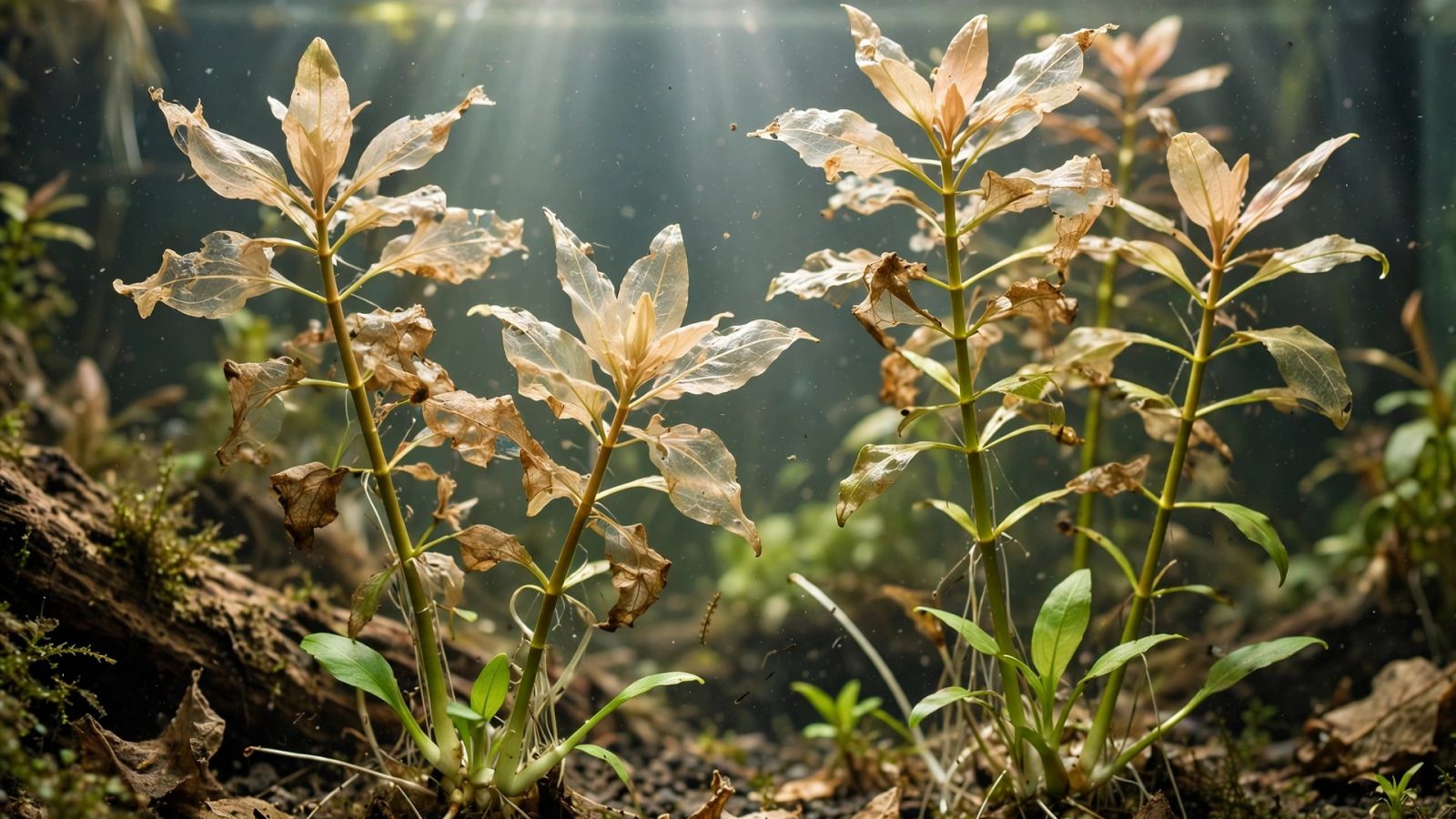
Watching new plants dissolve into mush days after planting is one of the most disheartening experiences in the hobby — and one of the most misunderstood. When hobbyists ask why are my aquarium plants melting, the answer is usually reassuring: most melting is a normal transition, not a dying plant. Commercially grown aquarium plants are raised with their leaves in the air, and when you submerge them, they shed those air-grown leaves and replace them with underwater-adapted ones. It looks like death. It is actually renovation.
That said, not all melting is harmless transition. This guide helps you tell the difference between normal emersed-to-submersed melt and the kind of melting that signals a real problem — and gives you a recovery protocol for each case.
What “Melting” Actually Means
Melting describes leaves turning soft, translucent, and jelly-like before disintegrating. It is different from yellowing (usually nutrient-related) and from browning (often diatoms or decay of already-dead tissue). True melt has a distinctive texture: the leaf loses its structure and feels slimy rather than crisp. If your leaves are yellowing but holding their shape, you are likely looking at a nutrient deficiency instead.
The Normal Kind: Emersed-to-Submersed Transition Melt
Most aquarium plants sold in pots or bunches are grown emersed — roots in water, leaves in humid air — because it is faster and cheaper for farms. Emersed leaves are thicker, often a different shape, and sometimes even a different color than the submerged form. Cryptocoryne is the famous example: emersed crypt leaves can look nothing like the submerged ones.
When you plant them underwater, the plant abandons the air-adapted leaves and grows new ones built for submerged life — thinner cuticles, different chloroplast arrangement, sometimes entirely different leaf shapes. The old leaves melt away as the new ones emerge. This is the plant working correctly.
How to recognize transition melt
- Timing: starts 3–14 days after planting, sometimes up to a month for slow species like crypts.
- Pattern: old leaves melt while tiny new leaves appear at the base or growing tip.
- The growing point survives: this is the critical sign. If the crown, rhizome, or stem tip is firm and alive, the plant will recover.
- Species known for it: Cryptocoryne (notorious “crypt melt”), swords, stem plants grown emersed, tissue-culture plants adjusting to your water.
What to do about transition melt
Mostly, nothing — but a few things help:
- Do not uproot the plant to “check” it. Every uprooting resets the adjustment clock. If the roots or rhizome are in place, leave them alone.
- Remove fully melted leaves promptly. Rotting foliage fouls the water and can trigger ammonia spikes that stress everything else.
- Keep conditions stable. Consistent light, no fertilizer experiments, no rescapes. Stability is what the plant needs while it rebuilds.
- Be patient on the timeline. Fast stem plants rebound in 2–3 weeks. Crypts can take 4–8 weeks to push confident new growth. The plant is not on your schedule.
Crypt Melt: The Special Case
Cryptocoryne deserves its own section because it melts more dramatically — and more often — than anything else. Crypts can melt all their leaves in response to almost any environmental change: planting, a big water change, a parameter swing, even moving the pot across the tank. Experienced keepers joke that crypts melt if you look at them wrong.
The reassuring part: the root system and rhizome almost always survive. A melted crypt with intact roots will regrow, often producing tougher leaves better suited to your specific water. The standard advice is to plant crypts and then pointedly ignore them for two months — no moving, no “checking,” no fussing. They reward neglect with some of the most beautiful foliage in the hobby.
When Melting Signals a Real Problem
Transition melt has the signature pattern above: new plant, old leaves melting, growing point alive. Suspect something else when:
Established plants start melting
A plant that has grown well for months and suddenly melts is not transitioning — something changed. Run through the recent history: new light? Rescape that disturbed the substrate? CO2 ran out? Big water-parameter swing? Established-plant melt is almost always a response to a recent change, and identifying the change is the diagnosis.
The growing point or rhizome is mushy
Check the crown, rhizome, or stem base. Firm and white/green means alive. Mushy, brown, and foul-smelling means rot — often rhizome rot from being buried too deep (common with anubias and Java fern) or from anaerobic substrate conditions. Rotted tissue will not recover; trim back to firm healthy tissue with sterile scissors. If the entire rhizome is mush, the plant is lost — remove it before it fouls the tank. Our guide to rotting aquarium plant roots covers the rescue protocol in detail.
Melting follows a water change
If plants melt within 24–48 hours of a water change, suspect the water itself: chlorine/chloramine from an under-dosed conditioner, a large temperature swing, or a sharp pH/KH shift. This is an acute shock response, not a deficiency. See plants dying after a water change for the full troubleshooting sequence.
Only the leaf tips or edges melt
Tip melt on otherwise healthy plants often points to a CO2 fluctuation (in injected tanks, often the CO2 running out or a solenoid issue) or to physical damage. If you run CO2, check the system first — it is the most common cause of sudden tip melt in high-tech tanks.
Tissue-Culture Plants: A Special Transition
Tissue-culture (in-vitro) plants come from sterile lab conditions — high humidity, no algae, no bacteria, perfect nutrients. Going from that to your tank is the biggest environmental jump any aquarium plant makes. Expect significant melt, sometimes most of the plantlet, over the first two to three weeks.
The payoff is worth it: tissue-culture plants are pest-free and algae-free, and the growth that emerges in your tank is fully adapted from day one. Plant them promptly (do not let the gel dry out), rinse the nutrient gel thoroughly, split the clump into small portions, and give them stable conditions. Do not judge them for a month.
The Recovery Protocol
Whether the melt is transition or problem-driven, the recovery steps are the same:
- Identify the type. New plant + firm growing point = transition. Established plant or mushy crown = problem; find the trigger.
- Remove dead tissue. Trim melted leaves at the base. Rotting organic matter feeds ammonia and algae.
- Stabilize. No changes to light, fertilizer, CO2, or scape until new growth is clearly established. Every change is a new adjustment the plant must make.
- Protect the survivors. If algae starts colonizing weakened plants, address it early — stressed plants are algae magnets. Reduce the photoperiod slightly (to 6 hours) while plants recover.
- Wait on the plant’s timeline. New submerged leaves on stem plants: 2–3 weeks. Crypts and swords: 4–8 weeks. Anubias and Java fern: new leaves are slow; judge by the rhizome staying firm and green.
Prevention: Buying and Planting to Minimize Melt
- Buy submerged-grown when you can. Plants already growing underwater in a shop tank skip the transition entirely. Ask the shop whether stock is emersed or submersed.
- Acclimate gently. Float the pots in your tank for an hour to equalize temperature before planting.
- Plant at the right depth. Crowns at the substrate surface, rhizomes above it. Buried rhizomes rot instead of transitioning.
- Start lean on light. New plants under blasting light with no established root system melt harder and grow algae faster. Start at 6 hours and increase as growth resumes.
- Do not fertilize aggressively on day one. A transitioning plant cannot use much fertilizer; the algae can. Start at half dose and ramp up with new growth.
Frequently Asked Questions
Should I remove a melting plant or leave it?
Leave it if the growing point, rhizome, or roots are firm and alive — remove only the melted leaves. Remove the whole plant only if the crown/rhizome is mushy and foul-smelling throughout.
How long does transition melt last?
Fast stem plants: 2–4 weeks. Crypts, swords, and rhizome plants: 4–8 weeks. If there is zero new growth after two months and the base is still firm, conditions (usually light or nutrients) need attention — work through our diagnostic for plants that won’t grow.
Can melting spread to other plants?
Transition melt itself is not contagious. But rotting tissue releases ammonia, which stresses neighboring plants and feeds algae — which is why removing dead leaves promptly matters.
My fish are fine but plants are melting — is the tank cycled?
Melting is rarely about the nitrogen cycle directly. Fish and plants have different needs; a cycled tank can still melt new plants through transition, and an uncycled tank’s ammonia spikes can damage plants. Treat them as separate issues.
Species-by-Species Melt Expectations
Knowing what is normal for your specific plant prevents panic. Here is what to expect from the most commonly melted species:
Cryptocoryne (all species)
The undisputed melt champions. Expect total leaf loss within 1–3 weeks of planting or any major disturbance. Roots and rhizome survive; regrowth in 4–8 weeks. Do not move them, do not “check” them, do not apologize to them — just wait.
Amazon swords (Echinodorus)
Emersed-grown swords shed long strap leaves and replace them with shorter, broader submerged foliage. Expect 50–80% leaf loss over 3–6 weeks, with new submerged leaves emerging from the crown throughout. Trim melting outer leaves to redirect energy to the crown.
Stem plants (Rotala, Ludwigia, Hygrophila)
Lower leaves melt first while tips keep growing — the classic “leggy transition.” Trim and replant the healthy tops once they have 5–8cm of submerged growth; discard the melted bases. This doubles your plant mass for free.
Anubias and Java fern
These melt less dramatically but transition slowly — old leaves yellow and decay over 2–3 months while new leaves emerge at a glacial pace. The rhizome staying firm is your proof of life. Resist the urge to declare them dead at week six.
Vallisneria
Notorious for melting when introduced to new water chemistry, then rebounding with a vengeance once adapted. Often melts harder with liquid carbon products — dose conservatively or skip them for the first month.
Carpeting plants (Monte Carlo, dwarf hairgrass, HC Cuba)
Tissue-culture carpets melt patchily over 2–4 weeks. The surviving nodes spread to fill gaps. Do not replant the whole carpet at the first sign of melt — the portions that survive are your adapted colony.
Melting vs Dying: The Decision Framework
When you are staring at a dissolving plant, run this checklist:
- Is the growing point alive? Firm crown, green rhizome, or growing stem tip = alive. Mush = dead.
- Is there ANY new growth? Even tiny — new leaves, white root tips, a green nub on the rhizome. Any new growth means recovery is underway.
- How long has it been? Under 8 weeks for slow species is still normal transition. Over 8 weeks with zero new growth and a firm base means conditions need fixing, not more patience.
- Are tankmates affected? One species melting while others thrive = species-specific transition or mismatch. Everything melting simultaneously = systemic problem (water, chemicals, temperature).
If the answers are “alive, some new growth, under two months, only this species” — you do not have a problem. You have a plant doing exactly what plants do.
When Melt Keeps Happening: The Repeat-Melt Pattern
Some hobbyists report plants that melt, recover partially, then melt again in cycles. This almost always traces to an unstable condition the plant never fully adapts to: fluctuating CO2, a heater cycling wide temperature swings, or a fertilizer routine that starts and stops. Plants can adapt to suboptimal-but-stable conditions far better than to optimal-but-chaotic ones. If you see cyclic melt, stop optimizing and start stabilizing — pick reasonable settings and leave them alone for two months.
The Beginner’s Melt Survival Kit
If you are setting up your first planted tank, expect melt and prepare for it rather than fearing it:
- Buy 30% more plants than the scape needs. Some loss to transition is normal; overplanting guarantees a full scape even after melt takes its share.
- Start with easy species. Anubias, Java fern, vallisneria, and hygrophila melt less dramatically than crypts and tissue-culture carpets. Build confidence with forgiving plants first.
- Schedule nothing for week 3. The worst melt hits around weeks 2–4. Do not plan a rescape, do not invite anyone to admire the tank, do not judge the hobby. Week 8 is the reveal.
- Keep a melt diary. Note planting dates and when each species rebounds. Next tank, you will know exactly what to expect — and you will be the calm one reassuring panicked beginners.