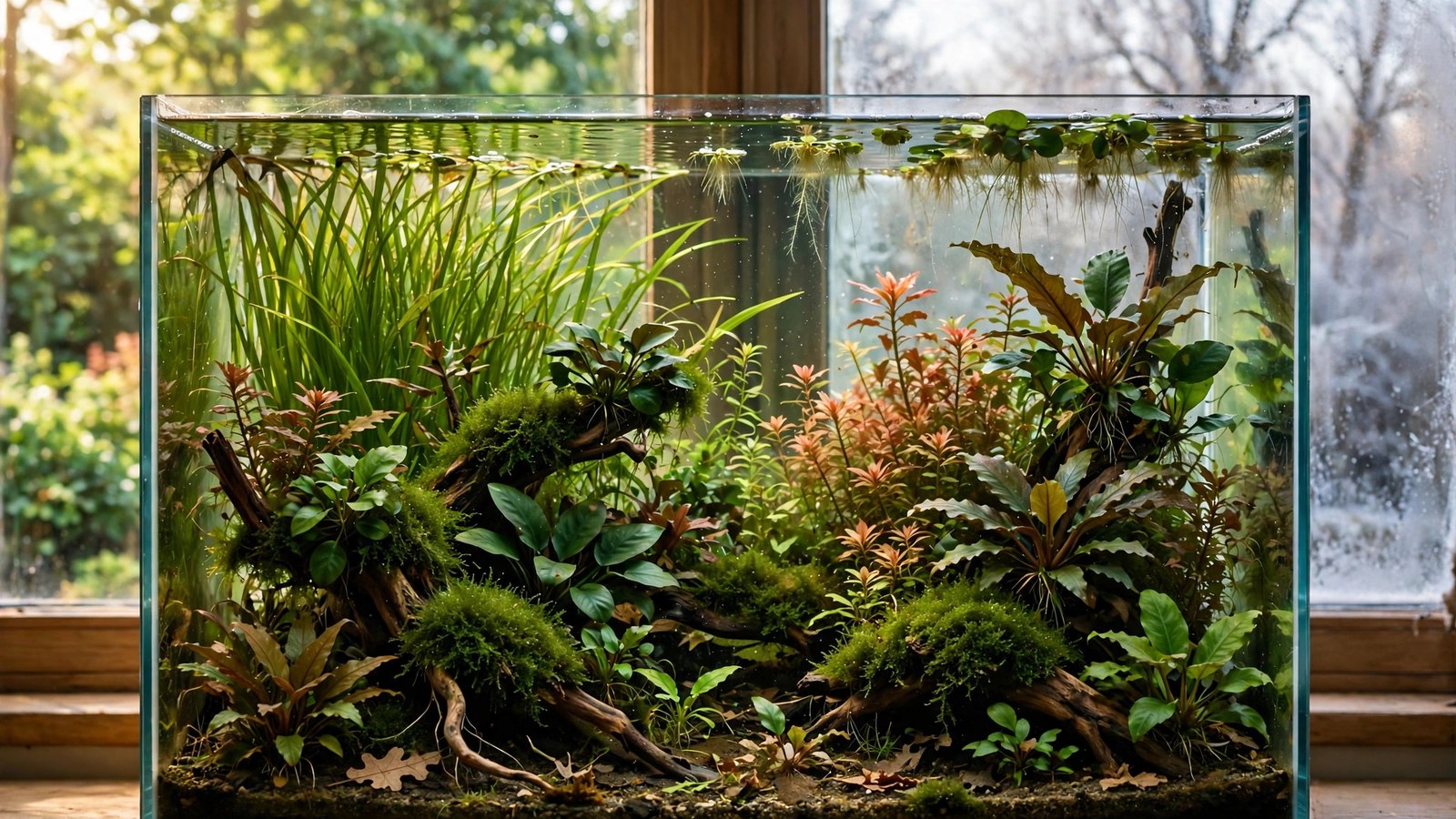
Your aquarium lives indoors, but it still feels the seasons. Summer heat waves push tank temperatures into the danger zone, winter's short days and dry air change evaporation and light dynamics, and the shoulder seasons bring their own quiet shifts. Seasonal aquarium plant care isn't about dramatic overhauls — it's about small anticipatory adjustments that keep your garden thriving while the world outside swings between extremes.
Summer: The Heat Challenge
Summer is the hardest season for most planted tanks, and the enemy is temperature. Most aquarium plants thrive between 72–78°F (22–26°C). As room temperatures climb into the 80s and 90s, tanks follow — and warm water holds less dissolved oxygen, accelerates metabolism (plants and algae grow faster), and stresses species evolved for cooler streams.
Recognizing heat stress in plants
- Wilting despite adequate water: Leaves go limp and translucent, especially in crypts and stem plants. The plant can't move water fast enough to keep up with heat-driven transpiration.
- Accelerated melting: Heat-stressed plants shed leaves faster. If your crypts melt every July like clockwork, temperature is the trigger.
- Algae explosions: Warm water + strong summer ambient light (even indirect window light lengthens the effective photoperiod) = algae paradise. Green water and thread algae spike in summer more than any other season.
- Oxygen stress: Plants photosynthesize oxygen by day but consume it at night. In hot, oxygen-poor water, heavily planted tanks can dip dangerously low overnight — fish gasping at the surface on summer mornings is the warning sign.
Cooling strategies that actually work
- Fans across the water surface: A clip-on fan blowing across an open-top tank cools 2–4°F through evaporation. Cheap, effective, and the first thing to try. Top off evaporated water more often (evaporation accelerates).
- Reduce the photoperiod: Drop from 8 hours to 6–7 in peak summer. Less light means less heat from the fixture and slower algae growth. Plants tolerate this fine for a few months.
- Raise the light fixture if it's sitting on the tank rim — even an inch of air gap reduces heat transfer significantly.
- Frozen water bottles as emergency cooling: rotate 2–3 frozen bottles through the tank during heat waves. Crude but effective for short spikes; monitor to avoid temperature swings (see our temperature swing guide).
- Run CO2 slightly leaner in extreme heat — stressed plants use less carbon, and excess CO2 in oxygen-poor warm water compounds livestock stress.
- Increase surface agitation at night (raise the filter output or add an air stone on a timer) to combat overnight oxygen dips.
What about chillers? They're the definitive solution but cost $300+ and make sense only for large tanks, cold-water species, or truly brutal climates. For most keepers, fans + photoperiod reduction handle everything short of a record heatwave.
Winter: The Light Famine
Winter's challenge is the opposite: not enough light and too-dry air. Shorter days mean less ambient room light reaching the tank (matters more than you'd think for tanks near windows), and indoor heating drops humidity, accelerating evaporation.
Winter adjustments
- Extend or intensify the photoperiod slightly if growth stalls — but watch for algae, since winter's lower temperatures slow plant metabolism while algae adapts quickly. Increase light or duration, not both at once.
- Top off evaporation diligently. Heated indoor air can double evaporation rates. Topping off with remineralized RO water (not tap, which adds minerals each time) prevents hardness creep.
- Watch heater reliability. A failed heater in winter kills faster than summer heat — cold shock is acute. If your heater is more than 2–3 years old, winter is the time to replace it preemptively or add a backup controller.
- Reduce feeding slightly if fish metabolism slows in cooler water — uneaten food fouls water that you're changing less enthusiastically in cold weather.
- Expect slower growth overall. Even with stable tank temperature, many plants grow marginally slower in winter — possibly responding to subtle cues we don't fully control. Don't chase it with extra fertilizer; the plants can't use it. Our weekly routine still applies, just with less trimming needed.
Spring and Fall: The Transition Seasons
The shoulder seasons are when most seasonal problems start, because change — not absolute conditions — stresses plants most:
- Spring: Lengthening daylight increases ambient light on the tank. Algae often blooms in March/April before plants ramp up. Preempt by cleaning up winter's accumulated detritus, removing dead leaves thoroughly, and doing a deep maintenance session as days lengthen.
- Fall: The first cold snaps swing room temperatures; heaters kick on after months idle (test them before you need them). Falling ambient light means it's time to verify your fixture's output hasn't degraded — LEDs dim slowly over years, and the decline becomes noticeable when ambient light stops compensating.
- Both transitions: Resist the urge to change everything at once. Adjust one variable (photoperiod, temperature target, dosing), wait two weeks, then adjust the next. Seasonal transitions punish impatience.
Seasonal Fertilizer Adjustments
Your fertilizer schedule should breathe with the seasons:
- Summer (fast growth): Plants at peak metabolism consume more. If you're on EI, summer is when full strength is most justified. On PPS-Pro or all-in-one, watch for deficiency signs appearing faster than usual and bump doses 25–50%.
- Winter (slow growth): Cut doses by a third to a half. Dormant-ish plants can't use full dosing, and the excess feeds winter algae (which, annoyingly, doesn't slow down as much as plants do).
- CO2: If you inject, summer heat may warrant slightly less (stressed plants, oxygen concerns); winter's vigorous growth under stable temps can handle normal or slightly more. Adjust by observing plant response, not by calendar.
The principle: fertilize the growth you have, not the growth you want. Seasonal dosing follows observed plant performance with a two-week lag — never dose ahead of growth.
Vacations and Seasonal Absences
Summer vacations and winter holiday travel collide with the two most demanding seasons. Before any trip longer than a few days, run through our vacation plant care guide — the short version: do maintenance before you leave (not after you return), set lights on timers with slightly reduced photoperiods, and arrange feeding (plants need no feeding, fish need little).
The Seasonal Maintenance Calendar
| Season | Key tasks |
|---|---|
| Spring | Deep clean as light increases; check for algae early; resume full fertilizing as growth accelerates; inspect equipment after winter |
| Summer | Heat management (fans, shorter photoperiod); increase water-change frequency if algae spikes; top off evaporation often |
| Fall | Test heaters before cold arrives; verify light output; deep-trim overgrown summer growth; recalibrate dosing as growth slows |
| Winter | Reduce fertilizer with slower growth; manage evaporation from dry heated air; replace aging heaters preemptively; enjoy the low-maintenance months |
Frequently Asked Questions
What temperature is too hot for aquarium plants?
Most tropical aquarium plants tolerate up to 82°F (28°C) short-term, but sustained temperatures above 84°F (29°C) stress all but the hardiest species. Cold-water plants (many mosses, some crypts) start suffering above 78°F. If your tank regularly exceeds 84°F in summer, active cooling isn't optional — it's required. Brief spikes are survivable; weeks of heat are not.
Should I turn off CO2 in summer?
No — but consider reducing it slightly during extreme heat. The logic: heat-stressed plants photosynthesize less efficiently, so they need less carbon; meanwhile warm water holds less oxygen, and the margin for livestock gets thinner. Drop your bubble rate 20–30% during heat waves and restore it when temperatures normalize. Never shut CO2 off abruptly — ramp changes over several days per our CO2 acclimation guide.
Do aquarium plants go dormant in winter?
True dormancy (like a lotus or aponogeton's rest period) happens in a few species, but most tropical aquarium plants don't go dormant — they just grow slower. Don't mistake slow winter growth for a problem requiring intervention. Maintain stable conditions, reduce fertilizer to match, and wait for spring. The exception: tiger lotus and some aponogetons may die back to a bulb/rhizome in winter; leave the bulb in place — it usually resprouts.
How do I handle a heat wave when I'm away?
Prevention beats reaction: before leaving in summer, set up a fan on a temperature controller (thermostat plugs cost ~$30 and switch the fan on automatically above your set point), reduce the photoperiod, and do a water change. Ask your tank-sitter to top off evaporated water. Frozen bottles only work if someone's there to rotate them — automate what you can.
Is window sunlight stronger in summer a problem?
Yes, often the main summer algae trigger. A tank that's fine near a window all winter can get blasted as the sun's angle changes in spring/summer. If summer brings a sudden algae bloom with no other changes, check whether direct sun now hits the tank during hours it didn't before. Sheer curtains, repositioning, or a background on the window-facing side solves it.
Work With the Seasons, Not Against Them
The seasonal approach to planted tanks is fundamentally about anticipation: fans ready before the heat wave, heaters tested before the cold snap, fertilizer adjusted to the growth you observe. None of these adjustments are dramatic — that's the point. Small, timely corrections keep the tank in its comfort zone year-round, and a tank that's never stressed is a tank that never gives you emergency problems.
Tissue-culture plants are the exception — they’re grown in sterile gel and adapt with minimal melting, which is part of what you’re paying for. Plants bought submersed from another hobbyist’s tank also transition with little melt, since they’re already in the right form.
Which Plants Melt Most (and Least)
Heavy melters (expect significant leaf loss)
- Cryptocorynes — infamous for “crypt melt,” sometimes dropping every leaf after any disturbance. They almost always recover from the roots within weeks.
- Stem plants grown emersed — rotala, ludwigia, and hygrophila often shed lower emersed leaves while the growing tips transition.
- Amazon swords — emersed-grown swords typically lose their broad oval aerial leaves and replace them with longer submersed ribbon leaves.
Light melters
- Anubias, java fern, bucephalandra — slow-growing rhizome plants transition gradually; occasional old-leaf melt but rarely dramatic.
- Vallisneria — usually transitions well, though it dislikes the move itself and may sulk for a week.
- Floating plants — minimal melt since their leaves were already at the air-water interface.
The Acclimation Protocol
Step 1: Quarantine or dip first
Before acclimating to your tank’s conditions, make sure you’re not acclimating pests along with the plant. Run new arrivals through our quarantine and dip protocol — it adds days upfront but prevents months of regret.
Step 2: Float to temperature-match (30 minutes)
Float the bag or container in your tank for 20–30 minutes to equalize temperature. Plants are less temperature-sensitive than fish, but a 10°F shock on top of transplant stress is an avoidable insult.
Step 3: Trim before planting
Remove any leaves that are already damaged, yellowing, or heavily algae-covered — they won’t recover and they’ll rot in your tank, feeding algae. For stem plants, trim off the bottom inch and any emersed leaves that look unlikely to adapt; the plant wastes energy maintaining leaves it’s going to shed anyway. Keep the healthy growing tips — that’s where recovery starts.
Step 4: Plant correctly the first time
Follow our planting guide — right depth, crown exposed on rosettes, rhizomes unburied on epiphytes. Every uprooting and replanting restarts the acclimation clock, so get placement right on the first attempt. Decide where each plant goes before it goes in the water.
Step 5: Run a gentle first week
For the first 7 days after planting:
- Moderate light — run your normal photoperiod but consider dropping intensity 20–30% if your light is dimmable. Blast-level light on a melting plant grows algae on the dying leaves, not recovery.
- Stable CO2 — if you inject CO2, keep it consistent. Fluctuating CO2 during acclimation is a melt accelerator. If you’re low-tech, this doesn’t apply — see growing without CO2.
- Half-strength fertilizer — new plants with damaged leaves can’t use full dosing, and the excess feeds algae. Ramp to full strength over 2–3 weeks per our fertilizer schedule.
- No disturbance — don’t move, trim, or “check on” new plants for at least two weeks. Every touch resets root establishment. This is especially critical for crypts.
Step 6: Remove melt, keep the base
As emersed leaves melt, remove the mushy material promptly — decaying leaves release ammonia and grow fungus that can spread to healthy tissue. But never discard the plant while the crown, rhizome, or roots are firm and alive. A crypt that’s lost every leaf but has firm roots is a plant that’s about to recover, not a dead plant. Give it 3–4 weeks before judging.
Telling Normal Melt From Real Problems
Normal transition melt:
- Affects oldest/emersed leaves first, newest growth last
- New submersed leaves emerge even as old ones dissolve
- Roots and crown stay firm and white/green
- Timeline: 1–4 weeks, then obvious new growth
Concerning melt (see our full melting diagnosis guide):
- New growth also melts or emerges deformed
- Rhizome or crown turns mushy and brown — this is rot, not transition
- Entire plant dissolves within days with no new growth after 4+ weeks
- Melting spreads to established plants that weren’t recently moved
Buying Tips to Minimize Melt
- Buy submersed-grown when available — hobbyist-grown cuttings transition with almost no melt.
- Choose tissue culture for sensitive species — crypts and delicate stems establish far more reliably from sterile cups.
- Avoid plants already melting in the store tank — some melt is normal, but a plant that’s mostly mush at purchase has less energy for recovery.
- Transport carefully — keep plants damp and out of direct sun/heat. A plant that dries out or cooks in a hot car melts far worse than one transported properly.
The First-Month Timeline: What to Expect Week by Week
Knowing what’s normal when removes most acclimation anxiety. Here’s the typical timeline for a healthy plant adapting to a new tank:
Week 1: The quiet week
Almost nothing visible happens. The plant is growing roots you can’t see and assessing its new environment. Some species (vallisneria, stem plants) may start shedding their lowest leaves. This is normal. Resist the urge to “help” — no moving, no extra fertilizer, no light changes. The most common beginner mistake is intervening during a week when the correct action is nothing.
Week 2: Melt peaks
This is when emersed leaves give up in earnest. Crypts may drop everything; swords shed their broad aerial leaves; stem plants lose lower foliage. It looks catastrophic and it’s usually fine. Keep removing mushy material, keep conditions stable, and watch the crown and growing tips — if those are firm and green, recovery is already underway.
Week 3: The turn
New submersed-adapted leaves emerge — smaller, thinner, often a slightly different shade of green than the emersed foliage. Stem plant tips start growing visibly; crypts push tiny curled leaves from the crown; swords unfurl narrow ribbon leaves. This is the moment most beginners exhale for the first time.
Week 4+: Established
New growth outpaces melt, and the plant is functionally yours. You can resume full-strength fertilizer, normal trimming, and stop treating it as fragile. Some slow growers (anubias, bucephalandra) take 6–8 weeks to show obvious progress — that’s their normal speed, not a problem.
Acclimating Different Plant Formats
Tissue-culture cups
Sterile, pest-free, and already adapted to high-humidity (not emersed) growth — tissue cultures melt the least of any format. Rinse the agar gel off gently (leftover gel rots and feeds fungus), split the portion into small plantlets, and plant per our planting guide. They establish slowly for the first two weeks, then accelerate. No dip needed, minimal acclimation stress — this is the premium experience you’re paying for.
Potted plants
Remove the pot and strip away the rockwool completely — leftover rockwool traps debris and rots. Tease the root mass apart gently; if it’s a dense mat, splitting it into 2–3 smaller portions actually establishes faster than planting one big clump (more growing points, better water flow around roots). Potted plants are usually emersed-grown, so expect the standard 2–4 week melt cycle.
Bare-root / bunched stems
Typically sold as weighted bunches. Remove any bands, foam, or weights, strip the lower leaves, and plant stems individually or in small groups. Bunched stems from the store are often already transitioning — check for new submersed growth at the tips, which tells you the plant is mid-adaptation and will settle quickly.
Hobbyist cuttings
Already submersed-grown and the fastest to establish — often showing new growth within days. The main acclimation factor is water-parameter difference between the two tanks. Float to temperature-match, plant promptly, and they’ll usually take off with minimal melt. This is why experienced hobbyists prefer trading cuttings over buying potted plants.
Frequently Asked Questions
Should I use a “plant starter” or transplant fertilizer?
Products marketed for transplant shock are mostly B-vitamins and mild hormones. They don’t hurt, but there’s no strong evidence they help aquarium plants specifically. Stable conditions and patience outperform any bottle. Save the money for more plants.
My new plant melted completely — bare crown, no leaves. Is it dead?
Probably not, if the crown or rhizome is firm. Crypts and swords routinely lose 100% of their leaves and regrow from the base within a month. The test is firmness: firm and pale/green means alive; mushy and brown/black means rot. Give firm-but-leafless plants a full 4 weeks before declaring them dead.
Can I speed up acclimation with extra light or CO2?
No — and trying usually backfires. A melting plant can’t use extra light; the excess just grows algae on its dying leaves. Keep light moderate and CO2 stable (not boosted) during acclimation. Growth speed comes from the plant’s own adaptation timeline, which you can’t rush, only avoid delaying.
Should new plants go straight into my main display tank?
After quarantine/dipping, yes — there’s no benefit to a separate “growing-in” tank for most plants. They acclimate to your water fastest in the tank they’ll live in. The exception is very delicate species going into a tank with boisterous fish; give those a few weeks in a calm corner or breeder box first.
The Patience Rule
The single most important acclimation skill is restraint: plant it right, set gentle conditions, remove decay, and then leave it alone for a month. The hobbyists with the best plant growth aren’t doing something clever in week one — they’re simply not interfering in weeks two through four while the plants do what they’ve evolved to do. Melt looks like failure and feels like failure, but in most cases it’s the visible part of a plant successfully becoming yours.