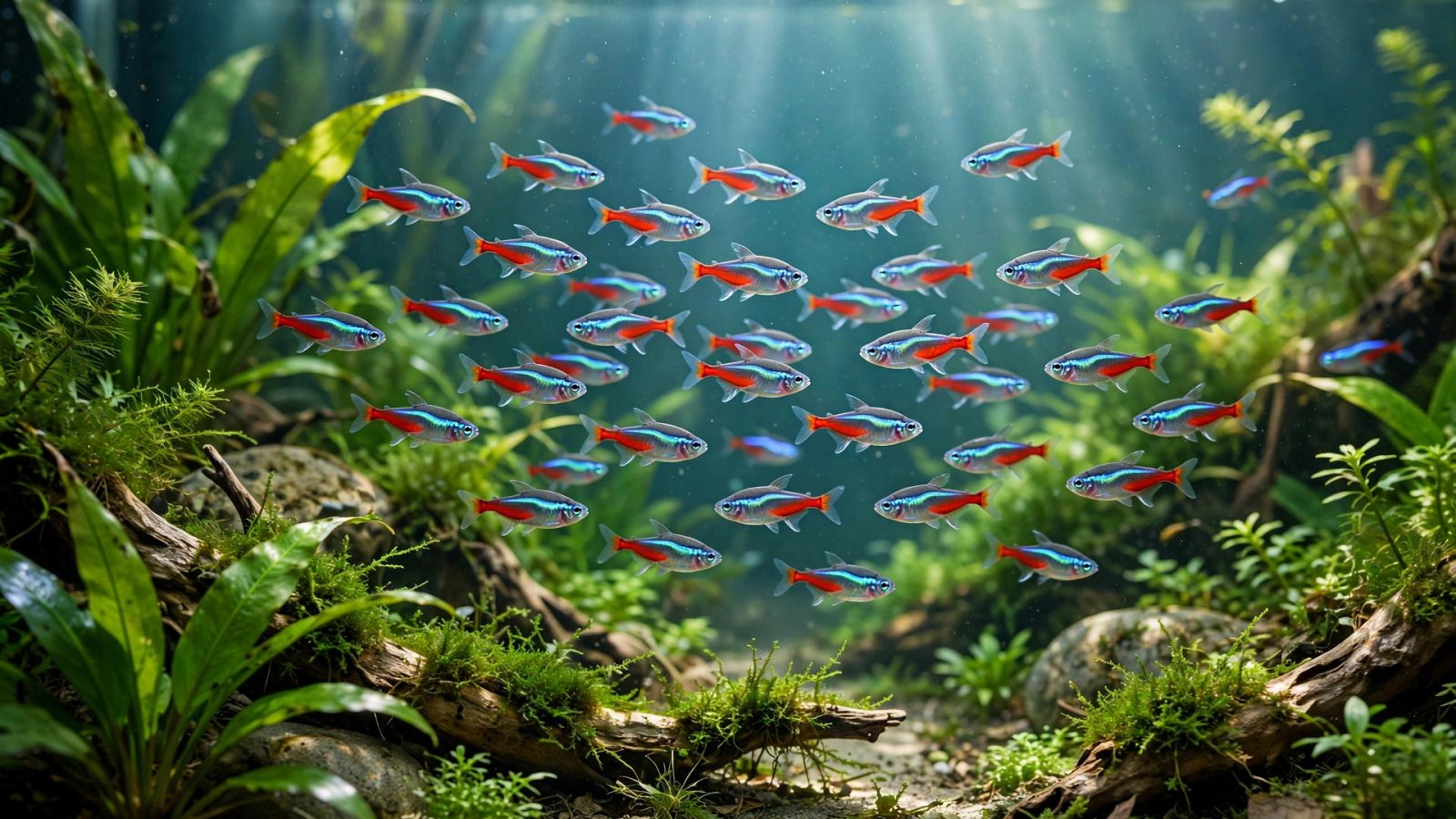
A planted tank without fish is a garden; with the right school moving through it, it’s an ecosystem. But not every fish suits a planted tank — some uproot, some shred leaves, some need water parameters your plants hate. These 12 schooling fish for planted tanks are plant-safe, appropriately sized, and chosen for how their colors and behaviors complement aquascapes rather than fighting them.
All twelve are peaceful, stay small (under 2 inches mostly), and won’t eat your plants. They’re grouped by the visual role they play in a scape.
The Classic Tetras
1. Neon Tetra (Paracheirodon innesi)
The iconic planted-tank fish for good reason: a school of 12+ neons moving as one through a green scape is the hobby’s defining image. Hardy, cheap, and perfectly sized. They prefer slightly acidic, soft water — which most plants also prefer. Keep schools at 10 minimum; neons in small groups get skittish and colorless.
2. Cardinal Tetra (Paracheirodon axelrodi)
Neon’s larger, more vivid cousin — full-length red stripe versus the neon’s half. Slightly more sensitive to water parameters and pricier, but unmatched color impact in a planted display. Needs warm water (78–82°F); pair with plants that like it warm.
3. Ember Tetra (Hyphessobrycon amandae)
Tiny (under an inch), fiery orange, and perfect for nano planted tanks where neons would look oversized. A school of 15 embers in a 10-gallon planted tank is a jewel box. Peaceful, hardy, and they school tightly — excellent movement against green.
4. Rummy-Nose Tetra (Hemigrammus rhodostomus)
The tightest schoolers in the hobby — rummy-noses move like a single organism, which is mesmerizing in a large planted tank. Their red faces also serve as a living water-quality indicator: pale faces often mean water issues before test kits confirm. They need stable, clean water, making them a good “canary” for high-tech setups.
The Rasboras
5. Chili Rasbora (Boraras brigittae)
Half-inch crimson jewels for nano tanks. A school of 12–15 chilis in a heavily planted 5–10 gallon is one of the hobby’s great small-scale displays. They need calm water and dense planting to feel secure — which is exactly what a planted nano provides.
6. Harlequin Rasbora (Trigonostigma heteromorpha)
The classic community rasbora: hardy, peaceful, copper-orange with a black wedge. Larger than chilis (2 inches), suited to 20+ gallon planted tanks. Extremely adaptable to water parameters — one of the most forgiving schooling fish available.
7. Lambchop Rasbora (Trigonostigma espei)
Harlequin’s slimmer, more colorful relative — brighter orange, tighter schooling. Often sold as harlequins; the lambchop’s thinner wedge marking distinguishes it. Same easy care, slightly better color.
The Danios & Barbs
8. Celestial Pearl Danio (Danio margaritatus)
“Galaxy rasbora” — deep blue body spangled with pearl spots, red fins. Stunning in a planted nano, though shyer than the list above; dense planting (which you’re providing anyway) brings them out. Best in species or shrimp-safe setups; boisterous tankmates keep them hidden.
9. Cherry Barb (Puntius titteya)
The peaceful barb — unlike tiger barbs, cherries won’t nip fins or harass tankmates. Males turn deep red when comfortable, females stay golden. Hardy across a wide parameter range, and they actively explore plant thickets rather than just hovering. Great for 20+ gallon community planted tanks.
The Livebearers & Others
10. Endler’s Livebearer (Poecilia wingei)
Half the size of guppies with twice the color intensity — and far less fry overload (though they’ll still breed). Males display neon green, orange, and black patterns. Perfect for planted nanos; the plants give fry cover and the colony self-sustains. See our guppy tank plants guide for cover strategies that apply equally.
11. Pygmy Corydoras (Corydoras pygmaeus)
Not a mid-water schooler, but the perfect planted-tank bottom crew: tiny (1 inch), schooling, gentle on plants, and endlessly entertaining as they perch on leaves. A school of 8–10 works the substrate without uprooting anything — unlike their larger cory cousins, which can bulldoze foreground carpets.
12. Otocinclus (Otocinclus vittatus)
The planted tank’s cleanup crew: 1-inch algae-eating machines that school loosely and never damage healthy plants. Essential in new setups for diatom control. They need established tanks with soft algae available — add after the tank matures (month 2+), and supplement with algae wafers. Buy 6+; they’re social and fragile alone.
Schooling Fish Rules for Planted Tanks
- School size minimums are real. 8–10 for larger species, 12–15 for nano species. Undersized schools = stressed, washed-out fish hiding in corners.
- One big school beats three small ones. Twelve neons make a statement; four each of three species make visual noise.
- Quarantine new fish. Planted tanks are hard to medicate (many treatments kill plants and invertebrates). A simple quarantine tub prevents 90% of disasters.
- Match temperature to plants. Most plants prefer 72–78°F; cardinals and rummy-noses want it warmer. Check overlap before combining.
- Feed the plants’ needs too. Fish waste is fertilizer — moderate stocking feeds plants gently. Overstocking overwhelms them; see our water parameters guide for balance targets.
Fish to Avoid in Planted Tanks
- Goldfish — eat or uproot nearly everything; need cold water most tropical plants dislike.
- Large cichlids — dig and redecorate (with exceptions; see our cichlid plants guide).
- Silver dollars, Buenos Aires tetras — enthusiastic herbivores that strip planted tanks.
- Common plecos — bulldoze scapes and outgrow tanks; otos do the algae job better.
Frequently Asked Questions
How many schooling fish for a 20-gallon planted tank? One school of 12–15 mid-water fish plus a bottom crew of 8 pygmy corys and 4–6 otos is a full, balanced load.
Will schooling fish eat shrimp? Most small tetras and rasboras ignore adult shrimp but may pick off newborn shrimplets. Dense moss (see our nano ideas shrimp paradise) keeps colonies breeding.
Can I mix two schooling species? Yes in 30+ gallons with proper school sizes for each. In smaller tanks, one strong school looks better and stresses fish less.
The Bottom Line
Start with the tank size, pick one signature school that fits it, add the cleanup crew, and stop. A single confident school moving through healthy plants is the entire aesthetic — everything else is garnish. Ember tetras or chilis for nanos, neons or harlequins for mid-size, rummy-noses for the big display. Plant heavily, school generously, and enjoy the show.
Species Profiles: Deeper Detail
Neon Tetra — The Details
Wild neons come from blackwater tributaries — soft, acidic, tannin-stained. They show best color in similar conditions: pH 6.0–7.0, dimmer lighting, dark substrate. In hard alkaline water they’re surviving, not thriving — still the hardiest of the classic tetras, but give them their preferred water and the blue stripe becomes electric. Lifespan 5–8 years in good conditions; the “neons die in weeks” reputation comes from mass-farmed stock and uncycled tanks, not the species.
Ember Tetra — Why Nanos Love Them
At under an inch, embers have the biomass of a large snail — a school of 15 barely registers on a 10-gallon’s bioload. This makes them the ideal nano school: visual impact without water-quality cost. They color up best in planted tanks (bare tanks wash them out) and their orange pops spectacularly against green and dark substrate.
Rummy-Nose — Reading the School
The red-face indicator is genuinely useful: bright red faces mean the fish feel safe and water is good; pale faces warrant an immediate water test. In planted high-tech tanks, rummy-noses are often the first to signal CO2 overdosing (gasping, pale) — they’re sensitive enough to be useful, hardy enough to not die from brief excursions.
Chili Rasbora — The Shy Jewel
Chilis need what planted nanos naturally provide: calm water, dense cover, dim corners. In a bare or bright tank they hide permanently; in a planted nano they’re out constantly. Dither fish paradox: the more hiding places you provide, the more you see them — security creates boldness.
Celestial Pearl Danio — Breeding Bonus
CPDs breed readily in planted nanos — eggs scattered among mosses, fry appearing as tiny slivers. A planted CPD tank becomes self-sustaining with minimal intervention. Males spar and display constantly in planted setups, showing colors pet-store specimens never reveal.
Otocinclus — The Care Guide Within the Guide
Otos starve more often than any other fish on this list — they’re wild-caught, arrive half-starved, and need established soft algae immediately. Add only to mature tanks (2+ months), buy 6+, and supplement with blanched zucchini and algae wafers from day one. The first two weeks determine survival; otos that make it past a month typically live for years.
Building the Community: Example Stocking Plans
10-gallon planted: 12 ember tetras + 6 pygmy corys + 4 otos (added month 2+) + cherry shrimp colony. Full, balanced, self-maintaining.
20-gallon long planted: 15 neon tetras + 8 harlequin rasboras + 8 pygmy corys + 6 otos. Two mid-water schools in a 20-long work because the footprint gives each school its own zone.
40-gallon breeder planted: 20 rummy-nose tetras (the showpiece school) + 12 cherry barbs + 10 pygmy corys + 8 otos. The rummy-nose school in a 3-foot tank is a genuine spectacle.
Feeding Schooling Fish in Planted Tanks
Small, varied, and not too much: quality micro-pellets or crushed flake as the staple, frozen daphnia or baby brine shrimp 2–3x weekly for color and conditioning. Feed what they eat in 2 minutes, once or twice daily. In planted tanks, uneaten food rots among leaves — a feeding ring or consistent feeding spot trains fish to eat in the open where you can monitor. Well-fed schooling fish color up dramatically; the difference between flake-only and varied diets is visible within weeks.
Acclimation: Doing It Right
Float the bag 15–20 minutes for temperature, then drip-acclimate over 30–45 minutes for sensitive species (cardinals, CPDs, otos) — planted-tank water often differs significantly from store water in pH and hardness. Net fish in; never add store water to your tank. Dim lights for the first few hours. Don’t feed on day one; start small feedings on day two. New schooling fish hide for 24–72 hours — normal. If they’re still hiding after a week, the school is likely too small or the tank too bare.
Biotope Matching: Fish + Plants + Water
The most striking planted tanks match fish to a region — and the plants follow:
- Amazon blackwater: Cardinal tetras, rummy-noses + Amazon swords, java fern, anubias. Soft, acidic water, tannins, dim light. The classic.
- Southeast Asian stream: Harlequin rasboras, cherry barbs + crypts, java fern, Bucephalandra. Warm, soft, gentle flow.
- North American: Ember tetras are South American, but white cloud minnows + vallisneria + anacharis make a convincing temperate stream.
Biotopes aren’t mandatory, but they resolve half your decisions automatically — water parameters, plant choices, and fish all align because they evolved together. And a coherent biotope always looks more intentional than a random assemblage.
Quarantine: The Unskippable Step
A simple 5-gallon tub with a sponge filter and heater is your quarantine tank. New fish spend 2–3 weeks there while you observe for ich, fungus, and parasites. Treat in quarantine — most medications (copper, formalin, antibiotics) harm plants, kill invertebrates, and nuke beneficial bacteria. One quarantine tub prevents the nightmare scenario: dosing your display tank and watching the scape melt. This isn’t optional equipment; it’s the cheapest insurance in fishkeeping.
More Schooling Fish Worth Knowing
Green Neon Tetra (Paracheirodon simulans)
Neon’s smaller, bluer cousin — an intense lateral stripe that glows under aquarium lighting. Better suited to soft, acidic blackwater setups than standard neons. A school of 15 in a 15-gallon blackwater planted tank is unforgettable.
Black Neon Tetra (Hyphessobrycon herbertaxelrodi)
The hardy alternative: black-and-silver striping, adaptable to a wide parameter range, and tougher than regular neons. Less colorful but far more forgiving — the practical choice for beginners who love the tetra look.
Phoenix Rasbora (Boraras merah)
Chili rasbora’s close relative — slightly larger, deep red-orange. Same nano-tank role, same tight schooling. Often mixed with chilis in the trade; both are excellent.
The Dither Fish Concept
Shy fish (dwarf cichlids, gouramis) hide constantly in quiet tanks — but add an active schooling species and they emerge. The school signals “no predators here,” and the shy fish believe it. This is why a planted tank with a confident tetra school shows more of all its inhabitants. If your centerpiece fish hides, the solution often isn’t more hiding places — it’s a dither school.