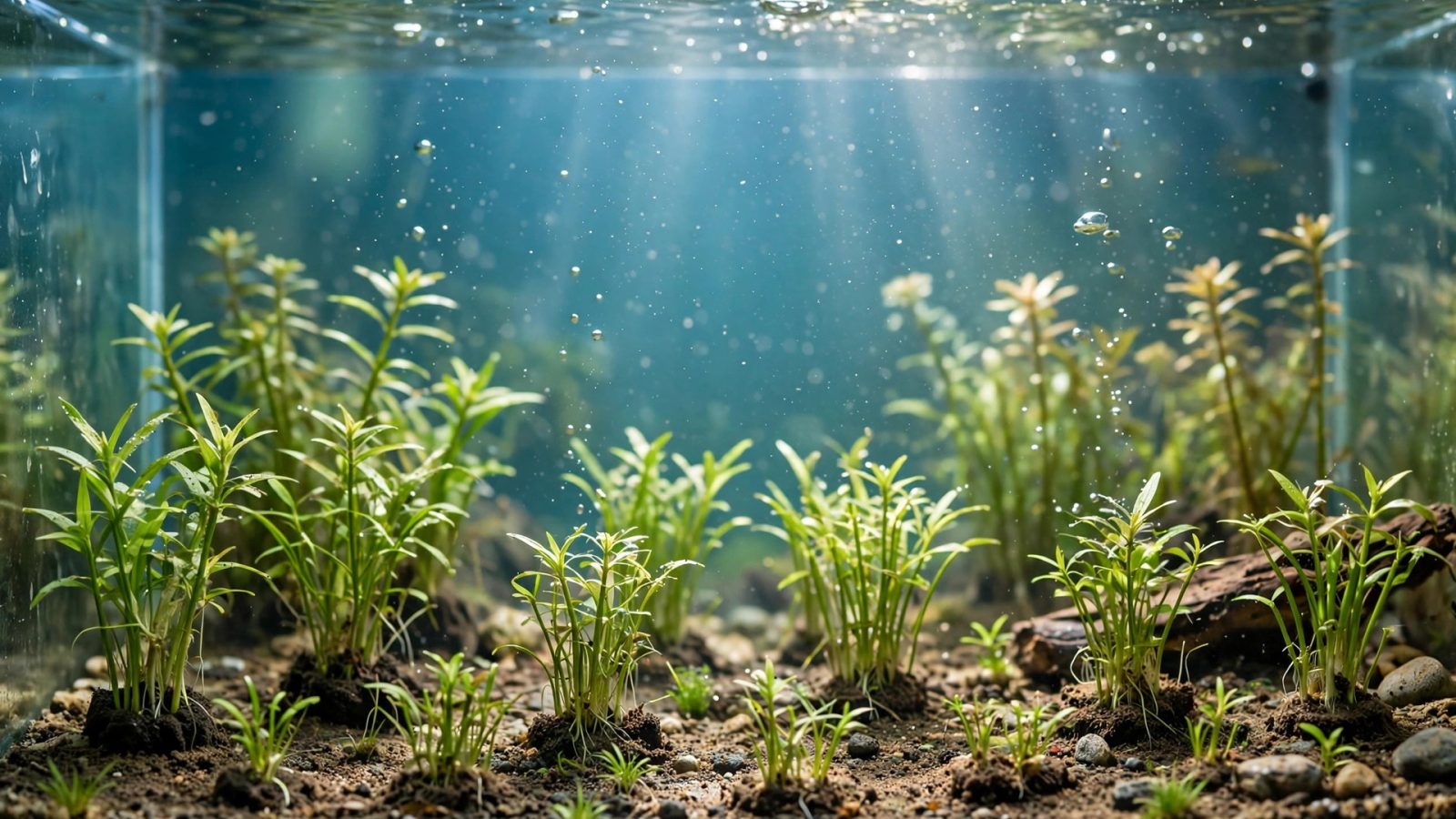
“How many plants do I need?” is the most practical question in planted tanks — and the one most guides dodge with “it depends.” Here’s the straight answer: plant roughly 70% of your visible substrate on day one, weighted toward fast-growing stems. This planting density isn’t about aesthetics (though it looks better instantly) — it’s about biology. Plants are your biofilter, your algae prevention, and your water stabilizer, and they can only do those jobs at sufficient mass.
The 70% Rule
Imagine looking down at your substrate through the front glass. If about 70% of what you see is planted (or will be within days, counting floaters), you’re in the right zone. The remaining 30% is open sand/gravel foreground, swimming space, and hardscape — the negative space that makes a scape breathe.
Why 70%? Below ~50% coverage, a new tank’s nutrient load (from substrate, especially soil or aquasoil) exceeds what the plants can absorb, and algae fills the gap — the classic “I planted a few stems and got an algae farm” story. Above ~70%, plants dominate nutrient uptake from day one, outcompeting algae before it establishes. It’s the single biggest predictor of a smooth start.
Translating Percent to Plant Counts
Rough starter quantities for common tank sizes (tissue-culture cups, potted plants, or stem bunches):
- 5-gallon: 6–10 plants/portions. Example: 2 anubias, 1 java fern, 1 crypt, 1 dwarf sag portion, 1 stem bunch, frogbit handful.
- 10-gallon: 12–18 portions. Double the 5-gallon plus a background stem group.
- 20-gallon long: 20–30 portions. This is where buying in bulk (stem bundles, 3-packs) pays off.
- 40-gallon breeder: 35–50 portions. Budget accordingly — or propagate from a smaller tank first.
These feel like a lot. They are a lot. New aquarists consistently underbuy by half — then buy the second half three weeks later after the algae lecture. Buy it all upfront; it’s cheaper than the algae battle.
What Counts Toward the 70%
Not all plants contribute equally to the biological workload:
- Fast-growing stems count double. Water sprite, anacharis, hornwort, guppy grass — these are nutrient sponges. A tank with ten stem bunches is “more planted” biologically than one with ten anubias, even at equal visual coverage.
- Floaters count. A third of the surface in frogbit or salvinia is serious filtration — arguably the fastest nutrient uptake in the tank.
- Slow epiphytes barely count (biologically). Anubias and java fern are wonderful, but a tank planted only with slow growers will still get algae. They’re the furniture, not the workforce.
The ideal starter mix: 50% fast growers (stems + floaters) for biological function, 50% slow growers and rosettes (anubias, crypts, swords, foreground) for the long-term scape. The fast growers do the heavy lifting while slow plants establish; you can thin the workers later as the scape matures.
The “Nursery” Trick for Tight Budgets
Plants are the biggest startup cost after the tank itself. Two ways to beat it:
- Buy small, propagate. One $8 pot of Staurogyne repens splits into 6–10 plantlets. One water sprite becomes five in a month. Buy for propagation potential, not instant fullness.
- Use a holding tank. A cheap plastic tub with a light grows out trimmings into new plants. Every pruning becomes inventory for the next tank or trade.
Planting Order Matters
Plant background stems first, midground second, foreground last — you won’t crush small plants reaching over them. Floaters go on after filling. Details in our betta tank build and dirted setup walkthroughs.
After Planting: What to Expect
Week 1: Some melting, especially crypts and tissue-culture plants. Normal — they’re adapting. Don’t uproot “dead” plants for at least two weeks; most rebound from roots.
Weeks 2–4: Fast growers take off; slow growers sit still (also normal). Algae may appear — diatoms especially. With 70% planting and 6-hour light, it stays minor and passes.
Month 2+: The tank fills in. Now you can remove excess fast growers if they’re crowding the scape vision — they’ve done their startup job.
Frequently Asked Questions
Can I add plants gradually instead? You can, but the tank cycles slower and algae gets a head start. If budget forces gradual planting, start with the fast growers (maximum biology per dollar) and add showpiece plants later.
Do I still need to cycle with heavy planting? Plants consume ammonia, which can mask an uncycled tank — readings look fine until plant uptake saturates. Still cycle properly; see our planted tank cycling guide. Heavy planting makes cycling faster and safer, not unnecessary.
What if I over-planted? There’s no such thing at startup. Thin later once the tank is stable — excess plants are a resource (trade, sell, start another tank).
Should I plant before or after filling the tank? Plant into damp (not flooded) substrate first, then fill slowly. Dry-start planting is far easier — stems stay put, you can see the layout clearly, and delicate foreground plants don’t float away. Fill by pouring water over a plate or plastic bag to avoid blasting your work apart.
My plants arrived before the tank is ready — how do I hold them? Float stems and floaters in any container with light; they’ll survive days to weeks. Keep rhizome plants (anubias, java fern) damp in a sealed bag — they tolerate this well. Don’t leave anything sealed in a hot delivery box; unbox on arrival day and get them into water or damp storage immediately.
The Bottom Line
Seventy percent coverage, half of it fast growers, all of it on day one. It’s the closest thing the hobby has to a guaranteed smooth start. Plants are the filter, the algae prevention, and the aquascape — and unlike equipment, they multiply.
Budget Planning: What It Costs
Realistic plant budgets for the 70% target (US prices, 2026):
- 5-gallon: $30–50. A few tissue-culture cups and a stem bundle.
- 10-gallon: $60–100. The sweet spot where bulk buying starts paying.
- 20-gallon long: $100–180. Buy stem bundles (10-stem packs) and 3-pack potted deals.
- 40-gallon breeder: $180–300. Or: buy half, propagate the rest over two months.
Money-saving hierarchy: propagate > buy bundles > buy potted > buy specimen plants. A single $10 pot of water sprite becomes five plants in a month. Patience is the cheapest plant in the hobby.
Where to Buy
- Local fish stores: See the plants before buying; often sell trimmings cheap. Best for beginners who want advice.
- Online retailers: Wider selection, often healthier (grown emersed in nurseries). Quarantine and inspect for pests.
- Hobbyist forums/marketplaces: Cheapest healthy plants — established growers sell trimmings for a few dollars. Plants arrive adapted to aquarium life, not nursery greenhouses.
- Tissue culture cups: Pest-free and snail-free, but tiny — they need weeks to size up. Great for carpets, poor for instant impact.
Quarantine and Pest Control
New plants carry hitchhikers: snails, snail eggs, algae, occasionally hydra or planaria. A simple alum dip (1 tablespoon per gallon, 2–3 hour soak, thorough rinse) kills most pests without harming hardy plants — skip it for delicate species. Quarantine new plants in a bucket with light for a week when possible; you’ll spot problems before they enter your display. This ten-minute habit prevents the “where did all these snails come from” mystery.
Planting for Specific Goals
- Fastest cycle: Maximum fast stems + floaters. Biology over beauty; rescape later.
- Breeding tank: Fine-leaved density everywhere (see our guppy plants guide).
- Show scape: Still plant 70% — but choose the right 70%: the scape’s intended species, planted small and grown in. Contest tanks are planted sparsely and grown out, but that’s a 6-month timeline most beginners shouldn’t attempt first.
- Low maintenance: Weight toward anubias, java fern, crypts, and mosses — but include some fast growers for biological function, thinned regularly.
Reading Your Tank’s Hunger
After the initial planting, your tank tells you whether it has enough plants — learn to read the signals:
- Nitrates persistently zero + plants stalling: Under-planted or under-fed. The tank is nutrient-starved. Add fish food (more livestock) or fertilizer, not fewer plants.
- Nitrates climbing despite water changes: Under-planted for the bioload. Add fast growers — especially floaters, the fastest nitrate removers.
- Algae on slow growers but stems thriving: Enough total plants, wrong composition. The fast growers are winning the nutrient race; add more of them or reduce light on the slow growers’ zone.
- Everything thriving, minimal algae: The balance is right. Don’t “fix” it — just maintain.
This diagnostic skill — reading the tank instead of the test kit alone — is what separates experienced aquarists from beginners. The plants are instruments; learn their language.
The Rescape Question
Eventually you’ll want to change the layout. In a planted tank, rescape in sections — never more than a third at a time. Uprooting everything at once destroys the root-zone ecosystem and releases an ammonia pulse from disturbed substrate. Section-by-section rescapes keep the biological engine running while you redesign around it. The tank is a living system first, a design object second — work with that priority and both goals succeed.
Buying Plants in Stages
If the full 70% is budget-prohibitive on day one, stage it intelligently:
Stage 1 (day one): All the fast growers — maximum biology per dollar. Stems, floaters, hornwort. This is the life-support purchase.
Stage 2 (week 3–4): Midground plants — crypts, anubias, java fern. The tank is stable; these establish without the new-tank stress.
Stage 3 (month 2+): Foreground and showpiece plants — carpets, red accents, specimen swords. Added to a mature, stable system where they’ll thrive immediately.
This staging spends the same total but puts the biological workers first and the ornaments later — which is exactly the priority order the tank needs.