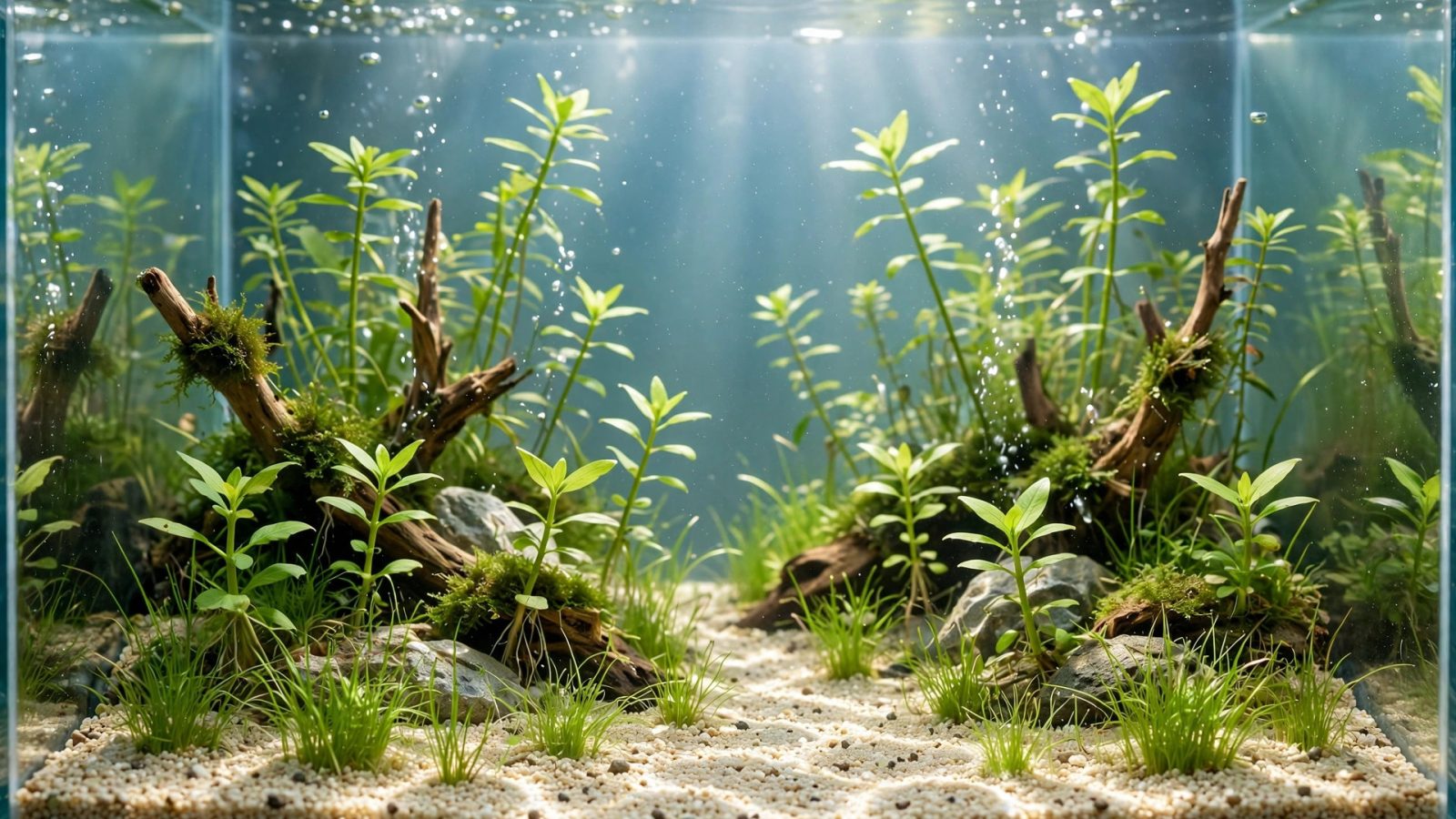
Standard cycling advice says: set up the tank, add ammonia, wait 4–6 weeks, test daily. Planted tanks get a shortcut — because plants themselves consume ammonia, a heavily planted tank can be safe for livestock far sooner. This silent cycle method uses plant mass as the primary biofilter, letting bacteria colonize at their own pace in the background.
This isn’t skipping the cycle — it’s cycling with plants doing the work. Done right, it’s faster and more stable than fishless cycling. Done wrong (too few plants, too many fish too soon), it’s just an uncycled tank with decorations.
Why Plants Change the Cycling Math
The conventional nitrogen cycle: fish produce ammonia → bacteria convert it to nitrite → different bacteria convert nitrite to nitrate → you remove nitrate with water changes. The bottleneck is bacterial colonization, which takes weeks.
Plants short-circuit this: they uptake ammonium directly — preferring it over nitrate, since converting nitrate costs energy. A tank packed with fast-growing stems can absorb the ammonia output of a light fish load almost as fast as it’s produced. The bacterial cycle still establishes (on filter media, substrate, surfaces), but the plants carry the load meanwhile. No ammonia spike, no nitrite spike — hence “silent.”
The Silent Cycle Method, Step by Step
Step 1: Plant Absurdly Heavily on Day One
This is the entire method’s foundation. 70%+ substrate coverage, weighted toward fast growers: water sprite, anacharis, hornwort, guppy grass, plus floaters (frogbit, salvinia) covering a third of the surface. Slow epiphytes (anubias, java fern) are fine additions but don’t count toward the biological workforce — they’re too slow. Our planting density guide gives exact numbers per tank size.
Step 2: Run Everything Normally
Filter on, heater set, lights 6 hours daily on a timer. The plants need stable conditions to start growing — growth is what drives ammonia uptake. Dose a light comprehensive fertilizer; new plants establishing need nutrients available.
Step 3: Wait and Watch (1–3 Weeks)
Don’t add ammonia, don’t add fish yet. Watch the plants: new growth (not just survival) is your signal. Water sprite unfurling new leaves, stem plants extending, floaters multiplying — that’s the biofilter coming online. Test ammonia and nitrite every few days; in a well-planted tank they’ll read near-zero throughout, which is expected, not suspicious.
Step 4: Add a Small Cleanup Crew First
Nerite snails, a few cherry shrimp, or 3–4 otos (otos need established algae — month 2+). These produce minimal waste while confirming the system handles bioload. Wait a week, test: ammonia and nitrite still zero, some nitrate appearing? The system works.
Step 5: Stock Gradually
Add fish in small groups — a third of your planned stocking per week. Each addition is a small ammonia increase; the plants and developing bacteria absorb it. Test after each addition. If you ever see ammonia above 0.25 ppm, pause stocking and do a water change — the plant mass wasn’t sufficient for that jump.
Timelines: Silent vs. Conventional
- Conventional fishless cycle: 4–8 weeks of dosing ammonia and testing, tank sits empty and ugly.
- Silent cycle, well-planted: 2–4 weeks to first livestock, with a growing, attractive tank from day one.
- Silent cycle, sparsely planted: doesn’t work — this is just an uncycled tank. Plant mass is the method.
Speeding It Up Further (Safe Boosters)
- Seeded filter media. Media from an established tank transplants a mature bacterial colony instantly — the single biggest accelerator. Ask a local fish store or fishkeeping friend.
- Bottled bacteria. Quality varies, but established products (containing actual Nitrospira) genuinely help. They’re a supplement to plant mass, not a replacement.
- Fast growers from established tanks. Plants already growing (not tissue culture, not fresh imports) start absorbing ammonia immediately — no adjustment lag.
- Warmth. Bacteria colonize faster at 78–80°F. You can cycle warm, then adjust to your livestock’s preference.
What NOT to Do
- Don’t dose ammonia in a planted tank. High ammonia burns plant leaves and encourages algae. The fishless-cycle ammonia-dosing protocol is for plant-free tanks.
- Don’t add the full fish load at once. The #1 silent-cycle failure. Gradual stocking is the method’s safety valve.
- Don’t trust zero readings blindly. Plants mask ammonia — readings look fine until uptake saturates. The gradual stocking schedule is what keeps you honest, not the test kit alone.
- Don’t crank the light to “help” plants. 6–8 hours moderate light. More light grows algae faster than it grows plants in an establishing tank.
Special Cases
Aquasoil tanks: Soils like ADA Amazonia leach ammonia for 2–4 weeks — which actually feeds the silent cycle. Plant heavily, do twice-weekly 50% water changes for the first two weeks to manage the leach, and don’t stock until ammonia reads zero consistently.
Dirted/Walstad tanks: Same principle — soil ammonia feeds plant growth. Follow our dirted setup timeline; the mineralized-soil prep reduces the initial spike.
Fish-in emergency: If you already have fish in an uncycled planted tank: 30–50% water changes daily until ammonia reads zero, add as many fast-growing plants as you can immediately (even floating a bunch of hornwort helps enormously), feed sparingly, and consider bottled bacteria. Plants + water changes will carry you through.
How You Know It’s Done
The tank is cycled when: ammonia and nitrite read zero 24 hours after feeding a full fish load, nitrate rises slowly between water changes (5–20 ppm), and plants show steady new growth. In a silent-cycled tank this state arrives quietly — there’s no dramatic “it’s cycled!” moment, just a tank that’s been stable for weeks. That’s rather the point.
From here, settle into the normal rhythm for your setup type — low-tech maintenance or high-tech discipline — and check water parameters monthly.
Frequently Asked Questions
Is silent cycling safe for the fish? When done as described — heavy planting, established growth before stocking, gradual additions — yes. The risk comes from shortcuts: sparse planting or full stocking on day one.
Can I silent-cycle with only slow plants (anubias, java fern)? Not effectively. Slow growers don’t uptake ammonia fast enough to carry a fish load. You need fast stems and floaters as the workforce.
Do I still need a filter? Yes — for circulation, mechanical filtration, and bacterial surface area. Plants handle ammonia; the filter handles particles and houses the long-term bacterial colony. The Walstad approach minimizes filtration, but beginners should keep one.
The Bottom Line
Heavy planting from day one, patience while plants establish (1–3 weeks), cleanup crew first, fish gradually. The silent cycle isn’t a hack — it’s the nitrogen cycle with plants doing what they evolved to do. Your reward: a tank that’s beautiful from week one and stable months sooner than the empty-tank method.
Day-by-Day: The First Two Weeks
Day 1: Substrate, hardscape, plant heavily (70%+), fill, equipment on, 6-hour photoperiod. Dose dechlorinator. Light fertilizer. Photograph the tank — you’ll want the before picture.
Days 2–3: Water may cloud slightly (bacterial bloom) — normal. Remove any completely mushy leaves. Top off evaporation. Resist all urges to rearrange.
Days 4–7: Test ammonia/nitrite. In a well-planted tank: near zero. Some crypt melt likely — leave roots. Diatoms may dust the glass — leave them; otos aren’t here yet.
Days 8–14: Look for new growth — the milestone that matters. Water sprite unfurling, stem tips extending, floaters doubling. If nothing is growing, check light duration and fertilizer before anything else. Once new growth is visible across multiple species, the biofilter is online.
The Bacteria You’re Growing (And Where)
Beneficial bacteria colonize every surface, but not equally: filter media holds the densest colonies (high flow + high oxygen), substrate hosts a large slow-growing population, and plant leaves carry biofilms that process ammonia at the surface. This is why “just add a filter” isn’t the whole story in planted tanks — the plants themselves are colonized surface area. A densely planted tank has vastly more bacterial real estate than a bare tank with the same filter. The silent cycle leverages this: maximum surface area from day one.
Fishless Cycling: When It’s Still the Right Choice
Silent cycling needs heavy planting. If you’re starting with few plants (budget, availability), conventional fishless cycling is safer: dose pure ammonia to 2ppm, wait for it to clear to zero in 24 hours, then stock. It takes 4–6 weeks but doesn’t depend on plant mass. You can also combine methods: plant heavily AND dose a small ammonia amount (1ppm) to feed both plants and bacteria — the belt-and-suspenders approach for the cautious.
Testing Kit Essentials
You need: ammonia, nitrite, nitrate, pH (liquid kit covers all). Nice to have: GH/KH kit, TDS meter. During cycling, test ammonia and nitrite every 2–3 days; the $20 kit pays for itself the first time it catches a spike before fish do. Test before water changes for accurate readings, and always test replacement water temperature — thermal shock kills more new fish than ammonia does.
After the Cycle: The First 90 Days
Cycling isn’t graduation — it’s enrollment. The first three months are when the tank’s ecosystem truly matures: bacterial diversity increases, plant roots establish deep networks, microfauna (copepods, seed shrimp) appear, and the substrate develops its living character. During this period: stock slowly, don’t rescape aggressively, maintain the routine, and let the tank become itself. The best planted tanks aren’t built — they’re grown, and growing takes a season. Your patience in these 90 days determines the next five years.
Emergency Fish-In Cycling: The Full Protocol
If fish are already in an uncycled tank, here’s the survival playbook:
- Test immediately. Know your ammonia and nitrite numbers — you’re managing a crisis, not guessing.
- Large water change now: 50% with temperature-matched, dechlorinated water. This is the fastest ammonia reduction available.
- Add plants immediately: Buy every fast-growing stem and floater you can — hornwort, anacharis, water sprite, frogbit. Even floating a $20 bundle of hornwort transforms the ammonia math within hours.
- Daily 30–50% changes until ammonia and nitrite read zero for three consecutive days.
- Feed sparingly: Once daily, tiny amounts. Every uneaten flake becomes ammonia.
- Bottled bacteria: Add per instructions — it helps, though it’s not instant.
- Reduce stocking if possible: Move some fish to a friend’s established tank temporarily if you’re severely overstocked.
Most fish-in emergencies stabilize within 1–2 weeks of aggressive management. The plants you added become permanent residents — the crisis leaves you with a better tank than you started with.
Stocking Order: Who Goes First
The sequence matters as much as the timing:
- Snails first (week 2–3): Nerites and ramshorns graze the diatoms and detritus of a new tank. Near-zero bioload, immediate utility.
- Shrimp next (week 3–4): Cherry shrimp colonies establish the micro-cleanup crew. They need stable parameters — not brand-new water.
- Bottom crew (week 4–5): Pygmy corys or otos (otos need established algae — wait for month 2).
- Main school (week 5–6): The centerpiece fish, added last when the ecosystem is proven.
- Centerpiece last (week 6+): Bettas, gouramis, dwarf cichlids — territorial fish added last to prevent territory claims over the whole tank.
This bottom-up sequence builds the ecosystem layer by layer — each addition’s waste feeds the next layer’s establishment. It’s slower than dumping everything in at once, and incomparably safer.
Cycling Myths
“Bacteria in a bottle cycles instantly.” It accelerates; it doesn’t teleport. Even the best products need days to colonize surfaces. They’re a booster, not a replacement for patience.
“Old filter media = instant cycle.” Close to true — it’s the fastest legitimate shortcut. But the media must stay wet and oxygenated in transit; dried-out media is dead media.
“Plants alone are enough.” Plants handle ammonia brilliantly but don’t replace the full bacterial ecosystem immediately. The silent cycle works because plants plus developing bacteria share the load — not plants alone forever.