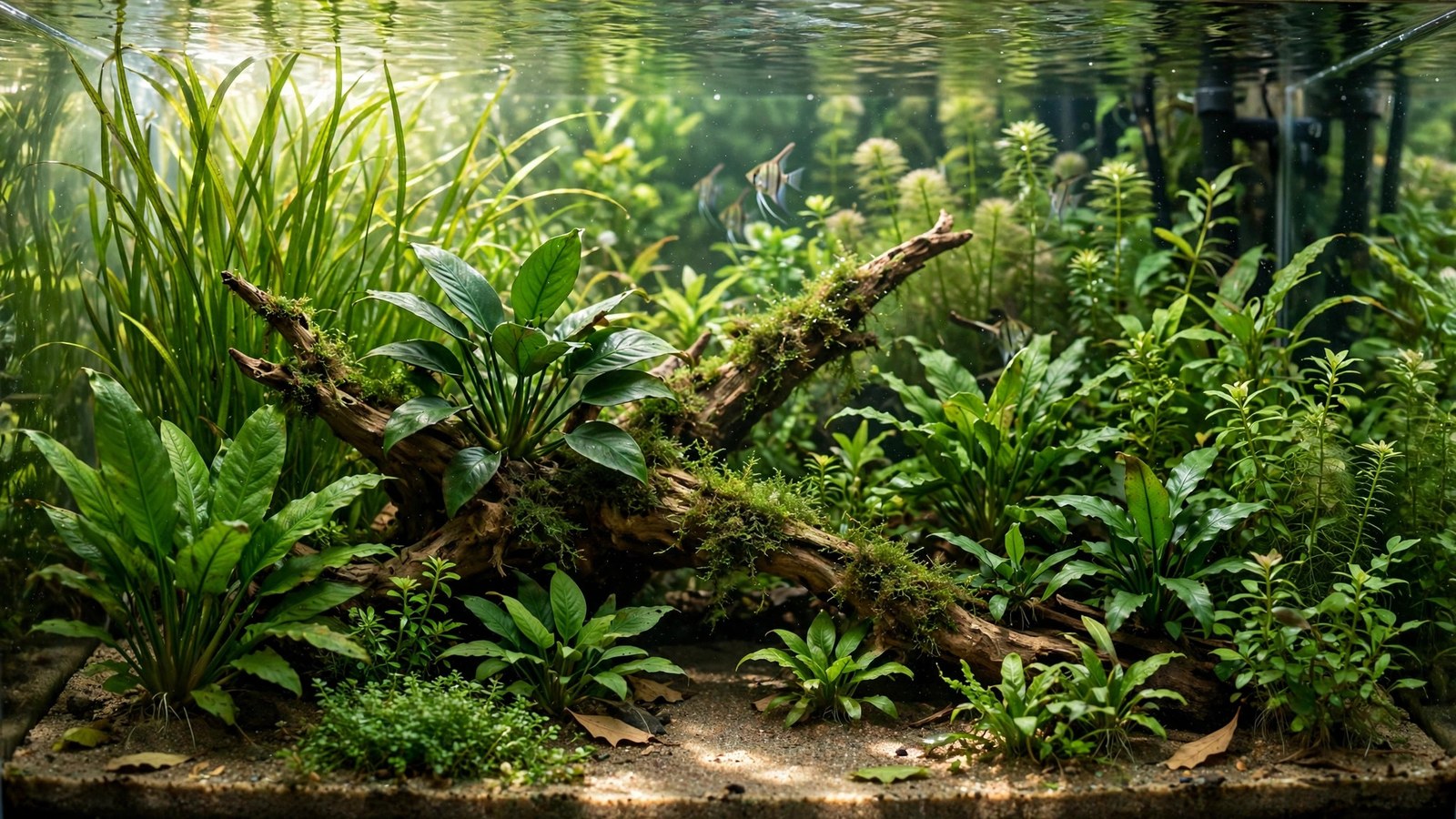
Angelfish are the classic centerpiece fish — tall, graceful, and dramatic — and they look their absolute best in a planted tank that echoes their Amazon home. A planted angelfish tank setup isn't just about beauty, though: the right plants give angels territory boundaries, spawning surfaces, and the security that turns skittish juveniles into confident, interactive adults.
Why Angelfish Need Plants (and Height)
Wild angelfish live among flooded forest roots and tall vegetation in the Amazon basin, navigating vertical structure. A tall tank with tall plants is their native architecture. In short, bare tanks, angels pace the glass and stress; in a planted tank with vertical elements, they patrol territories, display to each other, and — the real prize — breed.
Plants also serve a practical breeding function: angelfish lay eggs on vertical surfaces, and a broad Amazon sword leaf is their preferred spawning slate in captivity. No plants, no convenient spawning sites, far fewer of those fascinating breeding behaviors that make angels special.
Tank Size and Shape: Tall Matters
Angelfish need height first, volume second. Minimum workable setups:
- Single angelfish or pair: 30 gallons, 18+ inches tall
- Small group (4–6): 55 gallons — the classic angel tank
- Community with angels as centerpiece: 55–75 gallons
A standard 55-gallon (48" x 13" x 21" tall) is the sweet spot — enough height for adult angels' 8-inch fin span, enough length for territories. Our 75-gallon planted tank build scales these principles up for a showpiece. Avoid tall-but-narrow "column" tanks; angels need horizontal territory too.
Group dynamics: angels are cichlids with a pecking order. A single angel is peaceful; a mated pair is territorial when breeding; a group of 5–6 spreads aggression and looks spectacular. Never keep just two or three — the odd one out gets bullied relentlessly. Our plants for cichlid tanks guide covers the broader cichlid-plant picture.
Water Parameters: Warm, Soft, Stable
| Parameter | Target range |
|---|---|
| Temperature | 76–82°F (24–28°C) |
| pH | 6.5–7.2 |
| GH | 3–8 dGH |
| KH | 2–5 dKH |
| Ammonia / nitrite | 0 ppm |
| Nitrate | Under 20 ppm |
Warm and soft — the Amazon profile, shared with discus and neon tetras. Our planted neon tetra tank makes an ideal companion build since the water chemistry matches. For the full chemistry picture, see our planted tank water parameters guide.
Substrate and Hardscape
Dark sand or fine dark gravel, 2 inches deep — dark substrate intensifies angel coloration, especially blacks, marbles, and koi patterns. Active aquasoil suits the soft-water chemistry and grows the big root-feeding plants angels want.
Hardscape vertically: tall driftwood pieces reaching toward the surface, a few smooth stones. Angels use vertical wood as territory markers and occasional spawning sites. Arrange hardscape to break the tank into 2–3 visual zones — each zone becomes a potential territory, which is how you keep a group peaceful.
The Angelfish Plant List: Tall and Broad
Think vertical lines and broad leaves — plants that fill the water column, not the carpet:
Background: the tall curtain
- Vallisneria (jungle val, Italian val) — the definitive angelfish background. Tall ribbons reach the surface, sway gently, and create the vertical forest angels navigate. Spreads by runners into a full curtain.
- Amazon sword (Echinodorus bleheri) — broad leaves are spawning slates, resting perches, and territory anchors. One large sword per territory zone. Heavy root feeder — give it root tabs in inert substrate.
- Giant hygrophila / temple plant — fast-growing tall stems that fill the back quickly while slower plants establish.
Midground: structure and spawning sites
- Java fern on driftwood — broad, tough leaves at mid-height; angels frequently choose them for egg-laying. Attach to the vertical wood pieces.
- Anubias barteri on hardscape — big leaves, indestructible, perfect midground anchors that never need replanting.
- Cryptocoryne wendtii / balansae — soft-water classics; balansae's long crinkled leaves add midground height.
- Red tiger lotus — the color accent. Broad red lily pads at mid-height contrast beautifully with silver angels; train it by trimming surface leaves.
Surface and foreground
- Floating plants (frogbit, salvinia) — dim the light to the dappled level angels prefer and give the tank a finished look. See our floating plant guide.
- Foreground: keep it low and simple — dwarf sagittaria or a small crypt patch. Angels ignore the foreground; don't waste effort carpeting it.
Plant densely from day one — 60–70% coverage. Our planting quantity guide helps estimate. Dense planting from the start is what prevents a new angel tank from becoming an algae farm while the fish settle in.
Filtration and Flow
Angels are slow, tall fish — strong current exhausts them and flattens their fins. Use a canister filter or large hang-on-back with the output diffused through a spray bar aimed at the glass. You want full-tank circulation with no jets.
Cover intakes with pre-filter sponges. Juvenile angels are curious and their long fins snag; adults are strong but a sponge-covered intake is cheap insurance. The gentle-filtration approach matches our planted discus tank setup — discus and angels share water, temperament, and flow preferences.
Lighting: Moderate With Shade
Moderate LED lighting, 7–8 hours daily, with floating plants providing dappled shade over portions of the tank. Angels color up best under slightly subdued light — harsh bright light washes out their patterns and makes them skittish. If your angels hide when the lights are on full, that's the tank telling you to dim it.
Tankmates: What Works With Angels
The golden rule: anything that fits in an angel's mouth eventually will be. Adult angels eat neon tetras — it's their natural prey relationship. Choose tankmates accordingly:
- Safe: larger tetras (black skirt, lemon, diamond — too big to eat), corydoras, bristlenose plecos, keyhole cichlids, German blue rams, gouramis (peaceful species)
- Risky: neon/cardinal tetras (fine as juveniles, eaten as the angel grows), small rasboras, guppies (fins nipped, fry eaten)
- Avoid: fin-nippers (tiger barbs, serpae tetras) that shred angel fins, aggressive cichlids, and anything that outcompetes angels for food
Our schooling fish for planted tanks guide details more community combinations. When in doubt, stock the schooling fish first as juveniles alongside juvenile angels — fish that grow up together coexist better.
Feeding Angelfish in a Planted Tank
Angels are enthusiastic omnivores with big appetites. Feed a quality cichlid pellet or large flake twice daily, supplemented with frozen bloodworms, brine shrimp, and daphnia 3–4 times weekly. Variety drives growth, color, and breeding condition — angels fed only flake stay small and pale.
In a community tank, make sure angels actually get food — fast tetras steal everything. Target-feed with pellets dropped near the angels, or feed at both ends of the tank simultaneously. Juvenile angels need 3 small feedings daily for proper growth; adults do fine on two.
Breeding Behavior in Planted Tanks
A well-planted angel tank will eventually produce a breeding pair — you'll know when two fish claim a sword leaf, clean it obsessively, and chase everyone else away. The female lays rows of eggs on the leaf; the male follows, fertilizing; both parents fan and guard them.
In a community tank, most spawns get eaten — by the parents themselves once stressed, or by tankmates overnight. That's normal and fine unless you're breeding deliberately. To raise fry, move the spawning leaf (or the pair) to a dedicated breeding tank; our breeding tank plant setup covers the fry-rearing planted environment.
Cycling and Stocking Order
Plant heavily, cycle, mature 3–4 weeks — the standard planted-tank sequence from our faster cycling guide. Stock schooling fish and bottom dwellers first, angels last. Angels added to an established community settle faster and claim territory more calmly than angels forced to defend a new tank against newcomers.
Buy juvenile angels (quarter to half-dollar body size) in groups of 5–6 and let pairs form naturally. Picking a "pair" at the store is guesswork; groups let the fish choose. Quarantine all new fish 2–3 weeks — angels are susceptible to internal parasites from poor stock.
Maintenance
- 25–30% weekly water change — angels are sensitive to nitrate buildup and dissolved organics.
- Trim background stems monthly — vallisneria runners and hygrophila will take over without regular thinning.
- Remove old sword leaves at the base — angels spawn on fresh leaves; ratty old foliage gets ignored.
- Thin floaters weekly — total surface coverage starves the plants below.
- Vacuum lightly around plant bases; don't disturb established root systems.
Frequently Asked Questions
Will angelfish eat my plants?
Rarely. Angels may mouth soft new growth out of curiosity but don't graze like goldfish or silver dollars. The plant list in this guide is angel-safe. The real plant risk with angels is mechanical — large adults blundering through delicate stems during territorial disputes. Sturdy species in the right positions handle it fine.
Can angelfish live with neon tetras?
Juvenile angels and adult neons coexist fine, which is why the combination is so common — and why it ends in tears. As angels reach full size, neons become food; it's their natural predator-prey relationship. If you want the tetra look with angels, choose larger tetras like lemons, diamonds, or black skirts that stay too big to eat.
How can I tell if my angelfish are a breeding pair?
A true pair claims a territory together, cleans a spawning surface obsessively, and defends it jointly against all comers. Two angels merely tolerating each other isn't a pair. Pairs usually emerge from groups of 5–6 juveniles raised together — the fish choose each other, and once bonded they're exclusive.
Why are my angelfish fighting?
Establishing a pecking order is normal in the first weeks — lip-locking, chasing, and fin displays. It becomes a problem when one fish is cornered, stops eating, or shows fin damage. Causes: too few angels (2–3 guarantees a victim), too little territory structure (add more plants and sightline breaks), or a breeding pair terrorizing the tank (give the pair their own tank).
Do angelfish need tall plants specifically?
They don't need them to survive, but tall plants transform their behavior. Angels in tanks with vertical structure are bolder, display more, and breed more readily — it's the difference between surviving and thriving. Vallisneria curtains and tall swords aren't decoration for angels; they're habitat.
My angelfish laid eggs — what do I do?
Nothing, the first few times. New pairs usually eat their first several spawns while they learn. If you want to raise fry, wait until the pair spawns reliably (3–4 successful egg-laying cycles), then move the spawning slate or the pair to a dedicated rearing tank. In the community tank, enjoy the fascinating parenting behavior — it's one of the hobby's best shows.
The Angelfish Tank at Its Peak
A mature planted angelfish tank is the hobby's idea of elegance: tall fish patrolling vertical green, a mated pair guarding a sword leaf, dappled light through floaters. It takes patience — months for plants to fill in, months for juveniles to grow and pair — but no other freshwater setup delivers quite this combination of grace and living drama. Build it tall, plant it dense, stock it thoughtfully, and let the angels do what they've done for millions of years.
For the natural history behind this setup, see the freshwater angelfish species account on Wikipedia.
Tissue-culture plants are the exception — they’re grown in sterile gel and adapt with minimal melting, which is part of what you’re paying for. Plants bought submersed from another hobbyist’s tank also transition with little melt, since they’re already in the right form.
Which Plants Melt Most (and Least)
Heavy melters (expect significant leaf loss)
- Cryptocorynes — infamous for “crypt melt,” sometimes dropping every leaf after any disturbance. They almost always recover from the roots within weeks.
- Stem plants grown emersed — rotala, ludwigia, and hygrophila often shed lower emersed leaves while the growing tips transition.
- Amazon swords — emersed-grown swords typically lose their broad oval aerial leaves and replace them with longer submersed ribbon leaves.
Light melters
- Anubias, java fern, bucephalandra — slow-growing rhizome plants transition gradually; occasional old-leaf melt but rarely dramatic.
- Vallisneria — usually transitions well, though it dislikes the move itself and may sulk for a week.
- Floating plants — minimal melt since their leaves were already at the air-water interface.
The Acclimation Protocol
Step 1: Quarantine or dip first
Before acclimating to your tank’s conditions, make sure you’re not acclimating pests along with the plant. Run new arrivals through our quarantine and dip protocol — it adds days upfront but prevents months of regret.
Step 2: Float to temperature-match (30 minutes)
Float the bag or container in your tank for 20–30 minutes to equalize temperature. Plants are less temperature-sensitive than fish, but a 10°F shock on top of transplant stress is an avoidable insult.
Step 3: Trim before planting
Remove any leaves that are already damaged, yellowing, or heavily algae-covered — they won’t recover and they’ll rot in your tank, feeding algae. For stem plants, trim off the bottom inch and any emersed leaves that look unlikely to adapt; the plant wastes energy maintaining leaves it’s going to shed anyway. Keep the healthy growing tips — that’s where recovery starts.
Step 4: Plant correctly the first time
Follow our planting guide — right depth, crown exposed on rosettes, rhizomes unburied on epiphytes. Every uprooting and replanting restarts the acclimation clock, so get placement right on the first attempt. Decide where each plant goes before it goes in the water.
Step 5: Run a gentle first week
For the first 7 days after planting:
- Moderate light — run your normal photoperiod but consider dropping intensity 20–30% if your light is dimmable. Blast-level light on a melting plant grows algae on the dying leaves, not recovery.
- Stable CO2 — if you inject CO2, keep it consistent. Fluctuating CO2 during acclimation is a melt accelerator. If you’re low-tech, this doesn’t apply — see growing without CO2.
- Half-strength fertilizer — new plants with damaged leaves can’t use full dosing, and the excess feeds algae. Ramp to full strength over 2–3 weeks per our fertilizer schedule.
- No disturbance — don’t move, trim, or “check on” new plants for at least two weeks. Every touch resets root establishment. This is especially critical for crypts.
Step 6: Remove melt, keep the base
As emersed leaves melt, remove the mushy material promptly — decaying leaves release ammonia and grow fungus that can spread to healthy tissue. But never discard the plant while the crown, rhizome, or roots are firm and alive. A crypt that’s lost every leaf but has firm roots is a plant that’s about to recover, not a dead plant. Give it 3–4 weeks before judging.
Telling Normal Melt From Real Problems
Normal transition melt:
- Affects oldest/emersed leaves first, newest growth last
- New submersed leaves emerge even as old ones dissolve
- Roots and crown stay firm and white/green
- Timeline: 1–4 weeks, then obvious new growth
Concerning melt (see our full melting diagnosis guide):
- New growth also melts or emerges deformed
- Rhizome or crown turns mushy and brown — this is rot, not transition
- Entire plant dissolves within days with no new growth after 4+ weeks
- Melting spreads to established plants that weren’t recently moved
Buying Tips to Minimize Melt
- Buy submersed-grown when available — hobbyist-grown cuttings transition with almost no melt.
- Choose tissue culture for sensitive species — crypts and delicate stems establish far more reliably from sterile cups.
- Avoid plants already melting in the store tank — some melt is normal, but a plant that’s mostly mush at purchase has less energy for recovery.
- Transport carefully — keep plants damp and out of direct sun/heat. A plant that dries out or cooks in a hot car melts far worse than one transported properly.
The First-Month Timeline: What to Expect Week by Week
Knowing what’s normal when removes most acclimation anxiety. Here’s the typical timeline for a healthy plant adapting to a new tank:
Week 1: The quiet week
Almost nothing visible happens. The plant is growing roots you can’t see and assessing its new environment. Some species (vallisneria, stem plants) may start shedding their lowest leaves. This is normal. Resist the urge to “help” — no moving, no extra fertilizer, no light changes. The most common beginner mistake is intervening during a week when the correct action is nothing.
Week 2: Melt peaks
This is when emersed leaves give up in earnest. Crypts may drop everything; swords shed their broad aerial leaves; stem plants lose lower foliage. It looks catastrophic and it’s usually fine. Keep removing mushy material, keep conditions stable, and watch the crown and growing tips — if those are firm and green, recovery is already underway.
Week 3: The turn
New submersed-adapted leaves emerge — smaller, thinner, often a slightly different shade of green than the emersed foliage. Stem plant tips start growing visibly; crypts push tiny curled leaves from the crown; swords unfurl narrow ribbon leaves. This is the moment most beginners exhale for the first time.
Week 4+: Established
New growth outpaces melt, and the plant is functionally yours. You can resume full-strength fertilizer, normal trimming, and stop treating it as fragile. Some slow growers (anubias, bucephalandra) take 6–8 weeks to show obvious progress — that’s their normal speed, not a problem.
Acclimating Different Plant Formats
Tissue-culture cups
Sterile, pest-free, and already adapted to high-humidity (not emersed) growth — tissue cultures melt the least of any format. Rinse the agar gel off gently (leftover gel rots and feeds fungus), split the portion into small plantlets, and plant per our planting guide. They establish slowly for the first two weeks, then accelerate. No dip needed, minimal acclimation stress — this is the premium experience you’re paying for.
Potted plants
Remove the pot and strip away the rockwool completely — leftover rockwool traps debris and rots. Tease the root mass apart gently; if it’s a dense mat, splitting it into 2–3 smaller portions actually establishes faster than planting one big clump (more growing points, better water flow around roots). Potted plants are usually emersed-grown, so expect the standard 2–4 week melt cycle.
Bare-root / bunched stems
Typically sold as weighted bunches. Remove any bands, foam, or weights, strip the lower leaves, and plant stems individually or in small groups. Bunched stems from the store are often already transitioning — check for new submersed growth at the tips, which tells you the plant is mid-adaptation and will settle quickly.
Hobbyist cuttings
Already submersed-grown and the fastest to establish — often showing new growth within days. The main acclimation factor is water-parameter difference between the two tanks. Float to temperature-match, plant promptly, and they’ll usually take off with minimal melt. This is why experienced hobbyists prefer trading cuttings over buying potted plants.
Frequently Asked Questions
Should I use a “plant starter” or transplant fertilizer?
Products marketed for transplant shock are mostly B-vitamins and mild hormones. They don’t hurt, but there’s no strong evidence they help aquarium plants specifically. Stable conditions and patience outperform any bottle. Save the money for more plants.
My new plant melted completely — bare crown, no leaves. Is it dead?
Probably not, if the crown or rhizome is firm. Crypts and swords routinely lose 100% of their leaves and regrow from the base within a month. The test is firmness: firm and pale/green means alive; mushy and brown/black means rot. Give firm-but-leafless plants a full 4 weeks before declaring them dead.
Can I speed up acclimation with extra light or CO2?
No — and trying usually backfires. A melting plant can’t use extra light; the excess just grows algae on its dying leaves. Keep light moderate and CO2 stable (not boosted) during acclimation. Growth speed comes from the plant’s own adaptation timeline, which you can’t rush, only avoid delaying.
Should new plants go straight into my main display tank?
After quarantine/dipping, yes — there’s no benefit to a separate “growing-in” tank for most plants. They acclimate to your water fastest in the tank they’ll live in. The exception is very delicate species going into a tank with boisterous fish; give those a few weeks in a calm corner or breeder box first.
The Patience Rule
The single most important acclimation skill is restraint: plant it right, set gentle conditions, remove decay, and then leave it alone for a month. The hobbyists with the best plant growth aren’t doing something clever in week one — they’re simply not interfering in weeks two through four while the plants do what they’ve evolved to do. Melt looks like failure and feels like failure, but in most cases it’s the visible part of a plant successfully becoming yours.