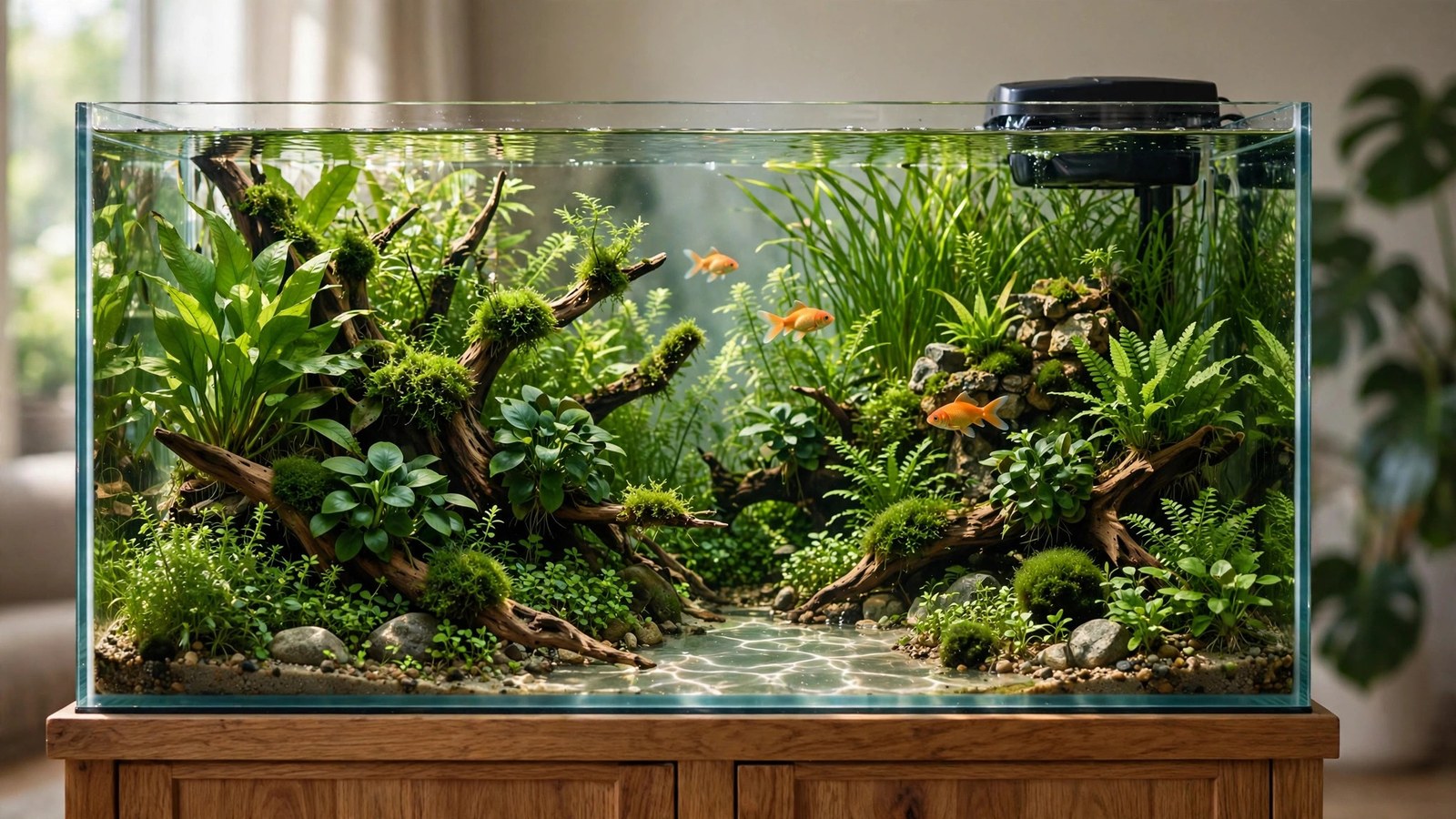
"You can't keep plants with goldfish" is one of the hobby's most repeated — and most wrong — claims. What's true is that you can't keep delicate plants with goldfish using beginner methods. Goldfish are big, hungry, rooting fish, and they will destroy a typical aquascaped tank. But with the right plant species, the right planting methods, and realistic expectations, a planted goldfish tank is not only possible — it's one of the healthiest environments a goldfish can live in.
Why Bother Planting a Goldfish Tank?
Goldfish are waste machines. A single adult fancy goldfish produces more ammonia than a dozen tetras, and nitrate accumulates relentlessly. Plants are the only filtration component that actually removes nitrate rather than just converting it — fast-growing species in a goldfish tank function as a living nitrate filter, measurably reducing how often you need massive water changes.
Plants also give goldfish something to do. A bored goldfish in a bare tank develops neurotic behaviors — glass surfing, gulping air, listlessness. Goldfish in planted tanks graze, explore, sift through leaves, and behave like actual animals. The enrichment value alone justifies the effort, before you even count the water-quality benefits.
The Goldfish Reality Check: Tank Size First
Before plants, the tank: goldfish need far more space than pet stores suggest. Minimums that actually work long-term:
- Fancy goldfish: 30 gallons for the first fish, +10 gallons per additional fish
- Single-tail / common goldfish: 55+ gallons, and honestly these belong in ponds
A planted 40-gallon breeder with two fancies is a realistic, achievable build — our 40-gallon breeder planted tank setup covers the equipment side. Small tanks and goldfish don't mix regardless of plants; no amount of greenery fixes a 10-gallon with a goldfish in it.
Water Parameters: Cold, Hard, Alkaline
| Parameter | Target range |
|---|---|
| Temperature | 65–72°F (18–22°C) — no heater needed in most homes |
| pH | 7.0–8.0 |
| GH / KH | Moderate to hard; stable KH prevents pH crashes |
| Ammonia / nitrite | 0 ppm — goldfish are ammonia-sensitive despite their reputation |
| Nitrate | Under 40 ppm (plants help enormously here) |
Cool water is actually a planting advantage: algae grows slower in cool tanks, and many tough plants thrive at 68°F. The hard, alkaline water rules out soft-water specialists but suits a solid list of goldfish-proof species. See our planted tank water parameters guide for the underlying chemistry.
Substrate: Big Gravel or Sand, Nothing Fancy
Goldfish sift substrate constantly, so choose with their mouths in mind: smooth, rounded gravel too large to swallow, or soft sand they can sift safely. Avoid sharp-edged gravel — goldfish get substrate stuck in their mouths and injure themselves on jagged edges. Active buffering soils are pointless here (goldfish want hard alkaline water) and get churned into mud by rooting behavior anyway.
Depth: 1.5–2 inches. Deeper beds become debris traps under goldfish bioloads, and anaerobic pockets are a real risk when big fish compact the substrate. Keep it shallow and vacuum it.
The Goldfish-Proof Plant List
The rule: tough leaves, bitter taste, or too fast to kill. Goldfish sample everything; plants survive by being unpalatable or indestructible.
Tier 1: nearly goldfish-proof
- Anubias (all varieties) — thick, leathery, bitter-tasting leaves goldfish mouth and abandon. Tie to wood and rocks; never plant in substrate where goldfish will uproot it. The backbone of every planted goldfish tank.
- Java fern — same story: tough, bitter, epiphytic. Windeløv and narrow-leaf varieties add texture. Attach firmly — goldfish bump into everything.
- Bolbitis (African water fern) — beautiful textured epiphyte that goldfish ignore. Slower growing but nearly indestructible once established.
- Crinum (onion plant) — strap-like ultra-tough leaves with a bulb base too heavy for goldfish to move. Dramatic and genuinely goldfish-proof.
Tier 2: survives with protection
- Amazon swords — goldfish nibble them but established swords with big root systems outgrow them. Plant them in heavy root-feeding substrate inside planting baskets (plastic pond baskets buried in the main substrate) to protect root zones from digging while roots grow through the mesh.
- Vallisneria — tough ribbon leaves; plant along the back in dense stands so nibbling is distributed. Jungle val's thicker leaves resist best.
- Hornwort (floating) — grows faster than goldfish can eat it. Float generous bunches; what gets nibbled regrows in days. Doubles as a nitrate sponge.
- Anacharis / elodea — goldfish love eating it, which is the point: it's a cheap sacrificial salad that keeps them off your good plants while absorbing nitrate. Replace regularly.
Plants to skip
Fine carpeting plants (goldfish uproot them in hours), delicate stem plants like rotala (eaten to nubs), dwarf hairgrass (treated as salad), and anything expensive — assume 20–30% plant losses to goldfish curiosity in the first month and plant accordingly.
Planting Methods That Survive Goldfish
How you plant matters as much as what you plant:
- Epiphytes on hardscape — tie anubias, java fern, and bolbitis to driftwood and rocks with thread or glue. Goldfish can't uproot what's not in the substrate. This should be 50%+ of your planting.
- Planting baskets — bury plastic pond baskets (with substrate inside) for rooted plants. The basket walls protect root zones from digging while roots grow through the mesh.
- Anchor with stones — ring new plantings with smooth river stones for the first month until roots establish. Remove the training wheels once plants are anchored.
- Plant big specimens — a mature amazon sword survives goldfish; a tissue-culture baby doesn't. Buy the largest plants you can afford for goldfish tanks.
- Feed vegetables — goldfish destroy plants partly from hunger for greens. Blanched zucchini, peas, and lettuce 2–3 times weekly redirects grazing onto food instead of your scape.
Filtration: Overfilter Aggressively
Goldfish need filtration rated for 2–3x the tank volume. A 40-gallon goldfish tank wants filtration rated for 80–120 gallons — a large canister or a pair of hang-on-backs. Goldfish produce solid waste that clogs mechanical media fast; clean pre-filters weekly.
Flow: goldfish — especially fancies — are poor swimmers. Diffuse the filter output with spray bars or baffles. You want thorough circulation without a current that exhausts round-bodied fish. Cover all intakes with pre-filter sponges; a fancy goldfish's flowing fins and a bare intake are a bad combination.
Lighting: Moderate, and Mind the Algae
Cool water plus goldfish nutrients equals algae opportunity. Run moderate light 6–8 hours daily — enough for anubias, ferns, and swords, not enough to farm green water. A timer is essential; inconsistent photoperiods trigger algae blooms in nutrient-rich goldfish water.
Consider this a low-tech build by necessity: CO2 injection in a goldfish tank is fighting the fish's own biology (huge bioload, constant substrate disturbance). The tough-plant palette thrives without it — our low-tech planted tank setup principles apply perfectly here.
Feeding: Vegetables Are Plant Insurance
A goldfish fed only flakes is a goldfish that eats your plants out of nutritional boredom. Feed a quality sinking pellet as the staple (fancies do better on sinking food — less air gulping), plus blanched vegetables 2–3 times weekly: zucchini, shelled peas, spinach, lettuce. Well-fed goldfish with regular greens still sample plants but rarely destroy them.
Feed only what disappears in 2–3 minutes, twice daily. Uneaten food in a goldfish tank becomes an ammonia bomb fast — and goldfish beg like they're starving regardless of how much they've eaten. Don't fall for it.
Cycling With Goldfish in Mind
Plant first, cycle fishless, add goldfish last. A planted tank cycles faster — our faster cycling guide covers the plant-assisted method — but goldfish bioloads demand a fully mature filter. Don't add goldfish to a tank that's merely "cycled"; give it 3–4 weeks of plant growth and stable readings first.
Add goldfish one at a time, a week or more apart, testing ammonia daily. Each goldfish is a major bioload step; the filter needs time to scale up. Two fancies is a full stock for a 40-gallon — resist the third.
Maintenance: The Honest Schedule
- 40–50% weekly water change — non-negotiable with goldfish. Plants reduce nitrate but don't eliminate the need for big, regular changes.
- Vacuum substrate weekly — goldfish waste accumulates visibly; hover over sand or dig lightly into gravel.
- Rinse pre-filter sponges weekly — they clog fast under goldfish bioloads.
- Trim and replant monthly — remove goldfish-damaged leaves promptly; decaying leaves in a goldfish tank foul water fast.
- Replace sacrificial plants — keep anacharis or hornwort going as the edible buffer; when it's gone, the good plants are next.
Frequently Asked Questions
Will goldfish really not destroy anubias and java fern?
They'll mouth them, especially in the first weeks, but the thick bitter leaves convince most goldfish to give up. The key is starting with mature, firmly attached specimens — a tiny anubias nana petite glued to a pebble might get bulldozed, while a big anubias barteri tied to driftwood is immovable. Size and attachment matter as much as species.
Can I keep a planted tank with common/comet goldfish?
It's much harder. Single-tails grow to 12+ inches, produce enormous waste, and bulldoze with real force — they're pond fish. In the 75+ gallon tanks they need indoors, tough epiphytes on heavy wood can work, but honestly a pond with water lilies suits them better. This guide targets fancy goldfish, which stay smaller and root less violently.
Do goldfish need a heater in a planted tank?
Usually not. Fancies thrive at 65–72°F, which most homes provide year-round. The danger is summer heat, not winter cold — tanks creeping above 78°F stress goldfish and crash oxygen. If your home exceeds 76°F regularly, a fan or chiller matters more than any heater.
My goldfish ate all my plants overnight. What now?
Start over with the Tier 1 list, plant bigger specimens, attach everything to hardscape, and — critically — start feeding blanched vegetables several times a week. Overnight destruction usually means hungry goldfish meeting delicate plants. The combination of tough species plus regular greens solves it in most cases.
How do plants affect goldfish water changes?
They reduce nitrate accumulation, which can let you stretch changes slightly — but don't. Goldfish also produce growth-inhibiting hormones and dissolved organics that plants don't remove. Keep the 40–50% weekly schedule; think of plants as a safety buffer, not a replacement for water changes.
Can I use CO2 in a goldfish tank?
You can, but it's rarely worth it. Goldfish tanks run cool with huge bioloads and constant substrate disturbance — poor conditions for the delicate plants that need CO2, and the tough plants that survive goldfish don't need it. Spend the CO2 budget on a bigger filter and better food instead.
The Planted Goldfish Tank Payoff
A planted goldfish tank won't win aquascaping contests — goldfish see to that. But it will give you healthier, more active, longer-lived goldfish in water that's measurably cleaner, with a tank that's genuinely pleasant to watch instead of a bare box of swimming waste factories. Build it with tough plants, anchor everything, feed your greens, and change your water — the goldfish will do the rest.
For the authoritative species data behind these parameters, see FishBase’s goldfish summary page.
Tissue-culture plants are the exception — they’re grown in sterile gel and adapt with minimal melting, which is part of what you’re paying for. Plants bought submersed from another hobbyist’s tank also transition with little melt, since they’re already in the right form.
Which Plants Melt Most (and Least)
Heavy melters (expect significant leaf loss)
- Cryptocorynes — infamous for “crypt melt,” sometimes dropping every leaf after any disturbance. They almost always recover from the roots within weeks.
- Stem plants grown emersed — rotala, ludwigia, and hygrophila often shed lower emersed leaves while the growing tips transition.
- Amazon swords — emersed-grown swords typically lose their broad oval aerial leaves and replace them with longer submersed ribbon leaves.
Light melters
- Anubias, java fern, bucephalandra — slow-growing rhizome plants transition gradually; occasional old-leaf melt but rarely dramatic.
- Vallisneria — usually transitions well, though it dislikes the move itself and may sulk for a week.
- Floating plants — minimal melt since their leaves were already at the air-water interface.
The Acclimation Protocol
Step 1: Quarantine or dip first
Before acclimating to your tank’s conditions, make sure you’re not acclimating pests along with the plant. Run new arrivals through our quarantine and dip protocol — it adds days upfront but prevents months of regret.
Step 2: Float to temperature-match (30 minutes)
Float the bag or container in your tank for 20–30 minutes to equalize temperature. Plants are less temperature-sensitive than fish, but a 10°F shock on top of transplant stress is an avoidable insult.
Step 3: Trim before planting
Remove any leaves that are already damaged, yellowing, or heavily algae-covered — they won’t recover and they’ll rot in your tank, feeding algae. For stem plants, trim off the bottom inch and any emersed leaves that look unlikely to adapt; the plant wastes energy maintaining leaves it’s going to shed anyway. Keep the healthy growing tips — that’s where recovery starts.
Step 4: Plant correctly the first time
Follow our planting guide — right depth, crown exposed on rosettes, rhizomes unburied on epiphytes. Every uprooting and replanting restarts the acclimation clock, so get placement right on the first attempt. Decide where each plant goes before it goes in the water.
Step 5: Run a gentle first week
For the first 7 days after planting:
- Moderate light — run your normal photoperiod but consider dropping intensity 20–30% if your light is dimmable. Blast-level light on a melting plant grows algae on the dying leaves, not recovery.
- Stable CO2 — if you inject CO2, keep it consistent. Fluctuating CO2 during acclimation is a melt accelerator. If you’re low-tech, this doesn’t apply — see growing without CO2.
- Half-strength fertilizer — new plants with damaged leaves can’t use full dosing, and the excess feeds algae. Ramp to full strength over 2–3 weeks per our fertilizer schedule.
- No disturbance — don’t move, trim, or “check on” new plants for at least two weeks. Every touch resets root establishment. This is especially critical for crypts.
Step 6: Remove melt, keep the base
As emersed leaves melt, remove the mushy material promptly — decaying leaves release ammonia and grow fungus that can spread to healthy tissue. But never discard the plant while the crown, rhizome, or roots are firm and alive. A crypt that’s lost every leaf but has firm roots is a plant that’s about to recover, not a dead plant. Give it 3–4 weeks before judging.
Telling Normal Melt From Real Problems
Normal transition melt:
- Affects oldest/emersed leaves first, newest growth last
- New submersed leaves emerge even as old ones dissolve
- Roots and crown stay firm and white/green
- Timeline: 1–4 weeks, then obvious new growth
Concerning melt (see our full melting diagnosis guide):
- New growth also melts or emerges deformed
- Rhizome or crown turns mushy and brown — this is rot, not transition
- Entire plant dissolves within days with no new growth after 4+ weeks
- Melting spreads to established plants that weren’t recently moved
Buying Tips to Minimize Melt
- Buy submersed-grown when available — hobbyist-grown cuttings transition with almost no melt.
- Choose tissue culture for sensitive species — crypts and delicate stems establish far more reliably from sterile cups.
- Avoid plants already melting in the store tank — some melt is normal, but a plant that’s mostly mush at purchase has less energy for recovery.
- Transport carefully — keep plants damp and out of direct sun/heat. A plant that dries out or cooks in a hot car melts far worse than one transported properly.
The First-Month Timeline: What to Expect Week by Week
Knowing what’s normal when removes most acclimation anxiety. Here’s the typical timeline for a healthy plant adapting to a new tank:
Week 1: The quiet week
Almost nothing visible happens. The plant is growing roots you can’t see and assessing its new environment. Some species (vallisneria, stem plants) may start shedding their lowest leaves. This is normal. Resist the urge to “help” — no moving, no extra fertilizer, no light changes. The most common beginner mistake is intervening during a week when the correct action is nothing.
Week 2: Melt peaks
This is when emersed leaves give up in earnest. Crypts may drop everything; swords shed their broad aerial leaves; stem plants lose lower foliage. It looks catastrophic and it’s usually fine. Keep removing mushy material, keep conditions stable, and watch the crown and growing tips — if those are firm and green, recovery is already underway.
Week 3: The turn
New submersed-adapted leaves emerge — smaller, thinner, often a slightly different shade of green than the emersed foliage. Stem plant tips start growing visibly; crypts push tiny curled leaves from the crown; swords unfurl narrow ribbon leaves. This is the moment most beginners exhale for the first time.
Week 4+: Established
New growth outpaces melt, and the plant is functionally yours. You can resume full-strength fertilizer, normal trimming, and stop treating it as fragile. Some slow growers (anubias, bucephalandra) take 6–8 weeks to show obvious progress — that’s their normal speed, not a problem.
Acclimating Different Plant Formats
Tissue-culture cups
Sterile, pest-free, and already adapted to high-humidity (not emersed) growth — tissue cultures melt the least of any format. Rinse the agar gel off gently (leftover gel rots and feeds fungus), split the portion into small plantlets, and plant per our planting guide. They establish slowly for the first two weeks, then accelerate. No dip needed, minimal acclimation stress — this is the premium experience you’re paying for.
Potted plants
Remove the pot and strip away the rockwool completely — leftover rockwool traps debris and rots. Tease the root mass apart gently; if it’s a dense mat, splitting it into 2–3 smaller portions actually establishes faster than planting one big clump (more growing points, better water flow around roots). Potted plants are usually emersed-grown, so expect the standard 2–4 week melt cycle.
Bare-root / bunched stems
Typically sold as weighted bunches. Remove any bands, foam, or weights, strip the lower leaves, and plant stems individually or in small groups. Bunched stems from the store are often already transitioning — check for new submersed growth at the tips, which tells you the plant is mid-adaptation and will settle quickly.
Hobbyist cuttings
Already submersed-grown and the fastest to establish — often showing new growth within days. The main acclimation factor is water-parameter difference between the two tanks. Float to temperature-match, plant promptly, and they’ll usually take off with minimal melt. This is why experienced hobbyists prefer trading cuttings over buying potted plants.
Frequently Asked Questions
Should I use a “plant starter” or transplant fertilizer?
Products marketed for transplant shock are mostly B-vitamins and mild hormones. They don’t hurt, but there’s no strong evidence they help aquarium plants specifically. Stable conditions and patience outperform any bottle. Save the money for more plants.
My new plant melted completely — bare crown, no leaves. Is it dead?
Probably not, if the crown or rhizome is firm. Crypts and swords routinely lose 100% of their leaves and regrow from the base within a month. The test is firmness: firm and pale/green means alive; mushy and brown/black means rot. Give firm-but-leafless plants a full 4 weeks before declaring them dead.
Can I speed up acclimation with extra light or CO2?
No — and trying usually backfires. A melting plant can’t use extra light; the excess just grows algae on its dying leaves. Keep light moderate and CO2 stable (not boosted) during acclimation. Growth speed comes from the plant’s own adaptation timeline, which you can’t rush, only avoid delaying.
Should new plants go straight into my main display tank?
After quarantine/dipping, yes — there’s no benefit to a separate “growing-in” tank for most plants. They acclimate to your water fastest in the tank they’ll live in. The exception is very delicate species going into a tank with boisterous fish; give those a few weeks in a calm corner or breeder box first.
The Patience Rule
The single most important acclimation skill is restraint: plant it right, set gentle conditions, remove decay, and then leave it alone for a month. The hobbyists with the best plant growth aren’t doing something clever in week one — they’re simply not interfering in weeks two through four while the plants do what they’ve evolved to do. Melt looks like failure and feels like failure, but in most cases it’s the visible part of a plant successfully becoming yours.