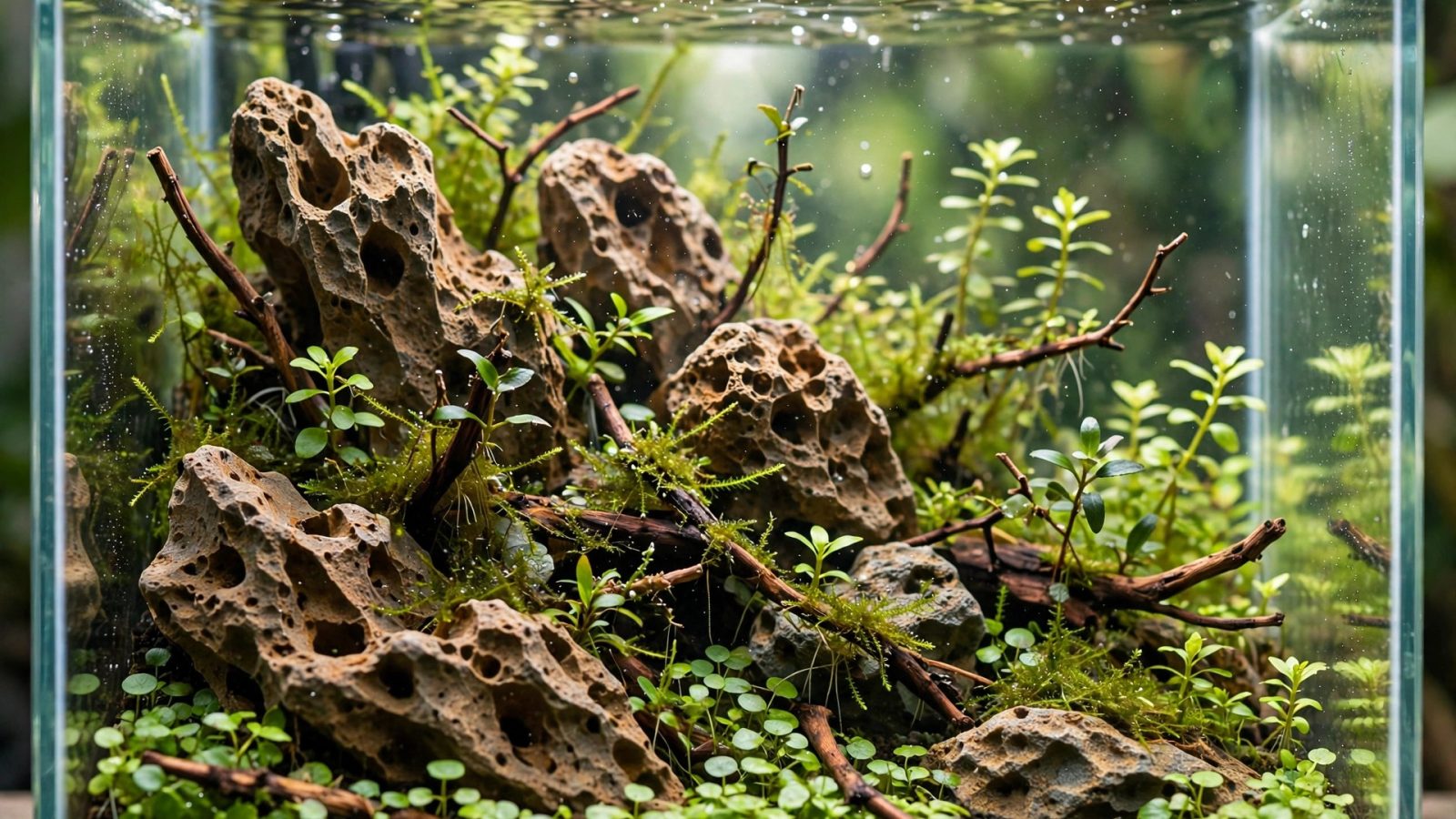
Hardscape in a nano tank is unforgiving. A piece of wood that’s a tasteful accent in a 60cm tank becomes a room-dominating monolith in a 30cm cube. A stone arrangement with perfect proportions at full size looks like random rubble when shrunk. Hardscape for nano aquascapes follows the same design principles as large tanks — but the tolerances are tighter, the material selection more critical, and the margin for error essentially zero.
Here’s how to choose and arrange wood and stone for tanks under ~40 liters so they look like landscapes, not clutter.
The Golden Rule: Proportion
In nano aquascaping, one oversized element destroys the entire composition. Guidelines:
- Focal wood/stone height: 1/3 to 1/2 of tank height, maximum. In a 25cm-tall nano, your hero piece should be 8–12cm tall. Anything taller visually crushes the space.
- Footprint: Hardscape should occupy no more than 1/3 of the substrate area. Nano tanks need open swimming space more desperately than large tanks — cramped nanos look messy, not lush.
- Branch thickness: Fine, delicate branching (thin spider wood, small manzanita twigs) suits nanos. Thick, chunky wood looks cartoonish at small scale.
- Stone size: The main stone 8–12cm in a 30cm tank. Supporting stones 3–6cm. Anything under 2cm reads as gravel, not hardscape.
Best Wood for Nano Tanks
- Small spider wood pieces: The top nano choice — intricate branching at small scale, perfect for moss trees. Buy several small pieces and compose; one bag of nano spider wood goes far.
- Manzanita twigs: Elegant thin branches; a single well-chosen twig can carry a 20-liter scape.
- Cholla wood sections: Ideal shrimp-nano hardscape — hides, grazing surface, and scale-appropriate. See our driftwood guide for details.
- Bonsai trees (small): The manufactured nano trees create an instant focal point. Choose the smallest sizes; even “small” commercial bonsai wood can overwhelm sub-20L tanks.
Avoid in nanos: large mopani chunks (too massive), thick Malaysian driftwood logs (wrong scale), grapevine (too soft, too bulky).
Best Stone for Nano Tanks
- Mini dragon stone (Ohko): Sold specifically in nano sizes; the honeycomb texture reads beautifully at small scale and it’s inert (shrimp-safe).
- Small Seiryu pieces: Stunning but mind the chemistry — in a 20L nano, even a few small Seiryu pieces shift pH measurably. Test with the vinegar test and monitor parameters.
- Lava rock rubble: Cheap, light, stackable — excellent for building nano terraces and backgrounds. Black lava + green moss is a classic nano combination.
- Small river pebbles: For natural-style nano biotopes; smooth and scale-appropriate.
Nano-Specific Arrangement Principles
Depth illusion is everything
Nano tanks are shallow front-to-back, so forced perspective matters enormously: large elements in front, progressively smaller toward the back; substrate sloped steeply (2cm front to 6–8cm back — see our depth guide); small-leaf plants in back, larger-leaf in front (counterintuitive but effective — it mimics atmospheric perspective).
The rule of thirds, strictly
In large tanks you can fudge composition; in nanos, place the focal point at exactly the 1/3 or 2/3 mark. Centered nano hardscape looks static and amateurish — there’s no room for the eye to wander past a centered object.
Negative space is precious
Leave 40–50% of a nano visibly open. The instinct is to fill the tiny space; resist it. Open sand foreground with a single stone group reads as a landscape; the same tank crammed with wood, stones, and plants reads as a pile.
Height without bulk
Nano scapes need vertical interest but can’t afford massive pieces. Solutions: thin vertical wood reaching upward (uses height, minimal footprint), stacked slate terraces (vertical structure, small footprint), tall thin stones. Think spire, not boulder.
Substrate and Hardscape Integration
In nanos, the substrate-hardscape boundary is highly visible — there’s nowhere to hide transitions. Bury stone bases properly (one-third under substrate), ensure wood bases are stable in the shallow bed (small pieces topple easily — anchor them), and keep the front substrate line clean and low. A 2cm foreground of fine sand with the hardscape rising behind it is the classic nano formula.
For planted nanos, aquasoil’s planting ease shines — pushing tiny carpet plantlets into aquasoil powder type beats fighting them into gravel. One 3L bag handles most nanos.
Common Nano Hardscape Mistakes
- One giant centerpiece: The single biggest nano mistake. Break it up or replace it.
- Too many materials: Wood + two stone types + shells in 20 liters = chaos. One wood type, one stone type, maximum.
- Ignoring the back glass: Algae on the back glass ruins nano depth illusion. Keep it clean or paint it dark.
- Unstable stacking: Small stones balanced precariously will topple — in a nano, a toppling stone hits glass within centimeters. Silicone key joints or bury deeper.
- Forgetting growth: That cute moss on the wood will triple in volume. Plants grow — leave room for 3 months of growth in your initial hardscape placement.
- Wrong-scale plants on right-scale hardscape: A perfect nano stone arrangement planted with giant Amazon swords is still wrong. Match plant scale to hardscape scale.
Nano Hardscape for Shrimp Tanks
Shrimp nanos have specific needs: maximum grazing surface (porous lava rock, cholla, moss-covered wood), abundant hides (stone crevices, cholla tubes — shrimplets survive by hiding), and inert materials only (no pH-raising stone for caridina). The hardscape is the shrimp’s habitat infrastructure — prioritize function, and the aesthetics follow naturally from a well-designed shrimp environment.
Budget Nano Hardscaping
Nano quantities are tiny — a “expensive” stone at $5/kg costs $10–15 for a nano’s worth. This is liberating: buy the premium small pieces. One beautiful 10cm dragon stone ($8) transforms a nano more than $50 of mediocre rock transforms a large tank. Splurge on the hero piece; fill supporting roles with lava rubble.
FAQ
Can I break large wood/stone into nano pieces?
Stone: yes — wrap in cloth, chisel along natural fracture lines. Freshly broken faces look natural after a few months of biofilm. Wood: saw carefully; seal nothing, just prepare the fresh cuts normally.
How do I keep small stones from shifting?
Bury deeper (half the stone in nano beds is fine), silicone clusters together, or nestle them into the substrate against larger anchor pieces.
What’s the minimum hardscape for a nano?
One hero piece + 2 supporting stones (or one wood + one stone) is a complete nano hardscape. Minimalism succeeds at small scale.
Three Proven Nano Layouts
1. The Island (20–30L)
A single mound of aquasoil slightly off-center, one hero spider-wood piece rising from it, 3–5 small dragon stones clustered at its base, carpet of Monte Carlo around the island, open sand foreground. The island occupies 1/3 of the tank; the rest is negative space. Simple, elegant, nearly impossible to get wrong.
2. The Valley (15–25L)
Two stone/wood groups — one at each third mark — with a low “valley” of carpet between them. Substrate sloped high at the sides, low in the middle. Creates a strong sense of journey through the scape. Works beautifully with lava rock + moss + dwarf hairgrass.
3. The Cliff (30–40L)
Stacked slate or lava rock forming a terrace wall on one side, tall plants behind it, low carpet in front. Maximum height drama in minimal footprint. The terrace construction must be stable — silicone the structure or bury it deeply.
Photographing Nano Scapes
Nano hardscape flaws hide in person and scream in photos. Before finalizing: photograph the dry arrangement from the front with your phone, convert to black and white (reveals compositional balance without color distraction), and squint at the thumbnail — if the composition reads at thumbnail size, it works. Professional aquascapers do exactly this; the camera is more honest than the eye.
Hardscape Maintenance in Nanos
- Algae shows more at small scale — a little green dust on nano stone is proportionally more visible. Keep a nano algae crew (a few cherry shrimp, one nerite) permanently.
- Don’t rearrange often. Every disturbance in a nano is proportionally massive — a shifted stone clouds the whole tank. Plan once, commit.
- Trim plants aggressively. Overgrown plants swallow nano hardscape in weeks. The hardscape should remain visible — if plants hide it completely, the scape’s skeleton is gone.
- Top up substrate around stone bases annually — nano beds compact and thin faster, exposing buried portions.
Scaling Up: What Changes in Larger Tanks
Understanding nano constraints illuminates large-tank freedom: in 100L+, you can use multiple focal points, mix textures more boldly, tolerate less precise placement, and let plants grow wilder without swallowing the hardscape. The nano discipline — proportion, negative space, restraint — improves large-tank scaping too. Many competition aquascapers practice compositions in nanos before committing to large builds.
The Nano Advantage
Here’s the secret: nanos are the best place to learn hardscape design. Materials cost little, arrangements take minutes to test, failures are cheap, and the tight constraints teach compositional discipline that transfers to every tank you’ll ever build. The aquarist who masters a 20-liter cube can scape anything.