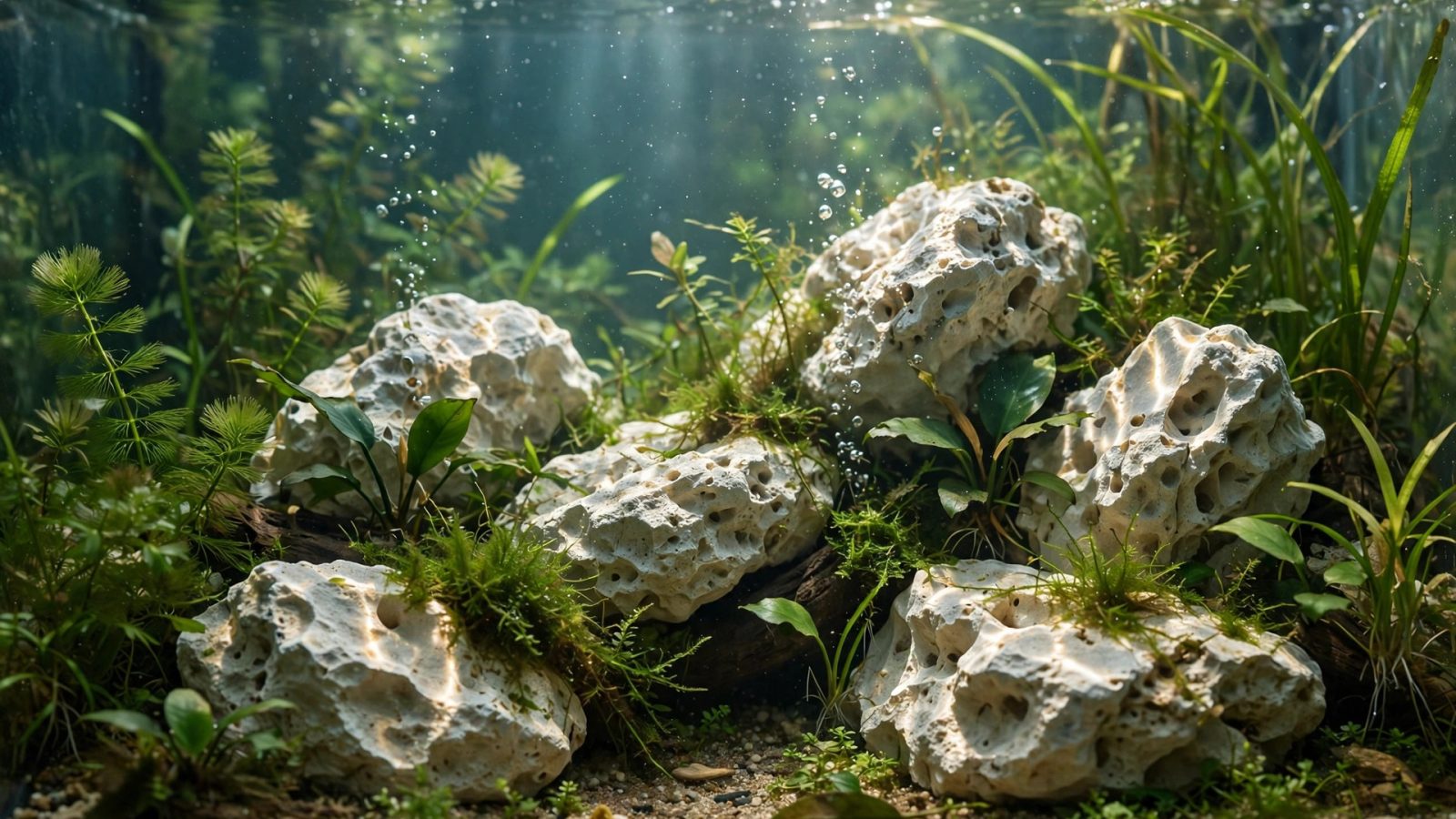
You found the perfect rock for your aquascape. Before it goes in the tank, one question matters more than any other: do aquarium rocks raise pH? Some do — dramatically. A beautiful piece of limestone or Seiryu stone can push your pH from 6.5 to 8.0 and send KH soaring, with real consequences for plants, fish, and shrimp.
The good news: a 30-second vinegar test tells you whether any rock will affect your water. Here’s how it works, what the results mean, and what to do about reactive rocks.
Why Some Rocks Raise pH
Rocks containing calcium carbonate (limestone, dolomite, marble, chalk, Seiryu stone, Texas holey rock, coral rock, travertine) slowly dissolve in aquarium water. The dissolved carbonates increase KH (carbonate hardness), which buffers pH upward, and GH (general hardness) via calcium and magnesium. The effect is continuous — the rock doesn’t “run out” on any hobbyist timescale.
How much the pH actually rises depends on: the rock’s carbonate content, the total rock mass relative to water volume, your water-change schedule (which dilutes the effect), and your starting water chemistry. A single small pebble in a 200-liter tank is negligible; 15kg of Seiryu in a 60-liter Iwagumi is transformative.
The Vinegar Test: Step by Step
- Clean the rock — scrub off dirt so you’re testing the rock, not the mud on it. Let it dry (reactions show better on dry surfaces).
- Apply white vinegar — a few drops on the surface, ideally on a fresh chip or rough spot where interior mineral is exposed.
- Watch and listen for 30 seconds:
- Vigorous fizzing/bubbling = high carbonate content. This rock will raise pH, KH, and GH noticeably.
- Weak fizz, a few bubbles = mildly reactive. Effect depends on quantity — a little is fine, a lot shifts parameters.
- No reaction = effectively inert for aquarium purposes.
- Test multiple spots — especially any veins, white inclusions, or differently-colored areas. A granite with calcite veins may fizz only on the veins.
Stronger version: Muriatic (hydrochloric) acid diluted 10:1 detects weaker carbonates that vinegar misses. Handle with care — gloves, ventilation. For most hobbyists, vinegar answers the practical question.
What the Results Mean for Your Tank
Fizzing rocks (reactive)
Expect: pH rising toward 7.5–8.2, KH and GH climbing steadily between water changes. Suitable for: African cichlids, livebearers, hard-water plants (vallisneria, anubias, Java fern tolerate it), snails that need calcium. Unsuitable for: caridina shrimp (need pH <6.5), soft-water tetras and dwarf cichlids, CO₂-injected soft-water aquascapes, buffering aquasoils (the rock exhausts their buffering capacity).
Non-fizzing rocks (inert)
Granite, basalt, lava rock, slate, dragon stone (Ohko), petrified wood — use freely in any setup. Your water stays whatever your source makes it.
Common Rocks: Quick Chemistry Reference
- Raise pH: Limestone, Texas holey rock, Seiryu stone, coral/crushed coral, marble, travertine, dolomite, chalk
- Inert: Granite, basalt, lava rock, slate, dragon stone, petrified wood, quartz, river rock (most — test to confirm)
- Variable — always test: Sandstone, fieldstone, collected river rock, “assorted decorative rock” from garden centers
Detailed profiles of each type are in our best rocks for aquascaping guide.
I Already Have Reactive Rock — Now What?
Options, from simplest to most involved:
- Embrace it: If your livestock suits hard water, reactive rock is a feature. Rift-lake cichlid and livebearer tanks want this chemistry.
- Reduce quantity: Fewer/smaller reactive stones = smaller effect. Sometimes removing half the stone solves it.
- More water changes: Frequent large changes dilute the carbonate accumulation. Effective but labor-intensive as a permanent strategy.
- Counter with buffering soil: Aquasoil pulls pH/KH down while rock pushes up — they fight, exhausting the soil faster. Workable short-term, wasteful long-term.
- RO water: Starting from zero-TDS reverse-osmosis water and remineralizing gives full control, but the rock still adds carbonates continuously — you’ll chase parameters forever.
- Replace the rock: Honestly, the cleanest solution when chemistry and livestock are fundamentally mismatched. Sell the Seiryu to a hard-water keeper and buy dragon stone.
Plants and Hard Water: What Actually Suffers?
Most common aquarium plants tolerate moderately hard, alkaline water — anubias, Java fern, vallisneria (which loves hard water), hygrophila, and bacopa all do fine at pH 7.5–8.0. What struggles: soft-water specialists like tonina, eriocaulon, and some syngonanthus; red plants often color less intensely in hard water; and nutrient uptake of iron becomes less efficient above pH 7.5, so iron-deficiency yellowing is more common in hard-water tanks — supplement accordingly.
The bigger casualties are usually livestock, not plants: caridina shrimp simply don’t thrive above pH ~7.0, and soft-water fish show washed color and reduced breeding. Match the rock to the animals first, plants second.
Monitoring: What to Test and When
After adding any significant rockwork: test pH, KH, and GH weekly for the first month, then monthly. Test before water changes (to see the maximum drift) and record results — trends matter more than single readings. If KH climbs more than 2–3 degrees between weekly water changes, the rock’s effect is significant and you should decide whether that’s acceptable.
A stable tank with reactive rock isn’t a failed tank — it’s a hard-water tank. Own the chemistry you’ve built rather than fighting it.
FAQ
Will the rock stop affecting pH eventually?
Effectively no — carbonate rock dissolves over geological time. The effect may slow as surfaces develop biofilm coatings, but don’t count on it stopping.
Can I seal reactive rock to prevent leaching?
Epoxy-sealing is sometimes suggested, but sealants fail underwater over time, look unnatural, and defeat the purpose of natural stone. Better to use the right rock.
Does driftwood counteract rock pH effects?
Mildly — driftwood tannins lower pH slightly, but it’s a weak effect against kilograms of limestone. Don’t rely on it for meaningful correction.
My tap water is already hard — does reactive rock matter?
Less. If your tap is pH 7.8 with high KH, limestone rock changes little — you’re already there. The vinegar test matters most for soft-water keepers where the rock would create a chemistry shift.
The Chemistry in Plain Language
Here’s what’s actually happening in the water. Calcium carbonate (CaCO₃) dissolves slightly in water, especially in the mildly acidic conditions of a planted tank (CO₂ injection makes water more acidic, which dissolves carbonates faster — an important interaction). Dissolved carbonate becomes bicarbonate (HCO₃⁻), which is what KH test kits measure. Bicarbonate buffers against pH drops, holding pH higher.
This creates a feedback loop in CO₂-injected tanks: you inject CO₂ → pH drops slightly → more carbonate dissolves from the rock → KH rises → pH stabilizes higher → you inject more CO₂ to hit your target pH → more rock dissolves. Aquarists running Seiryu-heavy Iwagumi tanks with CO₂ often find their KH creeping up month after month. It’s manageable — regular water changes reset it — but it’s a permanent maintenance tax of the stone choice.
Testing Beyond Vinegar: The Bucket Test
For a quantitative answer before committing, run a bucket test: place the rock in a bucket of your tap water, aerate with an airstone, and test pH/KH/GH at day 1, day 3, and day 7. Compare against a control bucket of tap water alone. This tells you not just whether the rock reacts, but how fast and how much — a rock that moves pH 0.2 in a week is a different proposition from one that moves it 1.0.
The bucket test is worth the week for expensive stone purchases or sensitive livestock. It’s the difference between guessing and knowing.
Deliberate pH Raising: When It’s the Goal
Sometimes you want what reactive rock does:
- African cichlid tanks: Texas holey rock or limestone builds the hard, alkaline water (pH 7.8–8.6) these fish need, naturally and stably. This is the textbook use case.
- Livebearer tanks: Guppies, platies, and mollies thrive in harder water; a little limestone keeps parameters in their comfort zone.
- Snail-heavy tanks: Calcium from dissolving carbonates supports shell growth — nerites and mystery snails do visibly better with some carbonate in the water.
- Vallisneria-dominant scapes: Vallisneria is a hard-water specialist that grows explosively with carbonates available.
In these setups, reactive rock isn’t a problem to manage — it’s free, permanent water conditioning. The key is intentionality: choose the rock because of its chemistry, not in spite of it.
Rock, Substrate, and Chemistry Interactions
Hardscape and substrate chemistries interact. Key combinations:
- Reactive rock + buffering aquasoil: They oppose each other. The soil’s buffering capacity exhausts faster — sometimes in months instead of a year+. Avoid this combo when possible.
- Reactive rock + inert gravel/sand: Clean, predictable hard-water tank. The classic cichlid setup.
- Inert rock + buffering aquasoil: The soft-water aquascaper’s standard. No conflicts.
- Reactive rock + dirt: Dirt doesn’t buffer significantly, so the rock dominates — fine if hard water is the goal.
Plan hardscape and substrate together, not separately. Our substrate comparison and aquasoil guide cover the substrate side of these equations.
One Last Thing: Aesthetics vs Chemistry
Seiryu stone is the perfect example of the hobby’s central tension: the most beautiful option carries a chemistry cost. There’s no universally right answer — only the right answer for your water, livestock, and willingness to manage parameters. Test the rock, understand what it does, and make the choice with open eyes. That’s all the vinegar test asks of you: 30 seconds to replace guessing with knowing.