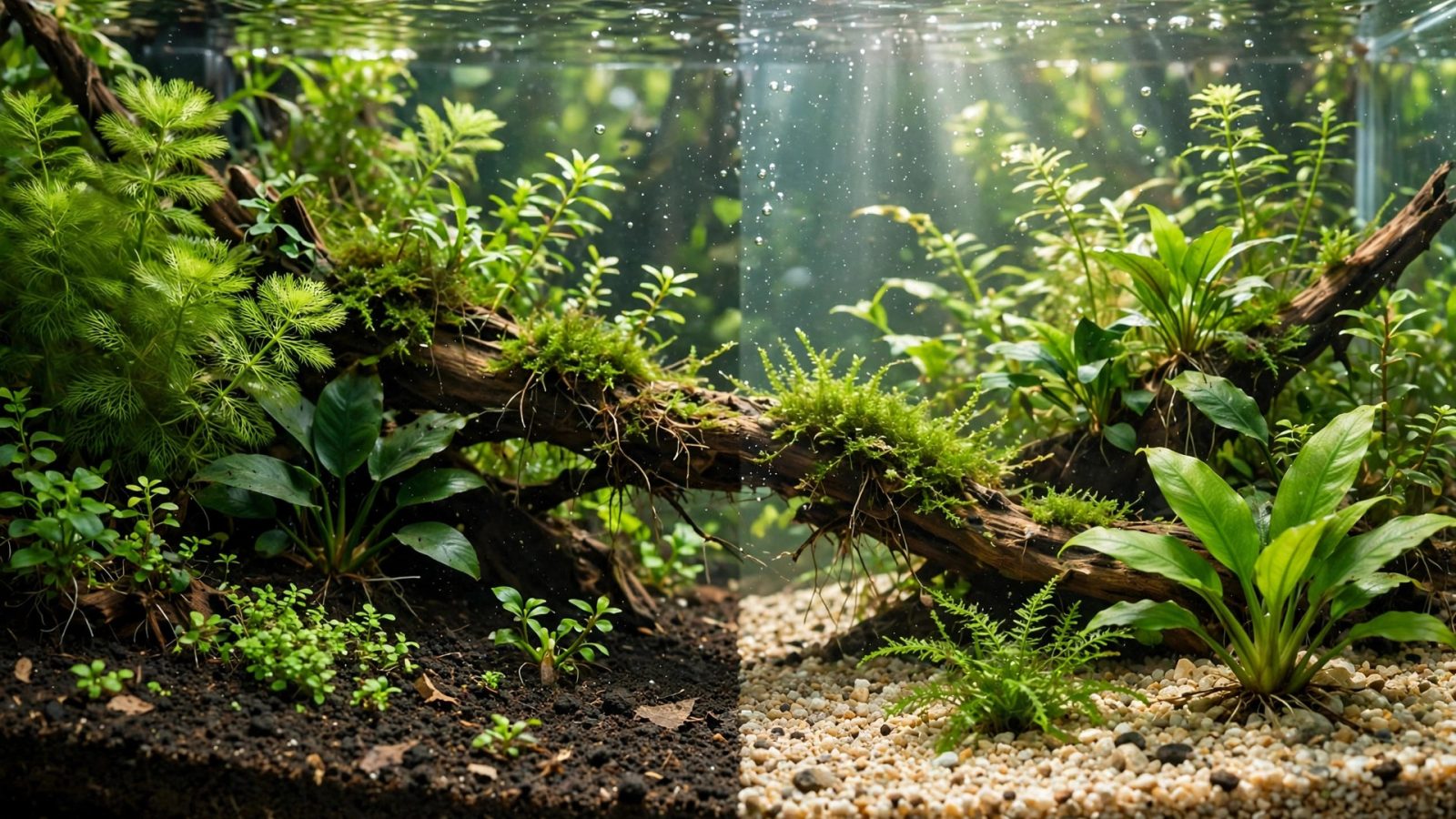
Choose the wrong substrate and your aquarium plants will struggle no matter how good your light or fertilizer routine is. Choose the right one and half the battle of growing healthy plants is already won. The debate between aquarium soil and gravel is the single most consequential decision a planted-tank keeper makes — it affects nutrient availability, root development, water chemistry, maintenance, and your wallet for years.
Here’s the honest short version: aquarium soil (aquasoil) feeds plants better and grows demanding species more reliably, but it costs more, needs replacing every couple of years, and can spike ammonia when new. Gravel is cheap, lasts forever, and looks natural, but it’s nutritionally inert — your plants will depend entirely on what you add via root tabs or liquid fertilizer. Neither is universally “better.” The right choice depends on your plants, your budget, and how much maintenance you’re willing to do.
This guide breaks down the full comparison — nutrients, cost over time, longevity, water chemistry, planting experience, algae risk, and which substrate suits which kind of tank — so you can decide with confidence instead of forum hearsay.
What Counts as “Aquarium Soil” vs “Gravel”?
The terms get thrown around loosely, so let’s define them. Aquarium soil (often called aquasoil) is a manufactured, nutrient-rich substrate made from baked volcanic soil or similar materials. The best-known brands are ADA Amazonia, Fluval Stratum, Tropica Aquarium Soil, and UNS Controsoil. These products come as small round granules, contain bound nitrogen, phosphorus, potassium and trace elements, and actively buffer water chemistry — most lower pH and soften water.
Gravel means inert aquarium gravel: small rounded or angular stones, typically 2–5mm, made from quartz, river rock, or coated stone. It contains essentially zero plant nutrients. Pea gravel from a garden center (rinsed well) and commercial aquarium gravels all fall in this camp. Sand behaves the same way nutritionally — inert — though it differs physically. For a detailed look at sand options, see our best sands for planted aquariums guide.
There’s also a middle ground: mineralized topsoil (a dirted tank capped with sand or gravel), which is nutrient-rich like aquasoil but DIY and far cheaper. We cover that method in how to mineralize topsoil for aquarium use.
Nutrient Content: The Core Difference
This is where the two substrates diverge most sharply. Aquarium soil is nutrient-loaded by design. A fresh bag of ADA Amazonia, for example, releases significant ammonia (NH₃/NH₄⁺) for the first 2–6 weeks — enough that you must cycle the tank before adding livestock. That ammonia is plant food: rooted plants like Amazon swords, cryptocorynes, and vallisneria gorge on it, and the explosive early growth aquasoil tanks are famous for comes largely from this initial nutrient dump, plus the longer-term bound nutrients that keep feeding roots for 12–24 months.
Gravel provides nothing. Plants rooted in plain gravel get nutrients only from the water column (liquid fertilizer) and whatever you push into the substrate as root tabs. This isn’t a death sentence — plenty of beautiful tanks run on inert gravel — but it means you are the nutrient supply chain. Forget to replace root tabs every 2–3 months and heavy root feeders will show it: pale new growth, small leaves, stalled runners.
Which plants care most? Heavy root feeders — Amazon swords (Echinodorus), cryptocorynes, vallisneria, tiger lotus, and most carpeting plants — show the biggest difference. Epiphytes like Java fern and Anubias, which feed from the water column, genuinely don’t care what’s on the bottom. Stem plants are intermediate: they’ll grow in gravel with good water-column dosing, but root in aquasoil faster and more densely.
Cost Comparison: Upfront vs Long-Term
Aquasoil costs roughly 5–10× more than gravel upfront. A 9-liter bag of premium aquasoil (enough for a standard 20-gallon tank at proper depth) runs $30–50; the equivalent volume of aquarium gravel costs $8–15. For a 75-gallon tank needing 4–5 bags, you’re looking at $150–250 in substrate alone versus $30–50 for gravel.
But the honest math includes the hidden costs on both sides:
- Aquasoil: high upfront cost, plus eventual replacement. Aquasoil granules break down over 1.5–3 years, turning to mud that compacts and loses structure. Budget for a full substrate replacement every 2–3 years in a high-energy tank.
- Gravel: cheap upfront, but root tabs cost $10–20 per year for a medium tank, and you’ll use more liquid fertilizer compensating for the inert substrate. Over three years, the gap narrows — though gravel still wins on pure cost.
If budget is the primary constraint, gravel plus root tabs is the smart play. If you want the best plant growth and can afford it, aquasoil earns its price in the first year.
Water Chemistry Effects
This is the difference beginners most often overlook. Most aquasoils actively buffer water: they pull KH down and lower pH, typically settling around pH 6.0–6.8 in the first months. That’s ideal for soft-water plants, caridina shrimp, and Amazonian fish — but it’s a problem if you keep hard-water livestock (African cichlids, livebearers, nerite snails that need calcium) or if your tap water is already very soft, where the buffering can crash pH.
Gravel is chemically inert (with one exception — see below). Your water stays whatever your tap makes it. That predictability is gravel’s quiet strength: no ammonia spike at setup, no pH swings, no surprises. You can add fish on day one of a cycled tank without worrying about what the substrate is doing.
The exception: some decorative gravels and crushed coral marketed as “aquarium gravel” do raise pH and hardness. And certain rocks commonly used as hardscape — looking at you, Seiryu stone — also shift chemistry. Our vinegar test guide shows how to check any rock before it goes in your tank.
Planting Experience and Root Development
Ask anyone who’s planted both: aquasoil is far easier to plant in. The small, uniform granules grip stems and hold them upright; you push a stem in and it stays. Gravel’s larger, looser particles let stems float back out — the classic beginner frustration of replanting the same stem five times. Fine gravel (2–3mm) is better than coarse pea gravel here, but still inferior to aquasoil.
Root development also differs. Aquasoil’s porous granules let roots penetrate easily and access bound nutrients throughout the substrate bed. In gravel, roots spread wider searching for food, and fine-rooted carpeting plants like dwarf hairgrass or Monte Carlo establish noticeably slower — they can still carpet in gravel with root tabs and CO₂, but expect weeks more of patience.
Longevity and Maintenance
Gravel wins longevity outright: it’s rock, it doesn’t decompose, and a gravel bed can serve for a decade. You vacuum it during water changes and it looks the same in year five as day one.
Aquasoil has a lifespan. The granules slowly crumble — faster in high-flow areas and where you frequently replant. After 18–36 months, old aquasoil becomes compacted mud that traps detritus, restricts root growth, and can develop anaerobic pockets. Replacing it means tearing the tank down. Some aquarists “recharge” old aquasoil with root tabs to extend its life, which works reasonably for another year or so.
Maintenance differs too. You should not deep-vacuum aquasoil — you’ll suck up the granules and destroy the nutrient-rich structure. Light surface siphoning only. Gravel tolerates (and benefits from) thorough vacuuming.
Algae Risk in the First Months
New aquasoil tanks are more algae-prone during the first 4–8 weeks. The ammonia leach that feeds plants also feeds algae if light is too strong or planting is too sparse. The standard protocol — heavy planting from day one, 6-hour photoperiod initially, large weekly water changes for the first month — exists precisely because of aquasoil’s nutrient dump. Follow it and you’ll be fine; ignore it and you’ll grow an algae farm.
Gravel tanks start cleaner. No ammonia spike, no nutrient surge — algae pressure depends entirely on your light/fertilizer balance from the start. For a beginner’s first tank, that forgiveness matters.
Which Substrate for Which Tank?
Choose aquarium soil if:
- You’re growing demanding plants: carpets, red stems, heavy root feeders
- You’re running CO₂ injection and want maximum growth
- You keep soft-water fish or caridina shrimp that benefit from the buffering
- You’re aquascaping for competition or photography and want the best results in year one
- You accept replacing substrate every 2–3 years
Choose gravel if:
- You’re on a budget or setting up a large tank where aquasoil costs get absurd
- You keep hard-water livestock (livebearers, African cichlids, snails)
- You want a low-maintenance tank that runs for years without teardown
- Your plant list is mostly epiphytes, Anubias, Java fern, and easy stems
- This is your first tank and you want the most forgiving start
Consider the hybrid: dirted tank with cap
Mineralized topsoil capped with sand or fine gravel gives you aquasoil-like nutrition at gravel-like prices — often under $15 total. It’s more work upfront (see the mineralization process and how to cap soil with sand), and rescaping is messier, but it’s the best value in the hobby for nutrient-hungry planted tanks.
Can You Mix Them?
Yes, with caveats. A common approach is aquasoil in the back (where the heavy planting is) and sand or gravel in the foreground — the classic nature-style layout. Use a physical divider (plastic strips, stones) during setup or they’ll intermingle within months. Don’t layer aquasoil under gravel expecting the best of both — the gravel cap compacts the soil, restricts nutrient exchange, and you lose the planting ease that justifies aquasoil’s price. If you’re capping, cap dirt, not aquasoil.
The Verdict
For a dedicated planted tank where plant health is the priority, aquarium soil wins on results. The growth difference with demanding species is real and visible within weeks. For everything else — budget builds, hard-water community tanks, low-tech setups with easy plants, and tanks you want to run unchanged for five years — gravel is the rational choice, especially paired with root tabs and sensible liquid dosing.
Whichever you choose, get the depth right (see how deep substrate should be), plant heavily from day one, and match the substrate to your actual plant list rather than your aspirations. The best substrate is the one suited to the tank you’re really going to keep.
Substrate Choice by Plant Species
Different plants care about substrate to very different degrees. Here’s how the main groups respond:
Carpeting plants (dwarf hairgrass, Monte Carlo, HC Cuba, glossostigma)
These are the most substrate-sensitive plants in the hobby. Their tiny root systems need fine, nutrient-rich material to anchor and spread. In aquasoil, a Monte Carlo carpet can fill in within 6–8 weeks under good light and CO₂. In gravel, the same carpet may take 4–6 months — runners struggle to grip coarse particles, and each node must find nutrients from tabs you placed weeks ago. If a lush carpet is your goal, aquasoil (or a dirted base) isn’t optional advice; it’s the difference between success and a year of frustration. Our substrate depth guide covers the shallow-but-sufficient bed carpets prefer.
Heavy root feeders (Amazon swords, cryptocorynes, vallisneria, aponogeton, tiger lotus)
An Amazon sword in fresh aquasoil is a sight to behold — leaves the size of your hand within months. In plain gravel with no root tabs, the same plant survives but stays stunted with pale, narrow leaves. With diligent root-tab replacement every 2–3 months, gravel-grown swords can look nearly as good — the key word is diligent. Cryptocorynes are particularly appreciative of aquasoil’s stable, slightly acidic root zone, which mimics the soft riverbeds they come from.
Stem plants (rotala, ludwigia, hygrophila, bacopa)
Stems are the least picky rooted plants. They absorb plenty through leaves, so water-column dosing carries them in either substrate. Aquasoil still gives faster, bushier growth and better coloration in red species (the iron and micronutrient availability helps), but a gravel tank with good liquid fertilizer grows perfectly respectable stems. If your scape is stem-heavy rather than carpet- or sword-heavy, gravel’s disadvantage shrinks considerably.
Epiphytes and floaters (Anubias, Java fern, bucephalandra, mosses, floating plants)
Genuinely substrate-indifferent. These plants attach to driftwood and rock or float freely. A tank of nothing but epiphytes on hardscape can run on bare glass. If this describes your plant list, spend your substrate budget on nice hardscape instead.
Switching Substrates: What to Expect
Many aquarists start with gravel and upgrade to aquasoil later. Here’s the honest picture of a substrate swap:
- It’s a full teardown. There’s no clean way to replace substrate with livestock and plants in place. Plan to temporarily house fish in a bucket with heater and filter for several hours.
- Expect a mini-cycle. You lose the beneficial bacteria living in the old substrate. Keep your filter media wet and running throughout — that’s where most of your bacteria live — and monitor ammonia daily for two weeks after the swap.
- New aquasoil leaches ammonia. Even in an established tank, fresh aquasoil releases ammonia for weeks. Large water changes (50%, twice weekly for the first month) and holding off on new livestock additions will get you through it.
- Plants will melt, then rebound. Cryptocorynes especially may melt all leaves after a substrate change. Don’t panic — they regrow from roots within weeks, usually stronger than before.
Going the other direction — aquasoil to gravel — is simpler chemically (no ammonia spike) but expect a growth slowdown as plants adjust to finding nutrients via your new root-tab routine instead of the substrate itself.
Frequently Asked Questions
Can I put aquasoil on top of gravel?
You can, but it’s backwards. The nutrient-rich layer should be where roots are — at the bottom. Aquasoil over gravel works only if the aquasoil layer itself is deep enough (5cm+) for roots; the gravel underneath then just wastes vertical space. The standard approach is the reverse only for dirted tanks: nutrient dirt on the bottom, inert cap on top.
Does aquasoil expire on the shelf?
Unopened bags keep for years — the nutrients are bound in the baked granules and don’t degrade meaningfully in the bag. Once wet and in a tank, the 2–3 year breakdown clock starts.
Is expensive aquasoil worth it over budget brands?
The premium brands (ADA Amazonia in particular) justify their price mainly through consistency and the intensity of the initial nutrient charge — stronger early growth. Mid-range options like Fluval Stratum or UNS Controsoil perform well for most hobbyists. See our aquasoil brand comparison for the full breakdown.
Can I grow plants in gravel with no fertilizer at all?
Only the toughest species (Java fern, Anubias, mosses attached to hardscape) will genuinely thrive. Everything rooted will slowly starve — it may take months to show, but pale growth and algae on struggling leaves are the eventual result. Even a basic all-in-one liquid fertilizer transforms a gravel tank’s prospects.
How do I know when my aquasoil is exhausted?
Signs: granules crumbling to mud when disturbed, substrate compacting into a dense layer, previously thriving root feeders stalling despite good water-column dosing, and increased detritus trapping. When you see several of these together, it’s time to supplement heavily with root tabs or plan a replacement.
Substrate and Aquascaping Style
Your layout ambitions should influence the choice too. Nature-style and Iwagumi aquascapes — the rock-and-carpet compositions that dominate aquascaping contests — are almost always built on aquasoil. The style demands dense carpets and precise planting that gravel makes unnecessarily hard. If you’re following an Iwagumi layout guide or similar, don’t handicap yourself with inert substrate.
Jungle-style and Dutch tanks, which lean on big stem masses and heavy root feeders, also benefit strongly from aquasoil but are more forgiving — a gravel-based Dutch tank with aggressive root-tab dosing can look excellent. Biototope and Walstad-style tanks have their own logic: Walstad method tanks use soil under a cap by definition (see our mineralized topsoil guide), while many biotope setups use sand or gravel to replicate specific riverbeds where nutrition comes from leaf litter and mulm rather than substrate.
Three-Year Cost Model: A Worked Example
For a standard 20-gallon (75L) planted tank, here’s what each path costs over three years:
- Aquasoil route: 2 bags premium aquasoil ($80) + replacement at year 2.5 ($80) = ~$160. Liquid fertilizer still needed but at lower doses.
- Gravel route: 1 bag gravel ($12) + root tabs ($15/year × 3 = $45) + slightly higher liquid fert use (~$30 extra over 3 years) = ~$87.
- Dirted route: topsoil + sand cap ($15) + mineralization effort (free, but 2–3 weeks) + root tabs from year 2 ($30) = ~$45.
Gravel wins on cost, dirt wins on value, aquasoil wins on results and convenience. There is no wrong answer — only a mismatch between the substrate and what you asked it to do. Pick the one that fits your plants, your livestock, your budget, and your patience, and your tank will thank you for years.
Making the Decision: A 5-Minute Checklist
Still torn? Run through this checklist — the majority answer points to your substrate:
- Plant list: Mostly carpets, swords, crypts, or red stems? → Aquasoil. Mostly Anubias, Java fern, mosses, and easy stems? → Gravel is fine.
- CO₂: Injecting pressurized CO₂? → Aquasoil multiplies the payoff. Low-tech without CO₂? → Gravel with root tabs is the classic low-tech approach for a reason.
- Livestock: Soft-water species or caridina shrimp? → Aquasoil’s buffering helps. Livebearers, cichlids, hard-water snails? → Gravel keeps chemistry stable.
- Budget: Under $30 for substrate? → Gravel or dirted. $80+ available? → Aquasoil.
- Timeline: Want the tank at its best within 3 months? → Aquasoil. Happy to build slowly over a year? → Gravel rewards patience.
Whatever you choose, remember that substrate is a foundation, not a magic spell. Great light, consistent CO₂, and regular maintenance grow great plants on gravel; neglect starves plants on the finest aquasoil. The substrate sets your ceiling — your care determines how close you get to it.
Grain Size Matters More Than You Think
Within each category, grain size is an underappreciated variable. Aquasoil comes in normal and powder types — the powder version (1–2mm granules) is made for foregrounds and small tanks, where it holds tiny carpeting plantlets far better than standard grains. Many aquascapers use normal type in back and powder type in front, getting the best of both.
For gravel, 2–3mm grain is the sweet spot for planted tanks. Pea gravel at 5–8mm looks natural but creates large gaps: stems wobble, detritus falls deep where vacuums can’t reach, and carpeting plants can’t anchor. Very fine gravel (1–2mm) plants beautifully but compacts over time, potentially restricting root spread — regular gentle poking with a skewer during water changes prevents this. Whatever gravel you choose, rinse it thoroughly before use; the dust in a new bag will cloud your tank for days if you skip this.
One last practical note: buy more than you calculate. Substrate depth recommendations (see our depth guide) assume a flat bed, but aquascapes need slopes and mounds that consume 20–30% more material. Running short mid-scape and mixing a different product to finish is a compromise you’ll notice every day. A spare unopened bag is cheap insurance — and it stores indefinitely.