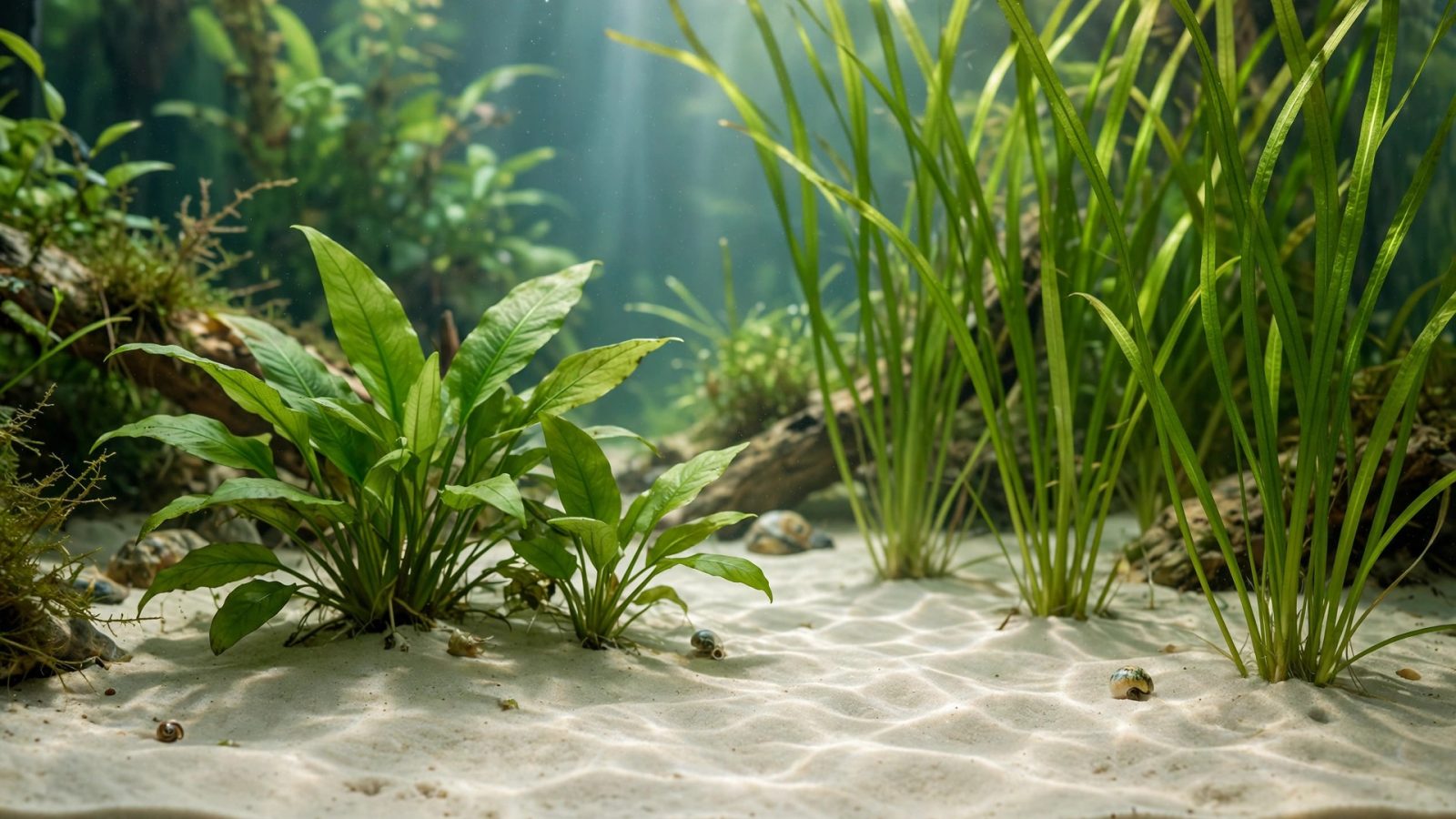
Sand is the most underrated substrate in the planted-tank hobby. It’s cheap, looks natural, is gentle on bottom-dwellers, and — paired with root tabs — grows plants far better than its “inert” reputation suggests. But not all sand is equal: grain size, color, and source determine whether your sand bed becomes a thriving root zone or a compacted, anaerobic mess.
This guide covers the 6 best sands for planted aquariums, what to look for (and avoid), how to prepare sand properly, and how to keep a sand bed healthy long-term.
What Makes Sand Good or Bad for Plants?
Sand is nutritionally inert — it feeds plants nothing. Its virtues and vices are purely physical:
- Grain size: The critical variable. Medium-coarse sand (0.5–1.5mm) allows water exchange and root penetration. Ultra-fine sand (<0.3mm) compacts into concrete-like layers that suffocate roots and trap toxic hydrogen sulfide.
- Uniformity: Evenly graded sand resists compaction better than mixed fine/coarse blends where small particles fill every gap.
- Color: Aesthetic choice with practical consequences — light sand shows every speck of algae and detritus; dark sand hides it but can make the tank feel smaller.
- Sharpness: Rounded grains (river sand, pool filter sand) are safe for corydoras barbels and loaches. Crushed/angular sand (some blasting sands) can injure bottom-dwellers.
1. Pool Filter Sand — The Hobby Standard
Grain: ~0.5–1.0mm, uniform, rounded quartz.
Color: Light tan/white.
Price: ~$10–15 for 50 lbs — absurdly cheap.
Pool filter sand (PFS) is the worst-kept secret in fishkeeping: a 50-pound bag costs less than a small bag of branded aquarium sand and performs identically. It’s pre-washed, uniformly graded, chemically inert, and the rounded grains are cory-safe. The light color brightens tanks and makes green plants pop — though it shows detritus, which honestly just reminds you to vacuum. If you want one sand recommendation without overthinking, this is it.
2. Black Diamond Blasting Sand — The Dark Alternative
Grain: ~0.5–1.0mm (medium grade), angular coal slag.
Color: Deep black with subtle sparkle.
Price: ~$10–12 for 50 lbs.
Black Diamond (coal slag abrasive, medium grit) gives the dramatic dark substrate look for pocket change. Fish colors intensify over dark substrate — neon tetras, cardinal tetras, and red plants all look strikingly better. Two caveats: it’s angular, so while most keepers report no issues with corydoras, the most delicate bottom-dwellers deserve observation; and you must buy medium grit — fine grit compacts badly. Rinse thoroughly; it’s dustier than PFS. Our depth guide applies equally to sand beds.
3. CaribSea Super Naturals — The Premium Natural Look
Grain: 0.5–1.5mm depending on variety.
Color: Multiple river-inspired tones (Torpedo Beach, Crystal River, Sunset Gold).
Price: ~$20–25 for 20 lbs.
CaribSea’s Super Naturals line is for aquarists who want a specific natural aesthetic — riverbed tans, pale golds — with aquarium-guaranteed safety. The grains are smooth, the color is consistent bag to bag, and it’s pH-neutral. You’re paying for curation and convenience versus PFS, which is fair if the exact shade matters to your scape. Functionally, plants grow the same in either.
4. Seachem Fluorite Sand — The Nutrient-Infused Option
Grain: ~1–2mm, porous clay.
Color: Dark brown/black.
Price: ~$25–30 for 15 lbs.
Fluorite is the odd one out: a nutritious sand. It’s porous baked clay rich in iron and trace minerals — not as loaded as true aquasoil, but genuinely beneficial for root feeders, and it never breaks down or needs replacing. It doesn’t buffer pH or leach ammonia, so startup is drama-free. The dust is legendary — rinse until you’re bored, then rinse more. Mixed 50/50 with inert sand, it stretches your dollar while boosting the bed’s fertility.
5. Play Sand — The Ultra-Budget Pick (With Caveats)
Grain: Variable, often very fine (<0.5mm).
Color: Pale tan.
Price: ~$5 for 50 lbs.
Play sand is the cheapest substrate on earth, and plenty of tanks run on it. But the fine, variable grain is genuinely worse for plants — it compacts readily, and dusty batches cloud water for days. If you use it: rinse exhaustively, keep the bed shallow (3–4cm max), and poke it regularly with a skewer to prevent anaerobic pockets. Honestly, pool filter sand costs $5 more for a dramatically better product. Play sand makes sense only when PFS is unavailable.
6. Estes Marine Sand (Stoney River) — The Coated Color Range
Grain: ~1mm, coated quartz.
Color: Huge range including black, white, and natural tones.
Price: ~$20 for 25 lbs.
Estes sands are polymer-coated for colorfastness — the coating won’t flake into the water like cheap dyed gravels. The black and white options are popular for striking aquascapes. Plants grow fine; the coating is inert and smooth. Choose this when you want a specific bold color with guaranteed aquarium safety.
Sands to Avoid
- Beach sand: Salt contamination, pollutants, and often illegal to collect. Not worth the risk.
- Construction/masonry sand: Unwashed, variable composition, may contain limestone (pH spike) or contaminants.
- Silica “moon sand” craft products: Ultra-fine, compacts terribly.
- Crushed walnut shell “sand”: Organic — decomposes and fouls water.
- Any sand with added fragrances or chemicals (some decorative craft sands).
Preparing Sand: The Rinse Protocol
Even “pre-washed” sand needs rinsing. Put 5–10 lbs in a bucket, blast with a hose while stirring vigorously, pour off the cloudy water, repeat until the runoff is nearly clear — typically 5–8 cycles. Skipping this gives you the classic new-sand milk-cloud that can take a week to settle. For blasting sand and Fluorite, double the cycles.
Keeping a Sand Bed Healthy
Preventing anaerobic pockets
The infamous “toxic gas bubbles” are hydrogen sulfide from anaerobic decomposition deep in compacted sand. Prevention is simple: keep sand beds 5cm or shallower in most areas, stock Malaysian trumpet snails (they burrow and aerate the bed nightly — the single best sand-bed maintenance crew), and gently stir the sand with a skewer during water changes. Small bubbles when disturbed are normal and harmless; rotten-egg smell means a genuinely anaerobic zone that needs breaking up.
Fertilizing a sand bed
Sand’s inertness means you’re the fertilizer. Push root tabs deep near heavy root feeders every 2–3 months, and dose the water column for stems and epiphytes. Sand actually holds root tabs well — the dense bed slows nutrient diffusion, keeping food near roots longer than loose gravel does.
Cleaning without clouding
Hover the siphon just above the sand surface — detritus lifts off while sand stays put. Every few weeks, gently rake the top centimeter with a fork to release trapped debris, then siphon. Our full substrate cleaning guide covers technique in detail. Never deep-vacuum sand aggressively; you’ll just make soup.
Sand as a Cap Over Soil
One of sand’s best roles is capping mineralized topsoil in dirted tanks — the sand seals in nutrients while presenting a clean, natural surface. Pool filter sand at 3–4cm over 2–3cm of mineralized soil is the classic Walstad-method build. See how to cap soil with sand for the technique that prevents the two layers mixing.
The Verdict
For most planted tanks, pool filter sand is the rational default — cheap, safe, plant-friendly with root tabs. Want dark? Black Diamond medium grit. Want built-in fertility? Fluorite sand. Sand won’t grow plants by itself, but as a clean, natural, fish-safe foundation that you fertilize intelligently, it’s one of the best values in the hobby.
Sand Color and Fish Behavior: More Than Aesthetics
Substrate color measurably affects livestock. Many fish adjust their coloration to their background — cardinal tetras, neon tetras, and most rasboras display deeper reds and brighter neons over dark substrate, while the same fish look washed out over bright white sand. This isn’t folklore; it’s camouflage physiology. If your priority is fish color, dark sand (Black Diamond, black Estes) is the evidence-based choice.
Conversely, bright sand has real advantages: it reflects light upward, illuminating plant undersides and making the tank feel larger and airier — valuable in small rooms or north-facing spaces. Bottom-dwellers like corydoras show natural sifting behavior more visibly on light sand, which many keepers enjoy watching. Some shy species are actually bolder over light substrate that resembles their native sandy riverbeds — wild-caught corydoras and dwarf cichlids often behave more naturally on pale sand.
Algae visibility cuts the other way: diatoms and green dust algae show dramatically on white sand and nearly vanish on black. If you’re prone to early-tank diatom phases (almost everyone with new setups), dark sand hides the ugly weeks.
Sand Depth: How Much Is Right?
For planted sand beds: 4–6cm in planting zones, 2–3cm in open foreground areas. Deeper than 7cm anywhere invites anaerobic trouble without meaningful benefit — roots of even large swords rarely exploit beyond 6cm. Sloping the bed (shallow front, deep back) creates the aquascaping sense of depth while keeping the average depth safe. Full numbers by plant type are in our substrate depth guide.
Transitioning an Existing Tank to Sand
Switching from gravel to sand is one of the highest-impact upgrades for a community tank — corydoras and loaches transform behaviorally within days. The process:
- House livestock temporarily in a bucket with heater, filter media, and tank water. This takes hours, not days — plan accordingly.
- Remove old substrate with a dustpan or large net. Keep filter media wet throughout; that’s your bacteria bank.
- Add pre-rinsed sand to the target depth, slope as desired, and place hardscape before refilling.
- Refill slowly over a plate to avoid cratering. Expect mild cloudiness for a few hours even with rinsed sand.
- Monitor parameters for a week — you removed bacterial surface area with the old substrate. Usually uneventful if filter media stayed wet, but test to be sure.
Sand and Specific Plant Groups
Carpeting plants in sand
Fine-medium sand (0.5–1mm) is actually excellent for carpets — dwarf hairgrass and Monte Carlo root readily, and runners spread across the smooth surface easily. The key is fertility: carpets are hungry, so place root tabs in a grid pattern (one every 10–15cm) under the planting zone and replace on schedule. Sand-grown carpets are slower than aquasoil carpets but entirely achievable.
Large root feeders in sand
Amazon swords and tiger lotus develop enormous root systems that do well in sand’s dense matrix — the roots get great anchorage. One large root tab quarterly per specimen keeps them lush. Vallisneria spreads via runners just under the sand surface; give it room and it’ll colonize.
Bulb plants
Aponogeton and crinum bulbs rot if buried too deep in any substrate, sand included — plant with the top third of the bulb exposed. Sand’s density actually helps here, holding the bulb at the right height without shifting.
Frequently Asked Questions
Will sand scratch my glass or acrylic tank?
Glass: no. Acrylic: possibly, if coarse grains get trapped in your algae scraper — use a soft pad and lift, don’t drag, near the substrate line. This is a maintenance-technique issue, not a sand problem.
Does sand affect pH?
True quartz and coal-slag sands are inert — no pH effect. But “sand” from garden centers may contain limestone; test any unknown sand with the vinegar test before use. Fizzing means carbonates — fine for hard-water tanks, wrong for soft-water setups.
Can I mix sand with gravel?
They’ll separate over time — sand sifts down through gravel, leaving gravel on top and sand below. This is harmless but looks messy at the boundary. If you want distinct zones (sand foreground, gravel back), use a physical divider strip during setup.
How often should I replace sand?
Essentially never — sand doesn’t decompose or exhaust. Deep-clean or replace only if it’s become deeply fouled from years of neglect. A well-maintained sand bed is a decade substrate.