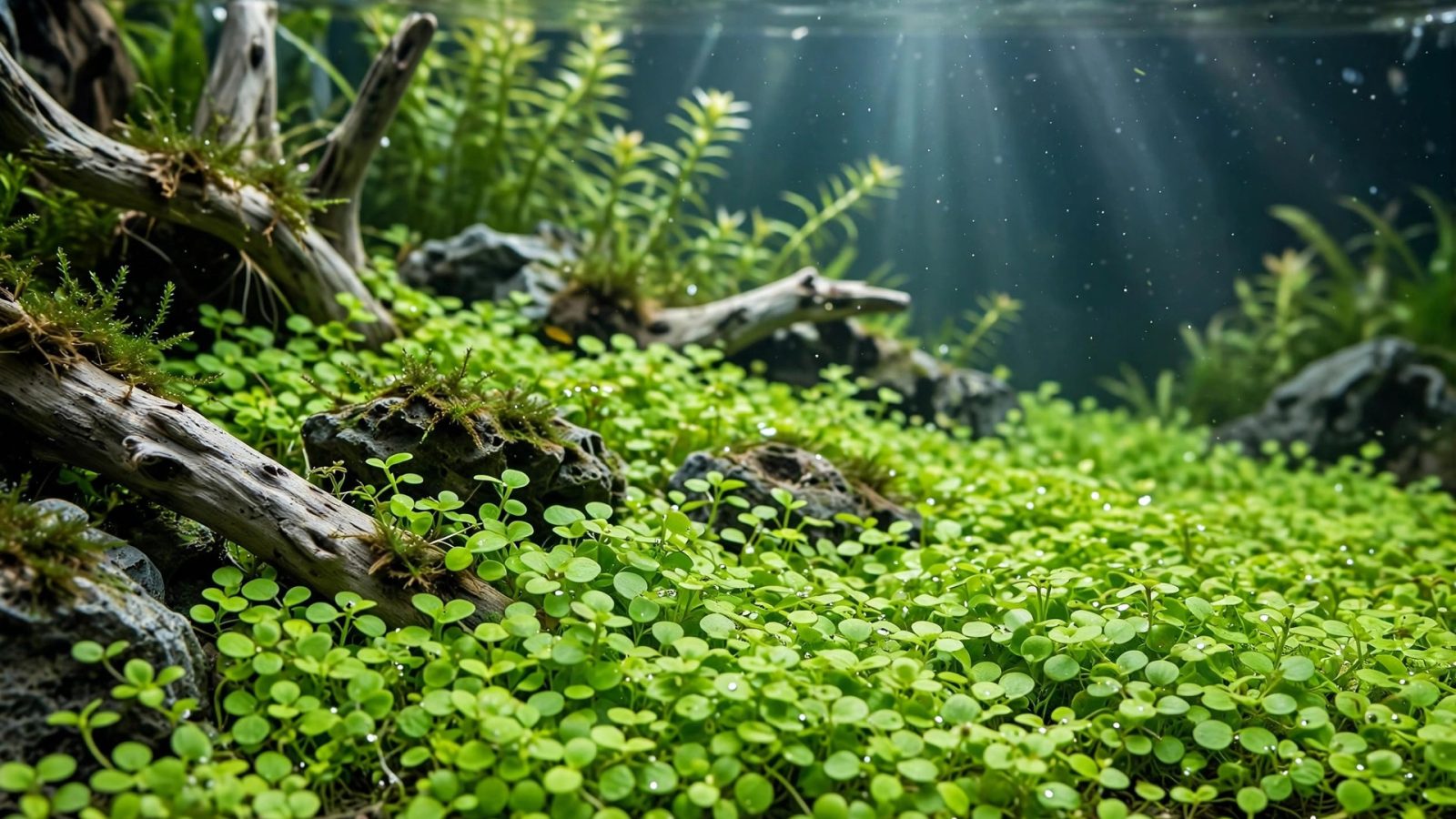
Monte carlo care sits at the center of the hobby’s favorite debate: can you really grow a lush carpet without CO2? Micranthemum tweediei — the small, round-leafed plant behind countless aquascaping contest winners — is the species everyone points to when arguing either side. The honest answer, backed by thousands of hobbyist experiences, is: yes, but the results look different, and the method matters more than the equipment.
This guide gives you both paths straight — what monte carlo does with CO2 versus without — plus the planting technique, substrate needs, and trimming routine that make the difference between a thriving mat and a melting disappointment.
Monte Carlo Care at a Glance
| Parameter | Recommendation |
|---|---|
| Scientific name | Micranthemum tweediei (sold as M. umbrosum ‘Monte Carlo’) |
| Light | Medium to high (40–60+ PAR for compact growth) |
| Temperature | 68–77°F (20–25°C); dislikes heat |
| pH | 6.0–7.0 |
| Water hardness | Soft to moderately hard |
| CO2 | Optional but dramatically effective |
| Fertilizer | Comprehensive liquid + root tabs; appreciates iron |
| Substrate | Fine aquasoil ideal; fine sand with tabs workable |
| Growth rate | Fast with CO2; slow-moderate without |
| Placement | Foreground carpet; also good on hardscape |
| Difficulty | Easy-Moderate with CO2; Moderate without |
CO2 vs. No CO2: The Honest Head-to-Head
| With CO2 | Without CO2 | |
|---|---|---|
| Time to carpet | 6–10 weeks | 4–8 months |
| Growth habit | Low, compact, dense | Taller, leggier, sparser |
| Leaf size | Small and tight | Larger, reaching for light |
| Rooting | Aggressive, deep | Shallower, slower |
| Algae risk | Lower (plant outcompetes) | Higher (slow growth invites algae) |
| Best method | Standard planting | Dry start strongly recommended |
The takeaway: monte carlo is one of the most forgiving carpet plants for low-tech tanks — more forgiving than dwarf hairgrass — but “forgiving” still means months of patience and the right technique. If you want the contest look on a low-tech budget, the dry start method below is your best friend.
Planting Monte Carlo
Monte carlo is sold potted, as tissue culture, or in mats. Each has a best approach:
- Tissue culture (best): pest-free, already submersed-adapted, and divides into dozens of tiny portions. Rinse off the gel, divide into small clumps, and plant in a grid 1–1.5 inches apart.
- Potted: remove rockwool, divide the mat into small portions. Expect some emersed-leaf melt in the first weeks.
- Pre-grown mats: lay directly on the substrate and pin the edges. Fastest instant coverage, but expensive for large areas.
Plant portions shallow — just enough to anchor. Monte carlo roots from stem nodes along the substrate surface; buried stems rot. Tweezers are essential; fingers are too clumsy for portions this small.
The Dry Start Advantage
For low-tech keepers, dry-starting monte carlo is the single highest-impact technique available:
- Arrange hardscape and damp (not soaked) aquasoil.
- Plant tissue-culture portions across the foreground.
- Mist daily, seal with cling film, 10–12 hours of light daily.
- In 4–6 weeks the portions merge into a mat with deep roots.
- Flood slowly. Expect 1–2 weeks of adjustment, then submerged growth resumes.
Why it works so well for monte carlo: unlimited atmospheric CO2 fuels fast emersed growth, and the plant establishes the dense root mat that low-tech submerged growth struggles to build. Many keepers report their dry-started monte carlo never looks back after flooding.
Light, Fertilizer, and Water
Medium to high light keeps monte carlo compact. Under low light it survives but grows upward instead of outward — the opposite of a carpet. Aim for 40+ PAR at the substrate and a 7–8 hour photoperiod. If the plant starts reaching, it is asking for more light, not more fertilizer.
Monte carlo feeds from both roots and leaves. In aquasoil, add a comprehensive liquid fertilizer 2–3 times weekly; in inert sand, add root tabs throughout the carpet zone as well. It appreciates iron — pale new growth often signals iron shortage. Follow a structured routine like our fertilizer schedule rather than dosing randomly.
Keep water on the cooler side of tropical — monte carlo sulks above 78°F. Good flow across the foreground prevents detritus settling into the mat, which is the usual prelude to algae and die-off underneath.
Trimming and Maintenance
- Trim when the mat reaches ~1 inch thick. Cut back to half an inch with curved scissors. Like hairgrass, trimming stimulates horizontal spread.
- Remove every cutting. Monte carlo fragments root wherever they land — including in your filter and among other plants.
- Replant the healthiest trimmings into thin spots to accelerate fill-in. Free plants from your maintenance routine.
- Thin dense mats every few months. Pull small plugs to let light reach the base layer; a mat that is too thick rots from below.
Monte Carlo on Hardscape
An underused trick: monte carlo grows beautifully attached to driftwood and rock, creeping over surfaces in a living green drape. Tie or glue small portions into crevices; the plant’s creeping habit does the rest. Combined with anubias and moss on the same hardscape, it creates the aged, overgrown look in a fraction of the time moss alone takes.
Common Monte Carlo Problems
Melting after planting/flooding
Transition melt, especially with potted emersed stock. Tissue culture melts far less. As long as some green nodes remain, regrowth follows within weeks. Do not disturb the substrate hunting for survivors.
Growing upward instead of carpeting
Insufficient light is the usual cause. Increase intensity or duration; trim tall growth hard to reset the plant’s habit. In low-tech tanks, accept a slightly taller, looser mat — it still looks natural.
Yellowing or pale growth
Nutrient deficiency — typically nitrogen or iron. Increase comprehensive liquid dosing and check root-tab freshness in inert substrates. Compare symptoms with our nutrient deficiency guide.
Algae in the mat
Usually too much light for the CO2 available, or detritus accumulation. Reduce photoperiod, improve flow, siphon the mat gently during water changes, and deploy Amano shrimp.
Sections detaching and floating up
Shallow rooting — common in new low-tech carpets. Press sections back down; they re-root. Long-term, the dry start method prevents this by establishing roots before flooding.
Monte Carlo vs. Dwarf Baby Tears (HC)
Beginners often confuse monte carlo with Hemianthus callitrichoides (HC/Dwarf baby tears). HC has smaller leaves and forms a tighter carpet, but it is significantly more demanding — it really does want CO2 and high light, and it melts readily in low-tech tanks. Monte carlo is the pragmatic choice: 90% of the look at a fraction of the difficulty. Unless you run high-tech, buy monte carlo.
Growing Monte Carlo Emersed
Monte carlo’s emersed form — grown in humid terrariums or nursery trays — is worth understanding even if you never do it deliberately:
- Emersed leaves are larger and rounder than submersed ones. Nursery pots often show this form; the transition to small submersed leaves takes 2–3 weeks.
- Emersed culture is fast. In a sealed container with damp soil and bright light, monte carlo doubles monthly — the fastest way to multiply your stock.
- DIY emersed farm: a plastic storage bin, an inch of damp aquasoil, bright light, and a transparent lid. Plant trimmings, mist weekly, harvest monthly. Free plants forever.
- Transition gradually: move emersed portions to the tank and expect 1–2 weeks of adjustment. Tissue-culture (already submersed) skips this entirely.
Tank Mate Compatibility
Monte carlo’s low carpet is vulnerable to specific tankmates:
- Safe: shrimp (all species), small tetras, rasboras, bettas, otocinclus, nerite snails. The ideal carpet-tank community.
- Caution: corydoras (their enthusiastic sifting uproots new carpets — wait until the mat is established), Amano shrimp in large numbers (they pick at new plantings).
- Avoid: goldfish (eat it), large cichlids (excavate it), digging loaches, apple snails (bulldoze it). A monte carlo carpet and a goldfish are mutually exclusive.
Rule of thumb: if the fish rearranges substrate, it rearranges your carpet. Plant the carpet first, add disruptive species never.
Long-Term Carpet Renovation
Even good carpets age. After 12–18 months, monte carlo mats develop thick underlayers of old growth that restrict flow and trap detritus. Renovation options:
- Hard reset trim: cut the entire mat to substrate level. It looks devastating for two weeks, then regrows denser from the established root base. Best done in spring when growth is vigorous.
- Section replacement: pull up the worst third of the mat and replant with fresh portions or trimmings. Less shocking, done in stages.
- Full replant: for carpets over two years old with chronic algae or compaction. Remove everything, refresh the substrate surface, and replant — essentially a new installation with mature tank biology supporting it.
Regular thinning (every few months from the start) postpones renovation indefinitely. The carpets that need resets are the ones that were never thinned.
Monte Carlo and Water Chemistry
Monte carlo is more particular about water chemistry than its easy-care reputation suggests:
- pH sweet spot: 6.0–7.0. Above 7.5, growth slows noticeably and leaves pale — the plant struggles to uptake iron in alkaline water.
- KH and CO2 relationship: in low-tech tanks, lower KH (2–4 dKH) means more available CO2 from the atmosphere-water equilibrium. High-KH tap water is a hidden handicap for low-tech carpets.
- TDS: monte carlo prefers cleaner water (TDS 100–200 ppm). In hard, mineral-heavy water, consider cutting with RO water for the carpet zone’s water changes.
- Temperature ceiling: sustained temperatures above 78°F cause gradual decline — leaves shrink, growth stalls, algae moves in. If your tank runs hot, monte carlo is not the carpet for you; dwarf sagittaria tolerates heat better.
These are optimizations, not requirements — monte carlo survives outside these ranges. But the difference between “survives” and “carpets beautifully” often lives in these details.
Photography and Showcasing Your Carpet
A mature monte carlo carpet deserves to be shown off. Tips from aquascaping photographers:
- Trim before shooting: a fresh trim 3–4 days before photography gives the densest, most uniform appearance.
- Water clarity: do a large water change the day before and run fine filter floss overnight. Suspended particles ruin carpet shots.
- Lighting angle: shoot with the tank lights at full power and room lights off. The carpet’s texture pops under direct overhead light.
- Water level: for top-down shots, lower the water to just above the carpet. The undistorted surface reveals the mat’s true density.
- Patience: the best carpet photos come 2–3 months after the carpet “finishes” — mature mats develop a richness new carpets lack.
Monte Carlo FAQs
Can monte carlo grow in gravel? It can, but fine gravel (2–3mm) works far better than coarse. The small roots grip fine substrate readily; in coarse gravel, use a thin aquasoil cap or accept slower establishment.
How long before I see runners? With CO2: 1–2 weeks. Without: 4–8 weeks. If no runners after two months, check light levels and consider the dry-start method.
Does monte carlo need trimming if I like it tall? Untrimmed monte carlo grows into a bushy mound 3–4 inches tall — attractive in its own right for midground use. Trim only if you want the carpet form.
Why is my monte carlo turning yellow? Usually nitrogen or iron deficiency. Increase comprehensive liquid dosing; in inert substrate, add root tabs beneath the mat.
Monte Carlo FAQs
Monte carlo or dwarf hairgrass for a first carpet?
Monte carlo is the easier beginner carpet: it tolerates lower light, spreads faster without CO2, and its round leaves hide patchiness better than hairgrass blades. Hairgrass gives the classic lawn look but demands more light and patience. If this is your first carpet attempt, start with monte carlo and graduate to hairgrass later.
How long does the dry start take for monte carlo?
Four to eight weeks in a humid, covered tank with daily misting and bright light. You are done when the mat looks filled in and resists a gentle tug — roots anchored into the substrate, not just sitting on it. Flooding earlier risks the whole mat lifting off in sheets.
Why is my monte carlo growing upward instead of carpeting?
Almost always insufficient light at the substrate level, sometimes combined with too little CO2. The plant stretches toward the light it can sense. Raise light intensity, trim the leggy tops to force horizontal runners, and check that taller background plants are not shading the foreground.
The Bottom Line
Monte carlo care comes down to a simple decision tree: running CO2? Plant it, trim it, enjoy your carpet in two months. Going low-tech? Dry-start it, be patient for six months, and enjoy a carpet that cost you nothing but time. Either way, fine substrate, good light, consistent feeding, and regular trims are non-negotiable. It is the most rewarding carpet plant for the effort invested — which is exactly why it dominates aquascaping contests and beginner forums alike.