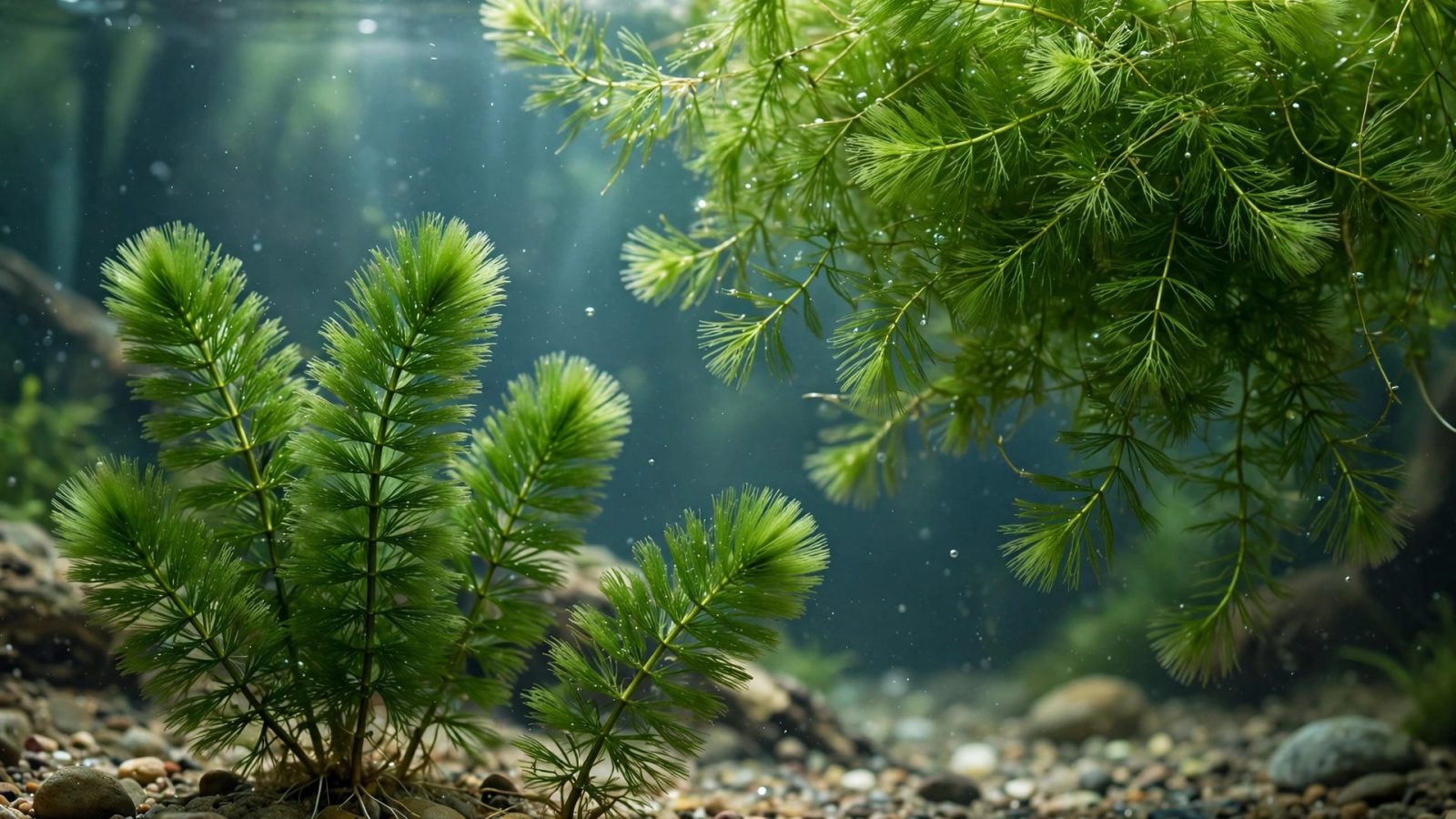
Hornwort care is about as simple as aquarium plants get — this feathery, free-floating stem plant grows in practically any water, needs no substrate, no CO2, and no special light. Drop it in the tank and it grows. It is the ultimate low-effort plant for new tanks, goldfish setups, breeding tanks, and anyone who wants living filtration without the learning curve.
But hornwort’s ease comes with infamous quirks: it sheds its needle-like leaves when stressed, creating a mess that gives it a bad reputation, and it wages chemical warfare on algae (and sometimes neighboring plants). This guide covers growing it floating versus planted, managing the needle drop, and using its algae-fighting properties wisely.
Hornwort Care at a Glance
| Parameter | Recommendation |
|---|---|
| Scientific name | Ceratophyllum demersum |
| Light | Low to high; extremely tolerant |
| Temperature | 59–86°F (15–30°C); very wide range |
| pH | 6.0–7.5 |
| Water hardness | Soft to hard; adaptable |
| CO2 | Not required |
| Fertilizer | None required; absorbs from water column |
| Growth rate | Very fast |
| Placement | Floating (best) or loosely planted |
| Difficulty | Beginner — trivially easy |
Floating vs. Planted: Which Is Better?
Hornwort has no true roots — only modified leaves that grip loosely. This means:
- Floating (recommended): drop stems on the surface and let them drift. They grow fastest this way, with full access to light and atmospheric CO2 at the surface. Floating hornwort forms excellent cover for fry and shy fish.
- Planted: you can anchor stems in the substrate, but they never truly root — they just sit there, and often work loose. If you want the planted look, weigh stems down with plant weights rather than burying them (buried stem bases rot).
For most purposes, floating wins. It is less work, grows faster, and avoids the rotting-base problem entirely. Planted hornwort makes sense only when you specifically want the vertical background texture — and even then, expect to re-anchor stems regularly.
The Allelopathy Effect: Chemical Algae Control
Hornwort’s most interesting trait is allelopathy — it releases compounds that inhibit algae growth. This is not folklore; it is documented well enough that hornwort is a standard recommendation for new tanks battling the early algae bloom. A generous mass of hornwort measurably suppresses green water and thread algae while it outcompetes them for nutrients.
The honest caveats: allelopathy is a mild effect, not a cure. It helps tip the balance in a tank that is already close to balanced; it will not rescue a tank with 12-hour photoperiods and zero water changes. And in very dense plantings, the same compounds may mildly suppress other plants — another reason to give hornwort its own zone rather than weaving it through a delicate aquascape. Think of it as a helpful teammate with strong elbows.
Needle Drop: Causes and Management
Hornwort’s notorious habit: when stressed, it sheds its fine needle-leaves, which drift everywhere — into filters, across the substrate, tangled in other plants. The plant itself usually survives; the mess is the problem. Triggers include:
- Sudden temperature changes — the most common cause. A cold water change or a heater failure can trigger a shed.
- New-tank introduction shock — nursery-to-tank transitions often cause initial shedding before the plant acclimates.
- Liquid carbon products — like vallisneria, hornwort can be sensitive to glutaraldehyde-based supplements.
- Very warm water — prolonged temperatures above 82°F stress it.
Management: keep conditions stable, acclimate new hornwort slowly, and if shedding starts, remove the loose needles promptly with a fine net before they clog your filter. The stems will regrow foliage once stable — hornwort’s recovery powers are excellent. For persistent melt issues across species, see why aquarium plants melt.
Hornwort for Goldfish Tanks
This is hornwort’s killer application. Goldfish eat or uproot most plants, but hornwort’s toughness, fast growth, and unpalatable texture let it survive where anubias and java fern are the only other options. Floating hornwort is ideal — goldfish cannot uproot what is not planted, and the dense mass gives them shelter while absorbing the heavy waste load goldfish produce. For the full goldfish-proof plant list, see our goldfish tank plants guide.
Growth, Trimming, and Propagation
Hornwort grows fast — inches per week in good conditions. Maintenance is minimal:
- Thin regularly. Remove handfuls when the mass doubles — which is often. Floating hornwort can shade the entire tank if ignored.
- Trim by breaking. Stems snap cleanly at nodes. No tools needed.
- Propagation is automatic. Every fragment grows. Side shoots branch from nodes continuously.
- Compost the excess. You will have plenty. Hornwort trimmings make excellent donations to club auctions — beginners love a plant they cannot kill.
Common Hornwort Problems
Shedding needles everywhere
Stress response — check for recent temperature swings, new-tank shock, or liquid carbon use. Stabilize conditions and net out the debris. Regrowth follows.
Stems turning brown and brittle
Usually old growth in low light, or heat stress. Remove brown sections; healthy green tips continue growing. In very warm tanks, consider it a cool-season plant.
Not growing / stagnant
Rare, but happens in extremely soft, nutrient-depleted water. A light comprehensive fertilizer usually restarts growth. Hornwort’s needs are minimal, not zero.
Tangling with everything
Working as designed — it is a drifting plant. Corral floating hornwort with airline tubing rings if you want to keep sections of the surface clear for feeding or light penetration.
Hornwort in Breeding and Quarantine Tanks
Beyond goldfish tanks, hornwort is standard equipment for breeding setups (cover for egg-scatterers and fry), quarantine tanks (easy to disinfect or discard), and hospital tanks (no substrate to trap medication). Its disposability is a feature — when a quarantine period ends, the hornwort goes with the risk.
Hornwort in Outdoor Tubs and Ponds
Hornwort is arguably better outdoors than in. In summer tubs and ponds it grows with wild abandon, providing shade that suppresses algae, shelter for wildlife, and oxygenation — all for free.
- Wildlife ponds: hornwort’s dense submerged mass is prime habitat for newt larvae, dragonfly nymphs, and tadpoles. It is a staple of wildlife-pond planting schemes.
- Winter survival: in mild climates, hornwort overwinters as dormant buds (turions) that sink to the bottom and regrow in spring. In harsh winters, bring a portion indoors.
- Algae control outdoors: the allelopathic effect scales up beautifully — a pond with established hornwort rarely suffers green water.
- Containment: outdoors, hornwort’s vigor is unchecked by glass walls. In natural ponds, check local regulations — it is invasive in some regions and should never be released into waterways.
Winter Care Indoors
Hornwort’s response to winter depends on your setup:
- Heated tanks: grows year-round without pause. No special care needed.
- Unheated indoor tanks: growth slows below 60°F but the plant persists. Reduce thinning frequency — it is not growing enough to need it.
- Cold-water native tanks: hornwort is one of the best plants for unheated setups with white cloud minnows and other cool-water species. See our cold-water plants guide for companions.
Hornwort vs. Anacharis (Elodea)
Beginners often confuse these two feathery stem plants. Key differences:
- Roots: anacharis grows true roots and can be planted properly; hornwort never roots.
- Texture: hornwort’s needles are finer and denser; anacharis leaves are slightly broader.
- Hardiness: both are tough, but hornwort tolerates warmer water better.
- Mess factor: anacharis sheds less when stressed — a meaningful advantage for tidy keepers.
- Allelopathy: hornwort’s algae-suppressing chemistry is stronger and better documented.
Both are excellent beginner plants. Choose hornwort for maximum vigor and algae suppression; choose anacharis for plantable structure and less shedding.
Hornwort and Water Quality Management
Hornwort’s nutrient uptake makes it a functional water-quality tool, not just a plant:
- Nitrate reduction: a dense hornwort mass measurably lowers nitrates — useful in heavily stocked tanks between water changes. It will not replace water changes, but it extends the safe interval.
- Phosphate absorption: hornwort is particularly effective at phosphate uptake, directly competing with the algae that thrive on excess phosphate.
- Oxygenation: fast photosynthesis means significant daytime oxygen production. In breeding tanks and summer heat, this margin matters.
- Toxin sensitivity: hornwort’s fast metabolism makes it an early warning system — if hornwort suddenly sheds or stalls, check for medication residues, metal contamination, or water-supply changes before they affect fish.
Use hornwort strategically: deploy heavy masses during cycling, after rescapes, or when fighting algae, then reduce to maintenance levels once the tank stabilizes.
The Bottom Line
Hornwort care is barely care at all: float it, keep temperatures stable, thin it before it takes over, and net up the needles when it complains. In exchange you get the fastest nutrient export, genuine algae suppression, and goldfish-proof greenery for pennies. It is not the prettiest plant in the hobby — but it may be the most useful one for beginners, and usefulness counts.