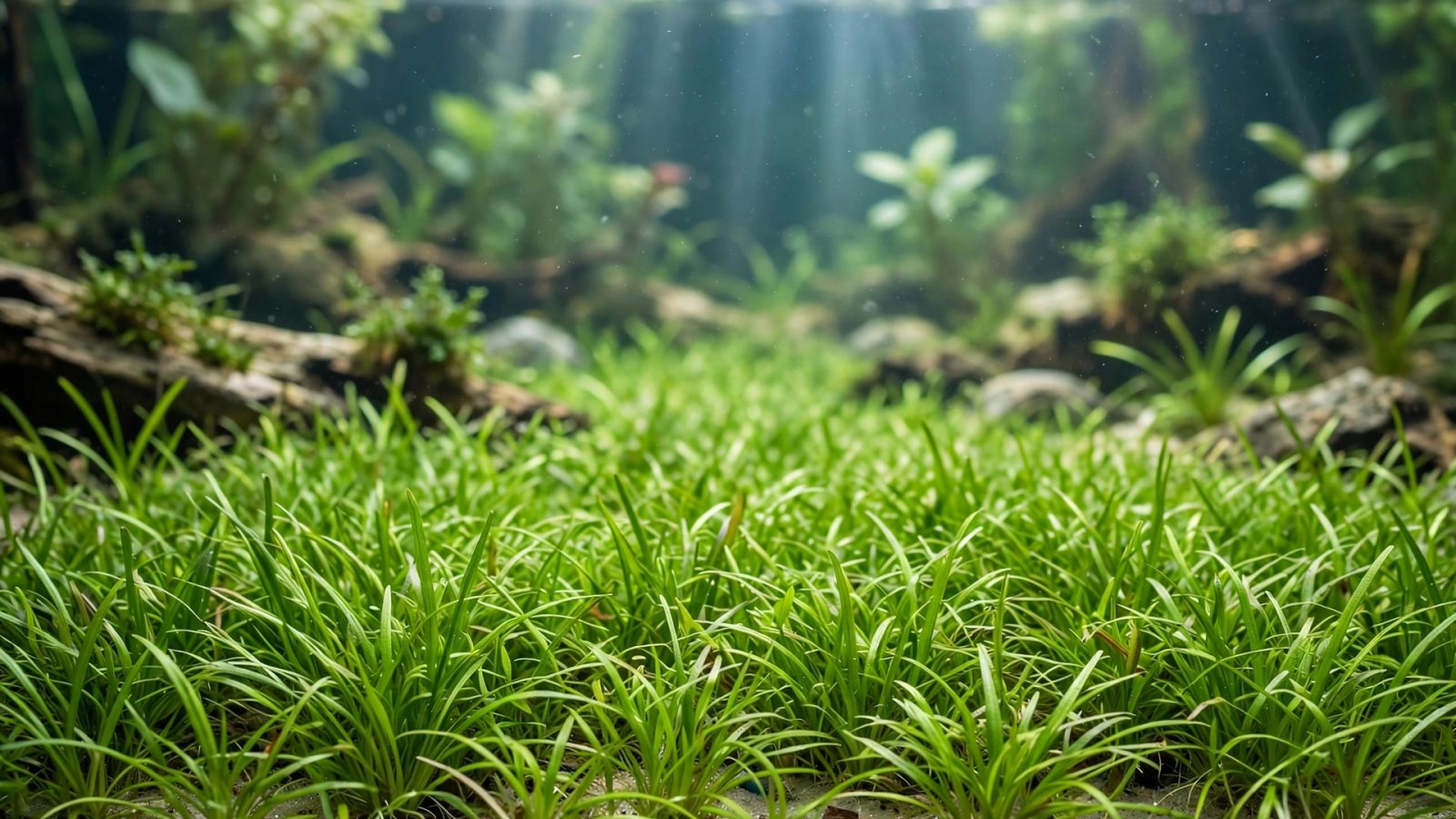
Dwarf sagittaria care is the low-tech aquarist’s answer to the carpet question. While dwarf hairgrass demands patience and monte carlo wants attention, Sagittaria subulata quietly spreads by runners into a grassy foreground in conditions where fussier carpets stall. It is not as fine-textured as hairgrass, but it is dramatically more forgiving — the carpet plant for people who have killed carpet plants.
This guide covers why dwarf sagittaria succeeds where other carpets fail, how to manage its enthusiastic runner spread, and the height-control trick that keeps it looking like a foreground instead of a meadow.
Dwarf Sagittaria Care at a Glance
| Parameter | Recommendation |
|---|---|
| Scientific name | Sagittaria subulata |
| Light | Low to medium (20–40 PAR); undemanding |
| Temperature | 68–78°F (20–26°C) |
| pH | 6.5–7.5 |
| Water hardness | Moderately hard preferred; adaptable |
| CO2 | Not required |
| Fertilizer | Root tabs in inert substrate; light liquid dosing |
| Substrate | 1.5–2 inches; sand or aquasoil |
| Growth rate | Moderate to fast via runners |
| Placement | Foreground (short form) to midground |
| Height | 2–6 inches depending on light (taller in low light) |
| Difficulty | Beginner |
Why It Beats Hairgrass for Beginners
Three advantages make dwarf sagittaria the pragmatic carpet choice:
- It spreads in low light. Where hairgrass sulks below 40 PAR, dwarf sagittaria sends runners happily at 20–30 PAR — standard kit-light territory. This alone makes it the right call for most beginner tanks.
- It tolerates coarse substrate. The runners and roots are sturdier than hairgrass’s delicate threads. It colonizes plain gravel that hairgrass cannot grip.
- It is nearly unkillable. Melt is rare, transition shock is minimal, and established colonies survive neglect that wipes out fussier foregrounds.
The trade-off is texture: sagittaria leaves are wider and coarser than hairgrass blades, giving a meadow look rather than a manicured lawn. In low-tech tanks, that meadow looks intentional and lush. Know what you are buying and you will not be disappointed.
Planting Dwarf Sagittaria
Plant individual rosettes 1–2 inches apart across the foreground, with roots buried and the crown at the surface — the same technique as vallisneria, its taller cousin. Space generously; the runners fill gaps faster than you expect. A single pot divided into a dozen plantlets can carpet a 20-gallon foreground in 2–3 months.
Substrate depth of 1.5–2 inches gives runners room to travel. Root tabs scattered through the planting zone in inert substrate pay off visibly — fed colonies spread roughly twice as fast as unfed ones.
Height Control: Light Is the Lever
Dwarf sagittaria’s height is remarkably light-dependent: under medium light it stays a 2–3 inch foreground; under low light it stretches to 5–6 inches, becoming a midground plant. This is not a defect — it is the plant adapting — but it means:
- For a true foreground, provide medium light (30–40 PAR) and trim tall leaves at the base.
- In low light, accept the taller form and use it as a midground transition instead of fighting it.
- Trimming works differently than hairgrass: do not mow it. Remove individual tall leaves at the base, like vallisneria. Cut leaves brown at the tips.
Runner Management
Dwarf sagittaria spreads exactly like its cousin vallisneria — horizontal runners through the substrate, daughter rosettes at intervals. In the foreground this is exactly what you want. Elsewhere, it is a weed. Monthly runner patrol keeps it contained:
- Trace stray runners back and snip them; replant or discard the daughters.
- A buried plastic barrier between foreground and midground zones works, though runners occasionally dive under.
- Embrace some spread — a sagittaria colony that softens the foreground-to-midground transition looks more natural than a hard carpet edge.
Light, CO2, and Fertilizer
Low to medium light suffices; more light means shorter, denser growth. CO2 is unnecessary — this is one of the genuinely low-tech carpet options, and adding CO2 mainly speeds up the runner maintenance schedule rather than transforming the look.
Feed at the roots: root tabs every 2–3 months in inert substrate. A light comprehensive liquid fertilizer supports the leaves. Like most runner-spreaders, hungry sagittaria shows it through slow spread and pale new leaves — the colony just sits there instead of advancing. Food restarts the march.
Common Dwarf Sagittaria Problems
Growing tall instead of carpeting
Low light. Either increase light for the foreground effect or reclassify it as a midground plant — both are valid, but decide intentionally.
Not spreading
Usually exhausted substrate or too-low light. Refresh root tabs and verify the foreground gets 20+ PAR. Newly planted colonies also pause for 2–3 weeks while establishing roots — patience before intervention.
Melting after planting
Uncommon but possible with emersed nursery stock. crowns usually survive; new submersed leaves follow. Leave the crowns undisturbed per the standard melt recovery approach.
Invading the midground
Normal vigor. Monthly runner patrol, or let a controlled drift create a natural transition zone.
Brown leaf tips
Old leaves aging out, or the aftermath of mowing (do not mow — remove whole leaves). Trim affected leaves at the base.
Dwarf Sagittaria in Aquascaping
Use it where a low-maintenance grassy foreground is wanted without the hairgrass commitment: jungle-style tanks, natural biotopes, and breeding setups where function beats form. It contrasts well with broad-leaf midground plants like cryptocoryne — fine texture against bold leaves is a foundational aquascaping contrast.
Sagittaria Species Compared
| Species | Height | Use |
|---|---|---|
| S. subulata (dwarf) | 2–6 in | Foreground carpet; the beginner choice |
| S. platyphylla | 8–12 in | Midground; broader leaves |
| S. lancifolia | 24+ in | Background; pond plant |
Only S. subulata suits foreground carpet duty. The larger species are background or pond plants — beautiful, but a different job entirely. When buying, verify the species: mislabeled tall sagittaria sold as “dwarf” is a common disappointment.
Natural Habitat: Why It Is So Tough
Sagittaria subulata grows wild in shallow streams, ditches, and marsh edges across the Americas — environments of fluctuating water levels, varying light, and disturbed substrate. This evolutionary background explains everything about its aquarium behavior: the tolerance for different substrates (it roots in mud, sand, and gravel in nature), the runner-spread strategy (colonizing disturbed ground fast), and the shrug at imperfect conditions. You are not coddling a delicate tropical; you are housing a weed with ambitions. Treat it accordingly — it wants to grow, and your job is mostly pointing it in the right direction.
Combining with Other Foregrounds
Dwarf sagittaria plays well with others:
- With dwarf hairgrass: plant sagittaria at the front edge and hairgrass behind it. The texture gradient — coarse to fine — creates natural depth.
- With monte carlo: monte carlo around hardscape bases, sagittaria in open areas. The round-leaf/flat-blade contrast is excellent.
- With crypt parva: the slowest foreground meets the fastest. Crypt parva clusters as accents within the sagittaria meadow.
- Avoid mixing with vallisneria in small tanks — the family resemblance blurs and the taller cousin shades the foreground.
Dwarf Sagittaria in Low-Energy Tanks
This plant’s true niche is the low-energy tank — the setups where other carpets fail:
- Stock-light kits: the all-in-one aquariums with weak built-in LEDs grow dwarf sagittaria happily. It is one of the few foregrounds that works under lighting most carpet guides dismiss as inadequate.
- No-fertilizer tanks: in stocked tanks with fish waste providing nutrients, dwarf sagittaria spreads with zero supplementation. The fish feed the plants; the plants clean the water.
- Walstad method: soil-substrate natural tanks are ideal — the rich soil fuels runner spread that rivals high-tech carpets in speed, if not fineness.
- Office and dorm tanks: minimal maintenance, no CO2 equipment, no dosing schedule. A sagittaria foreground with anubias on wood is the definitive low-effort aquascape.
Seasonal Behavior
Even indoors, dwarf sagittaria responds to seasonal cues:
- Spring surge: runner production peaks. The best time to start new colonies or expand existing ones.
- Summer vigor: fastest growth; also fastest spread into unwanted areas. Runner patrol matters most now.
- Autumn slowdown: growth moderates. Good time for major thinning — the plant recovers slowly but steadily.
- Winter rest: minimal growth. Leave it alone; spring will restart the cycle.
Dwarf Sagittaria FAQs
Dwarf sagittaria vs. micro sword — which carpets better?
Both are easy runner-spreaders, but dwarf sagittaria is tougher and taller. Micro sword (Lilaeopsis brasiliensis) stays shorter and finer but grows more slowly and sulks in poor light. If your tank has a stock LED and you want results this season, pick dwarf sagittaria; if you want the finest texture and have patience plus decent light, micro sword is the prettier carpet.
Will dwarf sagittaria spread in plain sand?
Yes — it is one of the few carpet plants that genuinely colonizes inert sand, provided you feed the roots. Push a root tab into the sand every few inches when planting and replace them every two to three months. Without root feeding, runners stall and the plants sit as isolated tufts instead of knitting into a carpet.
How much do I need for a 20-gallon tank?
Three to five pots, split into small clusters and planted a couple of inches apart across the foreground, will fill in within two to three months. Planting densely up front buys you a carpet months sooner than waiting for a single pot’s runners to cross the tank — with runner plants, the planting density you start with is the timeline you get.
The Bottom Line
Dwarf sagittaria care is refreshingly undramatic: plant it, feed the roots, give it reasonable light, and patrol the runners. It will not produce a contest-grade lawn, but it will produce a living green foreground in a low-tech tank with a stock light — something hairgrass and monte carlo often cannot promise. For beginners, that reliability is worth more than fineness of texture. Start here; upgrade to fussier carpets when (and if) you ever feel the need.