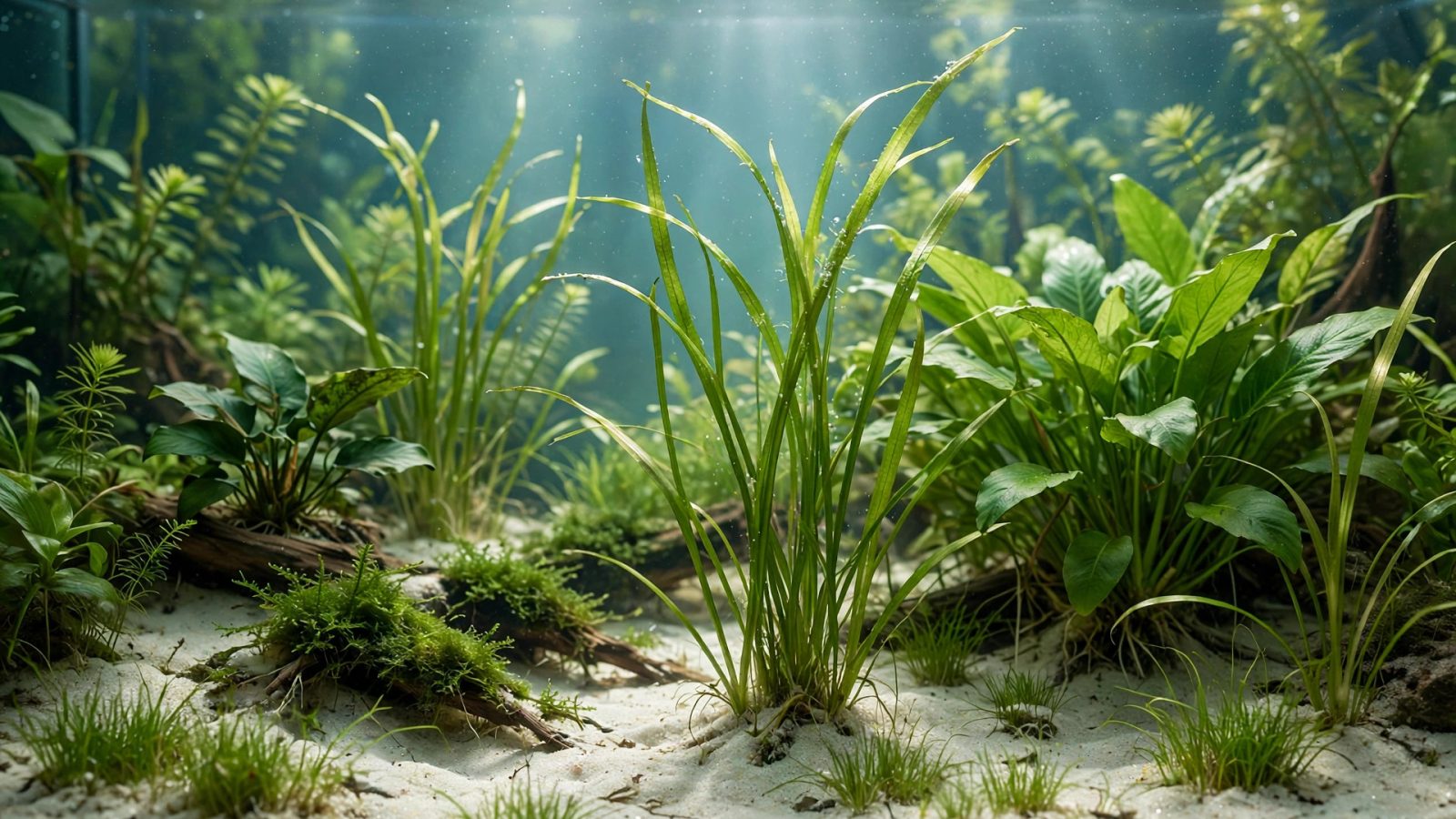
Do aquarium plants grow in sand? Yes — and thriving sand-bottom planted tanks are everywhere in the hobby, from corydoras showcases to minimalist iwagumi scapes. Sand has a reputation as a “difficult” substrate, but that reputation comes from people treating it like aquasoil and being surprised when it behaves differently. Sand grows plants beautifully once you understand its two quirks: it contains zero nutrition, and it compacts.
This guide covers exactly how to make sand work — species selection, the root-tab method, preventing compaction, and which sands to use.
Why Sand Has a Bad Reputation (and Why It’s Undeserved)
Three complaints follow sand around, and each has a straightforward fix:
- “Plants can’t root in sand.” They can — roots penetrate sand easily. What plants can’t do is eat sand, because it’s nutritionally inert. The fix isn’t a different substrate; it’s root tabs.
- “Sand compacts and causes anaerobic pockets.” Fine sand can compact over time, creating oxygen-free zones that produce hydrogen sulfide (the rotten-egg smell). The fix is grain choice and maintenance, covered below — and Malaysian trumpet snails, nature’s substrate aerators.
- “Sand is too dense for carpeting plants.” Runners spread through sand perfectly well. The issue is usually planting technique, not the substrate — see how to plant in substrate.
Choosing the Right Sand
Not all sand is equal. What you want:
- Medium grain (0.5–1mm) — pool filter sand is the hobby standard for good reason: uniform grains that resist compacting while looking natural. Avoid ultra-fine play sand, which compacts worst.
- Inert and aquarium-safe — pool filter sand, blasting sand (Black Diamond is popular for dark scapes), and aquarium-branded sands are all safe. Avoid marine/coral sand (raises pH and hardness — wrong for most planted setups) and any sand with added chemicals or fragrances.
- Color with intent — light sand brightens the tank but shows every speck of debris; dark sand hides debris and makes green plants and colorful fish pop. There’s no nutritional difference; it’s purely aesthetic.
Our best sands for planted aquariums roundup compares specific products. Whatever you choose, rinse it thoroughly before adding — unrinsed sand clouds the tank for days.
The Method: Root Tabs + Liquid Fertilizer
Sand’s zero-nutrition status defines the entire care approach:
Root tabs are mandatory for root feeders
Amazon swords, cryptocorynes, vallisneria, dwarf sagittaria, and tiger lotus cannot thrive in sand without root tabs — there is simply nothing for their roots to eat otherwise. Push tabs 2–3 inches deep near each heavy root feeder, spaced 4–6 inches apart, and replace every 2–3 months. A sword planted in sand with fresh root tabs will outgrow the same sword in aquasoil with exhausted nutrients — the delivery method matters more than the substrate brand.
Liquid fertilizer for everyone else
Epiphytes, stem plants, mosses, and floaters feed from the water column and don’t care what the substrate is. Run your normal liquid fertilizer schedule — sand changes nothing about water-column dosing.
The combination that works
Sand + root tabs (for root feeders) + liquid fertilizer (for everyone) = a complete nutrition system that rivals aquasoil at a fraction of the cost. This is the exact approach behind the “inert substrate plus targeted nutrition” strategy — effective, cheap, and fully controllable.
Preventing Compaction and Anaerobic Pockets
The legitimate sand concern. Anaerobic pockets form when fine substrate compacts so tightly that oxygen can’t penetrate, allowing anaerobic bacteria to produce hydrogen sulfide — toxic in large amounts, and capable of killing roots it contacts.
Prevention
- Keep sand depth moderate: 1.5–2.5 inches. Deep sand beds (4″+) are where anaerobic zones thrive. See our substrate depth guide for plant-specific numbers.
- Choose medium grain over fine — larger grains leave larger interstitial spaces for water flow.
- Add Malaysian trumpet snails (MTS). These burrowing snails constantly turn the upper substrate layers, preventing compaction naturally. They’re the single best sand-maintenance tool in the hobby — a small colony does more than any maintenance routine.
- Plant densely. Root systems physically break up substrate and oxygenate it — planted areas resist compaction far better than bare sand.
Maintenance
- Stir gently during water changes — run your fingers or a skewer through open sand areas monthly to break up early compaction. Avoid deep stirring near established plant roots.
- Hover-vac, don’t plunge. Hold the siphon just above the sand surface to lift debris without sucking up substrate. Sand is light enough to get pulled into siphons — the hover technique keeps it in the tank.
- Smell check: if you disturb the sand and get a rotten-egg smell, you have hydrogen sulfide buildup. Increase stirring frequency, consider MTS, and reduce depth in that area. Small amounts released gradually are harmless; it’s the undisturbed accumulation that’s dangerous.
Best Plants for Sand Substrates
Excellent in sand (with root tabs)
- Vallisneria — arguably the best sand plant; its runners spread aggressively through sand
- Dwarf sagittaria — carpets sand beautifully via runners
- Amazon swords — with tabs, grow enormous in sand
- Cryptocorynes — adapt well; wendtii is nearly indestructible in sand
- Red tiger lotus — bulb + tabs + sand = spectacular
Excellent in sand (no tabs needed)
- All epiphytes (anubias, java fern, bucephalandra) — attached to hardscape, indifferent to substrate
- All floating plants — no substrate contact at all
- Stem plants — root in sand fine; feed from water column via liquid ferts
Trickier in sand
- Fine carpeting plants (dwarf hairgrass, monte carlo) — doable but slower than in aquasoil; the dry-start method helps enormously
- Heavy root feeders without tabs — not a plant problem, a nutrition problem. Add the tabs.
Sand vs Aquasoil: Honest Comparison
- Cost: sand wins massively — $15–30 to fill a 20-gallon vs $50–100+ for aquasoil
- Out-of-box nutrition: aquasoil wins — it’s fertilized for 6–12 months; sand needs tabs from day one
- Longevity: sand wins — it’s inert forever; aquasoil exhausts and breaks down in 1–3 years
- Fish compatibility: sand wins for bottom-dwellers — corydoras, loaches, and stingrays need soft sand to protect barbels and bellies
- Water chemistry: sand is neutral (no pH buffering); aquasoil buffers pH down — relevant for shrimp keepers and soft-water species
- Convenience: aquasoil wins early (plant and go); sand wins long-term (never replaced)
The full debate is in our aquarium soil vs gravel comparison — sand sits in the same “inert substrate plus tabs” family as gravel.
Deep Dive: Anaerobic Pockets and Hydrogen Sulfide
The anaerobic-pocket warning gets repeated so often it’s worth understanding properly — what actually happens down there, and how scared you should be.
In oxygen-free substrate zones, anaerobic bacteria use sulfate instead of oxygen for respiration, producing hydrogen sulfide (H2S) as a byproduct. H2S is genuinely toxic — it kills root tissue on contact and, in large sudden releases, can harm livestock. The rotten-egg smell is your detection system; H2S announces itself long before it reaches dangerous levels.
Here’s the perspective most warnings skip: small amounts of H2S are normal and harmless. Deep substrate zones in nature produce it constantly; plants in the wild root right through it. The danger is specifically large undisturbed accumulations released all at once — the classic scenario is a 4-inch sand bed untouched for a year, then deep-stirred in one aggressive cleaning session, releasing a year’s worth of H2S in minutes.
The prevention hierarchy, in order of effectiveness:
- Moderate depth (under 3 inches) — the single biggest factor. Anaerobic zones need depth to develop; shallow sand simply doesn’t go anoxic.
- Malaysian trumpet snails — constant bioturbation keeps the upper layers oxygenated. A healthy MTS colony makes anaerobic pockets nearly impossible in normal-depth sand.
- Dense planting — living roots pump oxygen into the substrate (radial oxygen loss), creating oxygenated micro-zones around every root system. Heavily planted sand resists going anoxic far better than bare sand.
- Occasional gentle stirring of open areas — releases small amounts gradually, which is harmless.
If you inherit a tank with deep, long-undisturbed sand: don’t stir it all at once. Stir one small section per week over a month, with a water change after each session. Gradual release is safe; the panic-inducing stories all involve doing it all in one day.
Sand for Specific Tank Types
Corydoras and loach tanks
Sand isn’t just acceptable here — it’s the correct substrate. Corydoras sift sand through their gills while foraging; coarse gravel abrades their barbels and causes the chronic barbel erosion you see in gravel-bottom cory tanks. Use soft, smooth pool filter sand (avoid sharp blasting sand for delicate barbel species), keep it 1.5–2 inches deep, and let the corys themselves do your substrate stirring — a school of corydoras is a superb anti-compaction crew.
Shrimp tanks
Shrimp don’t care about substrate texture, but sand’s light color shows off shrimp beautifully — dark sand with red cherry shrimp is a classic combination. The fine grain also supports the biofilm shrimp graze on. Keep depth modest and let the shrimp colony’s constant foraging handle aeration.
Aquascaping showcase tanks
Sand is the go-to for negative-space scapes (iwagumi foregrounds, “beach” areas in nature scapes) because of its clean, uniform look. For show tanks, consider capping: nutrient-rich aquasoil in the planted back zones, sand in the visible foreground — you get aquasoil’s planting ease where it matters and sand’s aesthetics where it’s seen. Use a barrier (stones, plastic edging) to keep the layers from mixing over time.
Transitioning an Existing Tank to Sand
Switching a running tank from gravel to sand is doable but disruptive — plan it as a half-day project:
- Remove livestock to a bucket with tank water, heater, and aeration. This isn’t optional — substrate swaps spike ammonia and stress fish.
- Remove plants to a second bucket, keeping roots wet. Trim damaged roots while you’re at it.
- Scoop out the old substrate, then siphon the exposed bottom glass clean. This is also your chance to deep-clean years of trapped mulm.
- Add pre-rinsed sand (rinse it before swap day — wet sand is heavy and awkward to rinse mid-project).
- Replant immediately — don’t leave plants floating for hours. Work quickly but carefully.
- Refill slowly, reintroduce livestock after temperature stabilizes, and expect a mini-cycle: you removed a significant bacterial colony with the old substrate. Test ammonia daily for two weeks and change water aggressively at the first sign of a spike.
Honestly assess whether the swap is worth it — if the only motivation is aesthetics, a sand cap (1 inch of sand over the existing substrate) achieves 90% of the look with 10% of the disruption. Full swaps are for when the current substrate is actively wrong for your livestock.
Frequently Asked Questions
Will sand scratch my glass or acrylic tank?
Glass: no, sand is softer than glass. Acrylic: yes, potentially — trapped sand grains between your algae scraper and acrylic will scratch it. Use a soft sponge (never a razor or abrasive pad) on acrylic, and lift — don’t drag — magnetic cleaners.
Can I mix sand with gravel or aquasoil?
They separate over time — finer grains sift downward, leaving you with gravel on top and sand below within months. If you want the look of both, use physical barriers (stone borders, planting boxes) to keep zones distinct. Unbarriered mixing always ends as an unintentional layered mess.
How often do I replace sand?
Never, in principle — sand doesn’t exhaust or break down. In practice, deep-clean or partially replace it every few years if it becomes compacted with mulm beyond what stirring fixes. Compared to aquasoil’s 1–3 year lifespan, sand is effectively permanent.
Sand Substrate Setup Checklist
- Rinse sand until water runs clear (usually 4–6 rinse cycles)
- Add 1.5–2.5 inches, sloping slightly higher in back
- Push root tabs into planting zones before planting (easier than adding after)
- Plant per our planting guide — tweezers, proper depth, crown exposed
- Add MTS snails once the tank is cycled
- Start liquid fertilizer at half dose for the first month, then full schedule
- Mark root-tab replacement on a calendar (every 2–3 months)
Sand isn’t a compromise substrate — it’s a different substrate with different rules. Follow them (tabs for root feeders, medium grain, MTS colony, sensible depth) and sand grows plants as lush as anything in the hobby, at a tenth of the substrate cost, forever, without ever needing replacement.