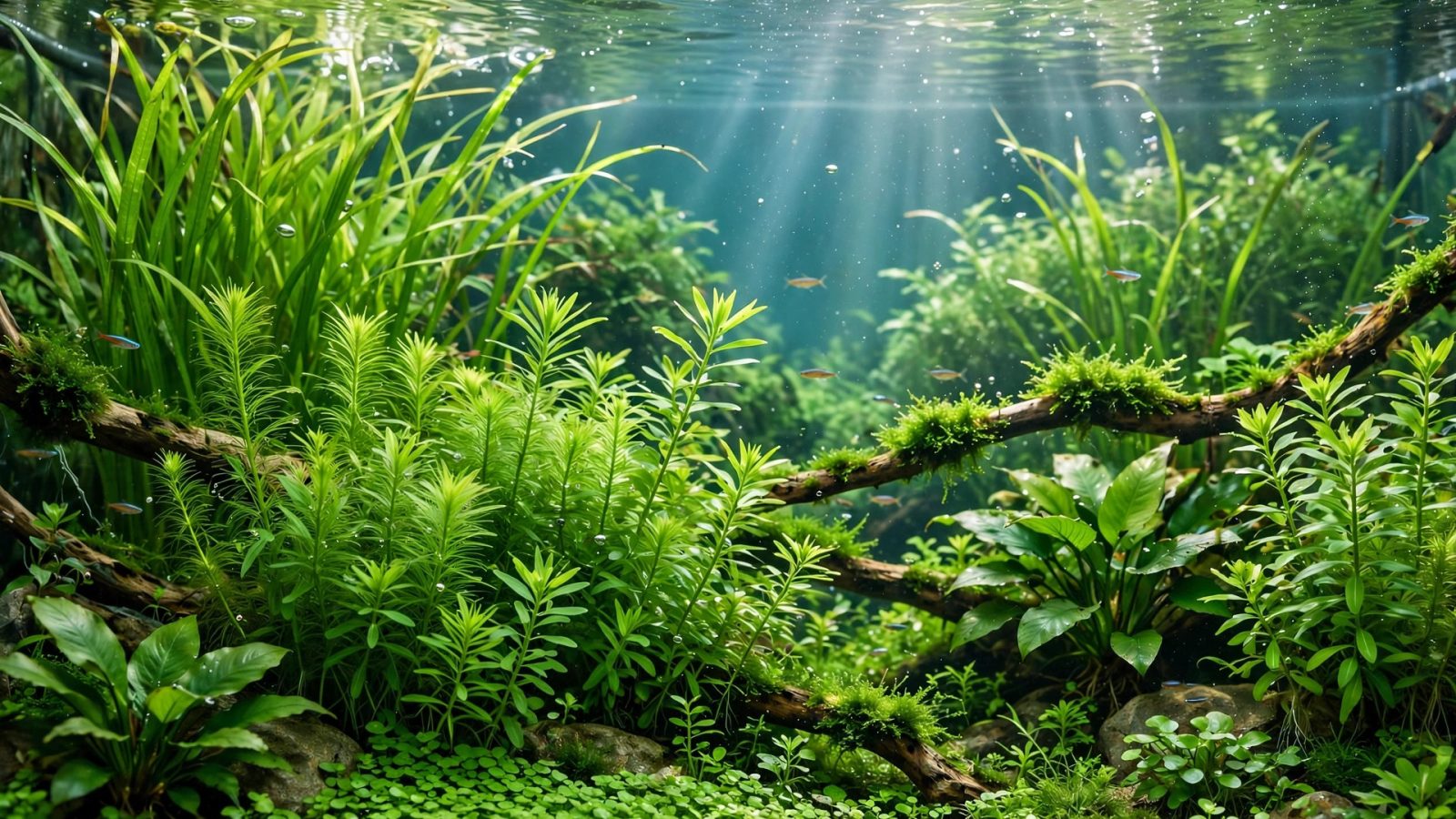
When to add plants to a new aquarium is one of the most argued questions in the hobby, and the debate has a clear winner: plant heavily on day one. The old advice to “cycle first, plant later” comes from the fish-first era and misunderstands what plants actually do in a new tank. Plants aren’t decorations you add after the tank is ready — they’re part of what makes the tank ready.
Why Day-One Planting Wins
A new aquarium’s core problem is ammonia: fish and decaying matter produce it, and until beneficial bacteria colonies establish (the nitrogen cycle), nothing removes it. Plants solve this directly:
- Plants consume ammonia directly — they prefer ammonium (ammonia’s form at typical aquarium pH) over nitrate, absorbing it through leaves and roots. A heavily planted new tank has a living ammonia filter from hour one.
- Plants outcompete algae — the #1 killer of new tanks is the algae bloom that strikes in weeks 2–6, when nutrients are high and biology is unstable. Dense planting from day one starves algae of its opening.
- Plants carry beneficial bacteria — every plant arrives with biofilm containing nitrifying bacteria, seeding your cycle the way bottled bacteria products claim to.
- Plants oxygenate the water — photosynthesis pumps oxygen into the water column, supporting the aerobic bacteria you’re trying to establish.
This is the principle behind the silent cycle — cycling a tank with plants instead of fish, letting plant uptake handle ammonia while bacteria colonies build gradually. Our guide to cycling planted tanks faster covers the method step by step.
The “Cycle First” Myth
The opposing advice — run the tank empty for 4–6 weeks, then add plants — made sense when tanks were fish-first systems where plants were decorative afterthoughts. Applied to planted tanks, it causes the exact problems it claims to prevent:
- An empty cycling tank with light and nutrients grows algae, not bacteria. Without plants competing, the new-tank algae bloom arrives on schedule and coats every surface — so your “clean” tank is an algae farm by the time plants arrive.
- Plants added to an algae-established tank must fight entrenched competitors instead of claiming the territory first.
- You lose 4–6 weeks of plant growth for zero benefit — plants don’t need a cycled tank; the tank needs the plants.
The one partial exception: if you’re doing a dark start (running the tank with no light for weeks to establish bacteria before planting), that’s a deliberate method with its own logic — but it’s an advanced technique, not a reason for beginners to delay planting.
How Heavily to Plant on Day One
“Heavily” has a number: aim for 70–80% of the substrate planted from the start. This sounds like a lot because it is — new-tank success correlates directly with initial plant mass. A sparse scattering of five plants in a 20-gallon tank won’t generate enough uptake to matter; a dense planting will.
Prioritize fast-growing stem plants for the initial fill — they’re the hardest-working ammonia consumers in the early weeks. Our fast-growing plants for new tanks list is essentially a day-one shopping list: water wisteria, hornwort, anacharis, rotala, hygrophila. These are cheap, grow explosively, and do the heavy lifting while your showpiece plants (swords, crypts, carpets) establish slowly.
Think of it as two waves:
- Day one: fast growers everywhere + your permanent hardscape-attached plants (anubias, java fern, mosses) + root-feeding rosettes in their final positions
- Month 2–3: once the tank stabilizes, remove or relocate some of the fast-growing “workhorse” plants and refine the scape with your long-term choices
Day-One Planting Checklist
- Substrate in and sloped — 2–3 inches in planting zones (see substrate depth)
- Hardscape placed — wood and rock positioned before plants, not after
- Root tabs in — pushed near planned root-feeder positions before planting (see root tab guide)
- Fill slowly — pour onto a plate or plastic bag to avoid cratering the substrate and uprooting everything
- Plant immediately — per our planting technique guide; tweezers, proper depth, crowns exposed
- Light: 6 hours/day for week one — short photoperiod while plants establish, increasing to 7–8 hours over the following weeks
- Fertilizer: half dose — new plants can’t use full dosing yet; ramp up per the fertilizer schedule
- Water changes: 40–50% twice weekly for the first month — this is the single most important new-tank habit (see water change guide)
- Filter running, heater set — from day one, obviously
What About Fish? (The Stocking Timeline)
Plants on day one doesn’t mean fish on day one. The stocking timeline:
- Day 1: plants in, no livestock (except perhaps the MTS snails for sand substrates)
- Week 1–2: test ammonia and nitrite. In a heavily planted tank, both often read zero within days — the plants are handling it.
- Week 2–3: if ammonia and nitrite read zero for several consecutive days, add the first small group of hardy fish or shrimp. Feed lightly.
- Weeks 3–6: stock gradually, one group at a time, testing between additions. Never add the full stocking at once to any new tank.
The plants give you a massive safety margin, but they don’t make the tank instantly invincible — bacterial colonies still need weeks to mature, and gradual stocking respects that. How many plants you need and which fish suit planted tanks help plan both sides.
The Science: How Much Ammonia Do Plants Actually Absorb?
“Plants consume ammonia” gets repeated as gospel, but the numbers matter — can plants really replace the bacterial cycle in a new tank? The honest answer is partially, and it depends on plant mass.
Fast-growing stem plants under good light can absorb roughly 1–2 ppm of ammonia per day in a densely planted tank. A typical new tank with a light fish load produces far less than that, which is why the silent cycle works: plant uptake alone handles the bioload while bacterial colonies establish in the background over 4–6 weeks.
But there are limits. A single betta in a 5-gallon with three anubias is not a silent cycle — that’s a fish-in cycle with decoration. The ammonia-uptake math only works at high plant mass relative to bioload: the 70–80% substrate coverage rule exists precisely because sparse planting can’t absorb enough to matter. Slow growers (anubias, java fern, bucephalandra) contribute almost nothing to ammonia uptake in the early weeks — they’re in the tank for the long game, not the cycle.
Plants also prefer ammonium (NH4+) over ammonia (NH3), and at typical aquarium pH (6.5–7.5) the vast majority of total ammonia exists as ammonium — convenient, since that’s the less toxic form anyway. This preference is why planted tanks are especially good at keeping the toxic fraction near zero.
Planting Order: What Goes In First
On day one, plant in this order — it minimizes rework and disturbance:
- Hardscape-attached plants first (anubias, java fern, mosses, bucephalandra) — tie or glue these to wood and rock before the hardscape goes in the tank. It’s ten times easier to attach plants to dry wood on a table than to submerged wood through tank glass.
- Background stems second — plant the tall fast-growers along the back while you have clear access, before foreground plants block your tweezers.
- Rosettes third — swords, crypts, lotus in their final midground positions, with root tabs already placed beneath them.
- Carpeting plants last — the fiddliest job, done when everything else is placed and you won’t be reaching over them.
- Floaters absolutely last — after filling, scatter them on the surface. They’d just get in the way earlier.
Frequently Asked Questions
Can I add plants to a tank that’s already cycling fishless with ammonia?
Yes — add them immediately. Plants will consume some of the dosed ammonia, which slows the bacterial cycle slightly (less ammonia for bacteria to eat), but the trade is worth it: you get algae prevention and a head start on growth. Just keep dosing ammonia to 2ppm as usual; the plants take their share and the bacteria get the rest.
Should I run CO2 from day one?
If the tank will be high-tech, yes — start CO2 on day one so plants photosynthesize at full capacity from the beginning. Stable CO2 from the start also prevents the fluctuation-triggered algae that plagues tanks where CO2 is added weeks later. For low-tech tanks this doesn’t apply — see growing without CO2.
My LFS said to wait a month before planting. Are they wrong?
They’re giving fish-first advice in a planted-tank context — it’s outdated, not malicious. The “wait” made sense when plants were decorations added to established fish tanks. In a planted tank, the plants are part of the establishment. Nod politely, buy the plants, and plant them today.
Special Cases
Aquasoil tanks
Aquasoil leaches ammonia for 2–6 weeks — this is normal and expected. Plant heavily on day one anyway; the plants consume the leached ammonia, and aggressive water changes (50% twice weekly) handle the rest. Don’t wait out the ammonia before planting — that wastes the exact period when plants are most useful.
Dry-start tanks
If you’re dry-starting a carpet (growing it emersed before flooding), the carpet establishes first, then you flood and plant everything else on flood day. The dry-start period replaces “day one” for the carpet; all other plants still go in at flooding.
Walstad / dirted tanks
Diana Walstad’s method requires heavy day-one planting — the soil + plants + light balance is the entire filtration concept. A sparsely planted Walstad tank fails; a densely planted one works. See our Walstad explainer.
Signs Your Day-One Planting Is Working
- Ammonia and nitrite stay at or near zero from the first week
- Fast growers show new growth within days
- Algae stays minimal — some diatoms (brown dust) in weeks 2–4 are normal and fade
- Water stays clear without chemical filtration
If instead you see persistent ammonia, melting across many species, and aggressive algae — check the fundamentals: enough plant mass (the 70% rule), adequate light, and whether you’re doing those twice-weekly water changes. The method works; the usual failure is under-planting while believing you planted heavily.
Plant on day one, plant heavily, and let your plants do what they’ve done for 400 million years: turn waste into growth. Your tank will cycle faster, algae will barely get a foothold, and you’ll be trimming healthy plants while the “cycle first” crowd is still scrubbing theirs.