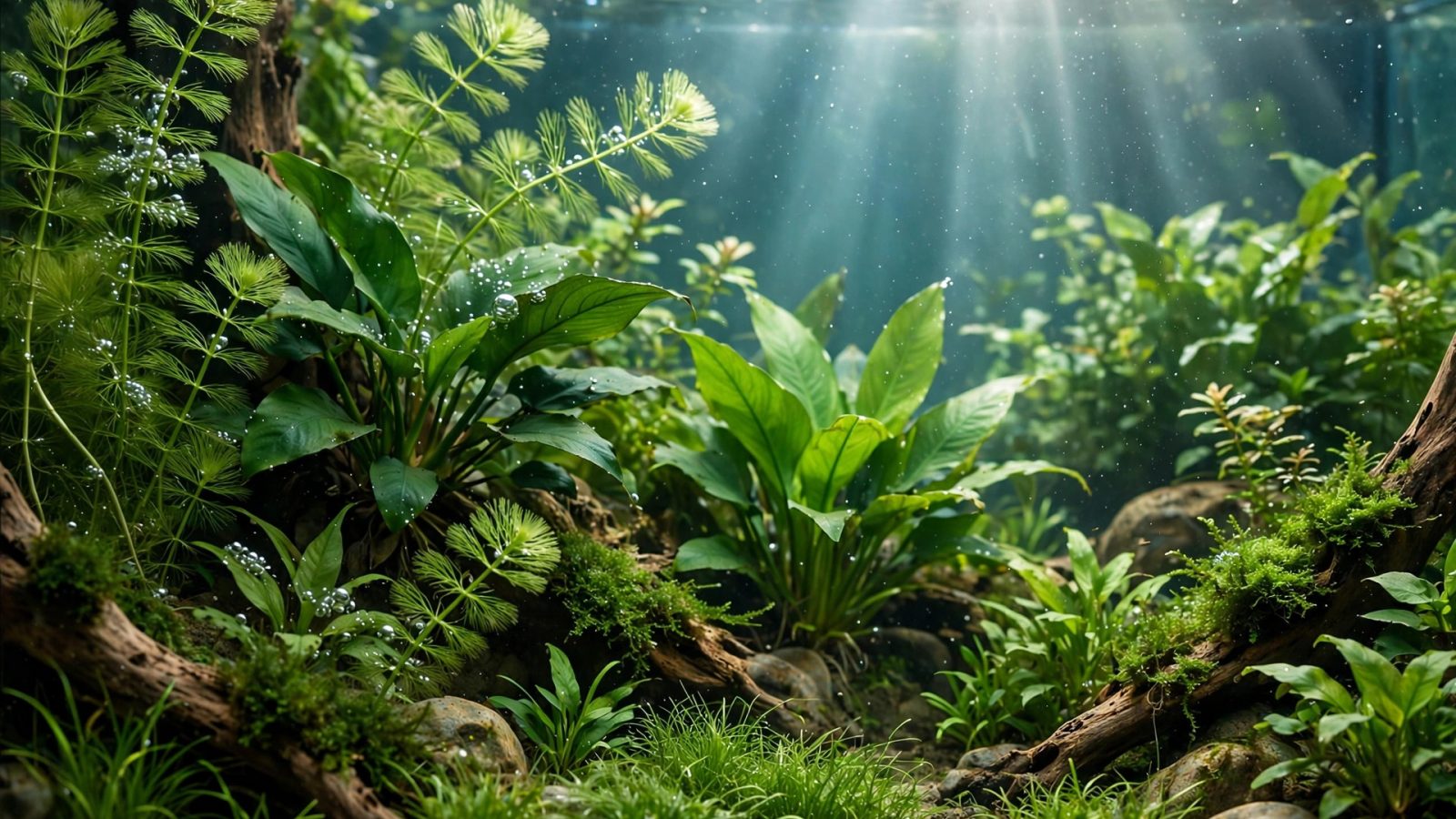
Liquid fertilizer vs root tabs is the first real decision in aquarium plant nutrition, and most beginners get it slightly wrong — they buy one, skip the other, and wonder why half their plants thrive while the other half starve. The truth is that liquid fertilizer and root tabs aren’t competitors. They feed plants through completely different pathways, and which one your plants need depends on how each species eats.
This guide explains exactly what each type does, which plants need which, when you need both, and how to stop wasting money dosing the wrong one.
How Aquarium Plants Absorb Nutrients
Every aquatic plant can absorb nutrients through its leaves from the water column — but not every plant does it equally well. Species fall roughly into two feeding styles:
- Water-column feeders absorb most of their nutrients directly from the water through leaves and stems. Epiphytes (anubias, java fern, bucephalandra, java moss) are the purest example — in nature they grow attached to wood and rock with their roots serving mainly as anchors. Floating plants are also exclusive water-column feeders since their roots dangle in the water.
- Root feeders draw the bulk of their nutrition through a true root system buried in substrate. Heavy root feeders include Amazon swords, cryptocorynes, vallisneria, dwarf sagittaria, and red tiger lotus. These plants evolved in nutrient-rich riverbeds and expect their food underground.
Most stem plants sit in the middle — they’ll take nutrients from wherever they can get them, which makes them flexible but also means they respond well to both methods.
Liquid Fertilizer: What It Is and What It Does
Liquid fertilizer is a concentrated nutrient solution you dose directly into the tank water, typically a few milliliters per 10 gallons, one to several times per week. An all-in-one liquid contains both macronutrients (nitrogen, phosphorus, potassium) and micronutrients (iron, magnesium, trace elements) in a single bottle.
Strengths
- Feeds every plant in the tank simultaneously through the water column
- The only way to fertilize epiphytes, mosses, and floating plants
- Easy to adjust — increase or decrease the dose and see results within weeks
- Distributes evenly via filter flow, so no plant gets missed
Limitations
- Nutrients in the water column are also available to algae — overdosing liquids is the fastest route to an algae bloom
- Heavy root feeders often can’t get enough from water-column dosing alone, especially in inert substrates like plain gravel or sand
- Needs re-dosing on a schedule (see our beginner fertilizer schedule); it doesn’t persist the way substrate nutrition does
Root Tabs: What They Are and What They Do
Root tabs (or root tablets) are compressed capsules of fertilizer you push deep into the substrate near plant roots. They dissolve slowly over 1–3 months, releasing nutrients directly into the root zone where heavy root feeders can access them.
Strengths
- Deliver concentrated nutrition exactly where root feeders need it, without raising nutrient levels in the water column
- Because they don’t spike water-column nutrients, they carry very little algae risk
- Long-lasting — one application feeds for weeks to months
- Transform inert substrates (gravel, sand) into viable growing medium for root-feeding species
Limitations
- Useless for epiphytes, mosses, and floaters — their roots don’t reach the tabs
- Easy to forget; most beginners never replace them and wonder why their swords decline after three months
- Disturbing the substrate (replanting, deep gravel vacuuming) can release a concentrated nutrient pulse into the water — a known algae trigger
- Hard to “adjust” — you can’t easily remove an overdosed tab
The Decision Tree: Which Do Your Plants Need?
Walk through your plant list:
If you keep mostly epiphytes, mosses, and floaters
Liquid fertilizer only. Anubias, java fern, bucephalandra, java moss, frogbit, salvinia — none of these benefit meaningfully from root tabs. A good all-in-one liquid on a regular schedule is the complete nutrition plan. (Our Java Fern care guide explains why this plant barely notices substrate at all.)
If you keep mostly swords, crypts, vallisneria, and other rosette plants
Root tabs essential, liquid fertilizer supplementary. These are the plants that visibly transform when you push a tab near their roots — bigger leaves, faster growth, richer color within a month. Add a light liquid dose too, since even root feeders absorb some nutrients through leaves, and any stem plants or floaters in the tank need it.
If you keep a mix (the most common case)
Both. This is the standard planted-tank approach: liquid fertilizer on a weekly schedule for the water column, plus root tabs every 1–3 months under the heavy root feeders. It’s not overkill — it’s matching each delivery method to the plants that use it. Our weekly schedule integrates both.
If you use aquasoil or another enriched substrate
Liquid fertilizer mainly; root tabs later. Fresh aquasoil is loaded with nutrients and feeds root feeders directly for the first 6–12 months. During this period, root tabs are redundant — dose liquids for the water column and let the soil do the underground work. Start adding tabs around month 6–12 as the soil depletes. (The full substrate nutrition picture is in our aquarium soil vs gravel comparison.)
If you use plain gravel or sand
Both, with emphasis on root tabs for root feeders. Inert substrates contain zero nutrition, so root-feeding plants are 100% dependent on tabs. This combination — inert substrate plus targeted tabs — is one of the most cost-effective ways to run a planted tank. Our guide to growing plants in sand covers the method in detail.
Common Mistakes
Using only liquid fertilizer with a sword-heavy tank
The classic scenario: stem plants and floaters look great, but the Amazon sword in the corner stays small and pale. The liquid is fine — the sword just can’t get enough through its leaves. One root tab nearby usually fixes it within a month.
Using only root tabs with epiphytes
The reverse: tabs under anubias and java fern do essentially nothing, since those plants’ rhizomes sit above the substrate. If your epiphytes look pale and stunted, they need liquid fertilizer, not more tabs.
Burying tabs too shallow
Tabs placed just under the surface leach into the water column instead of staying in the root zone — you get the algae risk of liquids with the inconvenience of tabs. Push them 2–3 inches deep, and keep them a few inches from the glass where they’d be visible as they dissolve.
Replacing tabs on a “when I remember” schedule
Tabs deplete silently. Mark it on a calendar: first Sunday of every 2–3 months (check your brand’s rated lifespan). The decline from exhausted tabs is gradual enough that you won’t notice until plants are seriously hungry.
Cost Comparison
For a typical 20-gallon mixed tank over a year: an all-in-one liquid fertilizer costs roughly $15–25 per bottle, and most beginners use 2–3 bottles a year dosing per the schedule. Root tabs run about $10–15 for a pack that lasts a year or more at the replacement rate above. Combined, you’re looking at roughly $40–80 per year — a few dollars a month for the single highest-impact thing you can do for plant growth after lighting.
When you’re ready to cut that cost significantly, dry fertilizers (EI dosing) replace the liquid bottle at a fraction of the price — our dry vs liquid comparison breaks down the math.
How to Place Root Tabs Correctly
Root tabs only work if they’re where the roots are — and most placement mistakes come from treating them like surface fertilizer.
- Depth: 2–3 inches deep. Push the tab well into the substrate with tweezers or a finger. Shallow tabs dissolve into the water column, causing algae blooms and wasting the nutrients meant for roots.
- Distance: 2–3 inches from the plant crown. Not directly under it (which can burn young roots with concentrated nutrients) and not six inches away (where roots may never reach). Ring heavy feeders with 2–3 tabs around the root zone.
- Spacing: every 4–6 inches in densely planted root-feeder zones. Think grid pattern, not random scattering.
- Timing: replace every 2–3 months. Tabs don’t announce when they’re spent — the plants do, with fading growth 8–12 weeks after placement. Mark replacement on a calendar; “when I remember” means “three months late.”
- New setups: place tabs before planting, while the substrate is undisturbed. Pushing tabs in after planting disturbs fresh roots.
Reading Your Plants: Which Deficiency Means What
Before choosing a fertilizer method, learn what hunger looks like — it tells you which delivery method the plant needs:
- Old leaves yellowing first, new growth green — mobile nutrient deficiency (nitrogen, potassium, magnesium). The plant is cannibalizing old leaves to feed new ones. Water-column dosing usually fixes this fastest, since leaves absorb directly.
- New leaves pale or deformed, old leaves fine — immobile nutrient deficiency (iron, calcium). New growth can’t pull these from old tissue. Iron deficiency (pale new leaves with green veins) is the classic — a chelated iron liquid dose corrects it in days.
- Pinholes in older leaves — potassium deficiency, the most common single deficiency in planted tanks. Both liquid potassium and root tabs supply it; liquid acts faster.
- Stunted roots, tiny new leaves on swords/crypts — root-zone starvation. This is the root-tab deficiency signature: the water column can be perfect while the substrate is barren. Tabs, not more liquid.
Our nutrient deficiency guide has the full diagnostic chart with photos descriptions. The key insight for this article: match the delivery method to the symptom’s location — leaf symptoms often mean water column, root/crown symptoms mean substrate.
Combining Both: Three Sample Regimens
The low-tech mixed tank (most beginners)
- All-in-one liquid fertilizer, half the label dose, twice weekly
- Root tabs near swords, crypts, and vallisneria, replaced every 3 months
- 50% water change weekly
The high-tech show tank
- EI-style dry or liquid dosing: full macro/micro schedule per our fertilizer schedule
- Root tabs under heavy root feeders as a supplement, not the primary feed
- 50% water change weekly (non-negotiable with EI-level dosing)
The epiphyte-heavy tank (anubias, java fern, buce, moss)
- Liquid fertilizer only — lean dosing, since slow growers need little
- No root tabs needed (nothing planted in the substrate to feed)
- Watch for algae: slow-growing plants plus excess nutrients is the classic imbalance. Dose lean.
Frequently Asked Questions
Can root tabs cause ammonia spikes?
Cheap or DIY tabs (especially osmocote-style garden fertilizer in gel caps) can leach ammonia if placed too shallow or overdosed. Quality aquarium-specific tabs placed at proper depth don’t cause measurable spikes. If you’re using DIY osmocote caps, place them deep, use fewer than you think, and test ammonia for a few days after.
Do I need root tabs with aquasoil?
Not for the first 6–12 months — aquasoil is a giant root tab. After that, as the soil exhausts, tabs extend its useful life significantly. Think of tabs as aquasoil’s retirement plan, not its competitor.
My tabs grow white fungus. Is that bad?
No — it’s harmless bacterial/fungal colonization of the tab’s binder, and it disappears in a week or two. Shrimp and snails often eat it. Only worry if the fungus spreads to plant tissue, which is rare.
The Bottom Line
Liquid fertilizer feeds the water; root tabs feed the substrate. Epiphytes, mosses, and floaters need the first; swords, crypts, and vallisneria need the second; a mixed planted tank needs both. Match the method to the plant, dose consistently, and you’ll stop wondering why half your tank thrives while the other half sulks — because every plant will finally be getting fed the way it actually eats.